
| ||||||||||||

When you're shopping for life insurance, you'll likely encounter some jargon. One distinction that often gets glossed over but can have real financial implications is whether a policy is "participating" or "non-participating." The difference isn't just semantic — it can affect your premiums, your cash value accumulation, and ultimately, your bottom line.
Let's break it down.
What is a "participating" life insurance policy?
A participating policy essentially allows the policyowner to share in the insurance company's financial success. How? Through dividends.
Now, it’s important to note up front that dividends are not guaranteed. And they aren't dividends in the sense of those you may get from owning stock in a publicly traded company.Life insurance dividends are actually considered a return of premium.
But to be eligible to receive dividends, one has to own a participating policy,
Participating policies are typically issued by mutual insurance companies. Unlike stock companies, mutuals don’t have shareholders. Instead, their members and participating policyowners share in the ownership of the company. This generally means that if a person is insured under one of a mutual company’s individual participating whole life insurance policies, they are a member entitled to vote for the board of directors. And if they also own that participating policy, they may be eligible to share in any dividends that are declared. (Related: Mutual vs. stock insurance companies: Key differences)
So, when a mutual company (like MassMutual) performs well, those benefits flow back through dividends to the people who own the participating policies.
“With a participating policy, when the company performs well, eligible policyowners may benefit through dividends,” said Sarah Hedges, CFP®, CLU, ChFC, head of field management – East, for MassMutual. “Those dividends provide flexibility and can be received as cash, used to reduce premiums, used to purchase additional paid up life insurance which increases the death benefit and cash value, or leveraged in other ways to support a policyowner’s goals.”
Again, such dividends are not guaranteed. But some life insurance carriers have been shown to be pretty consistent. MassMutual, for instance, has paid dividends to eligible participating policyowners every year since 1869. That's a track record that spans more than 150 years, through depressions, recessions, world wars, and pandemics.
“Consider choosing a carrier with financial strength and stability,” said Hedges.
What's a non-participating policy?
A non-participating policy does exactly what it says — it doesn't participate in the company's surplus. You get the guaranteed benefits spelled out in your contract — typically a death benefit and possibly some cash value accumulation, depending on the type of policy — but no dividends.
Non-participating policies are typically issued by stock insurance companies, where the profits go to shareholders rather than policyowners. Think of it this way: With a stock company, you're a customer. With a mutual company, you share in ownership and, as noted above, may be able to vote on the company’s leadership or receive a possible dividend.
Most term life insurance policies are non-participating. So are many universal life products, including indexed universal life and variable universal life. Even some specific types of whole life policies can fall into the non-participating category. (Related: Options for life insurance in your later years)
And, as noted earlier, policies issued by publicly traded life insurance companies are generally non-participating.
There's nothing inherently wrong with stock companies — they offer competitive products and serve millions of customers well. But the structural difference means they have different priorities. A mutual company doesn't have to worry about pleasing Wall Street or hitting quarterly earnings targets. Its primary obligation is to the policyowners.
The dividend advantage
When you receive a dividend, you typically have several options:
- Take it as cash. Just what it sounds like — the money goes into your bank account.
- Reduce your premium. Apply the dividend toward your next premium payment, effectively lowering your out-of-pocket cost.
- Purchase paid-up additional insurance. Use the dividend to buy more coverage that requires no additional premiums. This can increase both your death benefit and your cash value.
- Leave it with the insurance company to earn interest. Let the dividend accumulate in an account that earns interest.
- Repay policy loans. If you've borrowed against your policy's cash value, you can use dividends to pay down that loan. (Related: How to borrow from your whole life policy)
These options give you flexibility. Need cash flow this year? Take it as cash. Want to maximize your policy's long-term value? Buy paid-up additions. Planning matters, and dividends give you more levers to pull.
Impact on cash value and premiums
The dividend feature can significantly impact how your policy performs over time.
Let's say you have a participating whole life policy with $100,000 in cash value. If the insurance company declares a 2 percent dividend rate for the year, you'd receive $2,000 (minus any applicable fees). If you use that dividend to purchase paid-up additional insurance, you're adding to both your death benefit and your cash value permanently, with no additional premiums required.
Over 20 or 30 years, those dividends compound and can help the cash value grow beyond the guaranteed level of return in the contract when the policy was issued. So, what started as a modest policy can grow substantially, especially if the company maintains a strong dividend track record.
A MassMutual financial professional can map out such possibilities by generating an illustration of a whole life policy for you.
Connect with a MassMutual financial professional
When comparing policies, ask about the company's dividend history and look at the illustrated values in your policy documents — but remember dividends are not guaranteed. Actual dividends could be higher or lower than illustrated.
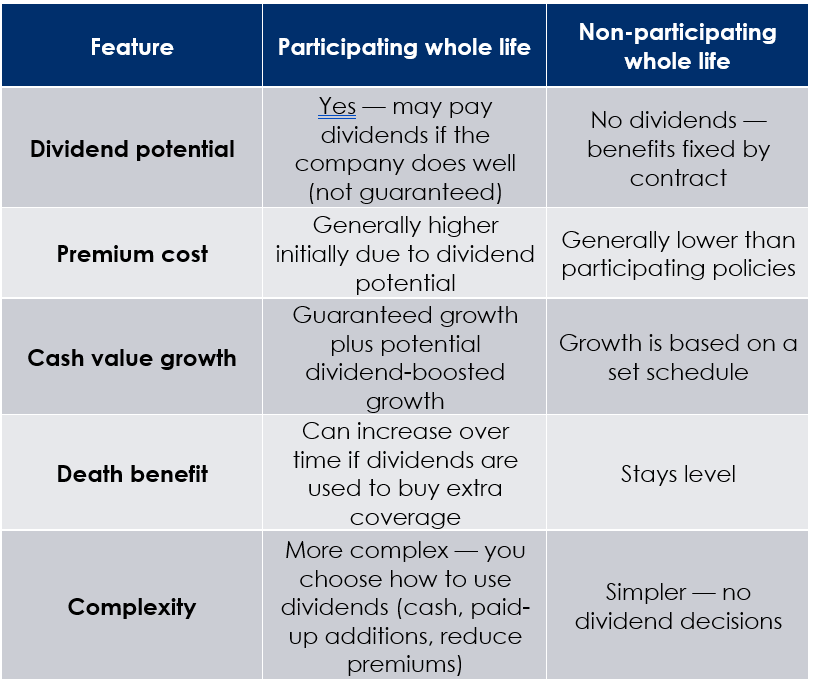
Premiums are another consideration. Participating policies often have higher initial premiums than non-participating policies. That's because the insurance company is building in some conservatism — basically pricing for a worst-case scenario, then returning the difference if things go better than expected.
Non-participating policies, by contrast, may have lower premiums up front because there's no expectation of dividends. Also, term policies generally tend to be lower cost generally, since they only provide coverage for a set period of time with none of the features of permanent life insurance.
Who might want a participating policy?
Participating policies tend to appeal to people who:
- Value long-term stability over short-term savings. If you're willing to pay a bit more now for the potential of dividends and enhanced cash value down the road, a participating policy makes sense.
- Want to build cash value conservatively. Whole life insurance with dividends offers predictable, tax-advantaged growth. It's not going to beat the stock market in a good year, but it won't crash in a bad one either.
- Appreciate the mutual structure. Some people just like the idea of doing business with a company where their interests align with the company's interests.
- Are planning for estate transfer or wealth accumulation. High-net-worth individuals often use participating whole life as part of a broader estate planning strategy. The death benefit is generally income-tax-free to beneficiaries, and the available cash value can be accessed during life.1 (Related: Tax advantages of life insurance)
Who might prefer a non-participating policy?
Non-participating policies can be a good fit for:
- Budget-conscious buyers. If you need pure protection at the lowest possible cost, term life insurance (which is non-participating) is practical. You can get a substantial death benefit for a relatively small premium.
- People who want simplicity. Non-participating policies are straightforward. No dividends to track, no options to choose. You pay your premium, the policy stays in force, and when you die, your beneficiaries get the death benefit. Simple.
- Those comfortable with stock companies. If you're comparing policies and a stock company offers a product that fits your needs at a competitive price, the fact that it's non-participating might not matter.
- People with temporary coverage needs. If you only need coverage for, say, 10 or 20 years — until the kids are through college or the mortgage is paid off — term life insurance (non-participating) may be the most economical choice. (Related: 4 times when term insurance may be the answer)
The tax treatment of dividends
One more thing worth noting: Life insurance dividends from participating policies are generally not taxed as income. Why? Because the IRS treats them as a return of premium, not as a profit distribution. You already paid taxes on the money you used for your premium, so getting some of it back isn't a taxable event.
That said, if you leave your dividends with the insurance company to accumulate interest, the interest portion is taxable. And if your total dividends over the life of the policy exceed the total premiums you've paid, the excess could be taxable. But those are relatively rare scenarios for most policyowners.
Making the choice
Choosing between participating and non-participating life insurance isn't about one being universally better than the other. It's about what aligns with your financial goals, your budget, and your risk tolerance.
- If you value the potential for dividends, appreciate the mutual ownership structure, and are planning for the long term, a participating whole life policy from a mutual company might be worth the higher premium.
- If you need straightforward protection at a lower cost, a non-participating form of coverage, like term life insurance, could be the smarter move.
The key is understanding what you're buying — and why. Life insurance is a long-term commitment. Taking the time to understand the difference between participating and non-participating policies can help you make a more informed decision that serves you and your family well for decades to come.
_______________
Frequently asked questions about participating policies
Q: Can I convert a non-participating policy to a participating one?
A: The policy type is determined when you purchase it. However, some term life insurance policies include a conversion feature that allows you to convert to a permanent policy (which could be participating whole life) within a certain timeframe, typically without a medical exam.
Q: How much can I expect to receive in dividends from a participating policy?
A: Dividends are not guaranteed and, if they are paid, the amounts vary based on the insurance company's financial performance. Historically, strong mutual companies like MassMutual have maintained consistent dividend payments even during economic downturns.
Q: Are all mutual insurance companies required to offer participating policies?
A: While mutual companies are structured to benefit policyowners and typically offer participating products, not every policy from a mutual company is participating. For instance, some universal life products offered by mutual companies are non-participating because their cash value is tied to interest rates or market indexes rather than company surplus. Similarly, term life insurance is almost always non-participating, even when issued by a mutual company. The key is to ask specifically whether the policy you're considering is participating and eligible for dividends.
_______________
Discover more from MassMutual …
Pros and cons of converting term life to whole life
What kind of life insurance do I need? Term or perm?
The power of a term-perm life insurance combination
_____________________1 Keep in mind that if a distribution on the policy, such as a loan, is taken, it will reduce the cash value and death benefit, can increase the chance the policy will lapse, and could result in a tax liability if the policy terminates before the death of the insured.