
| ||||||||||||

Beyond protection and the ability to build cash value, many whole life insurance policies typically offer a particular feature that many policyowners find attractive: the eligibility to receive dividends.
But this feature, while sounding simple, actually involves some complexity and comes with caveats. So, it’s important to understand the ins and outs of dividends in order to appreciate the overall benefit a whole life insurance policy may mean for you.
- First and foremost, dividends aren’t guaranteed. The amount of the overall dividend and the individual dividend payouts are subject to change, depending on the operating experience of the insurance carrier in a given year. Generally, it’s a case of when the insurance company does well in a certain year, its policyowners benefit from that success.
- Second, the policy has to be “participating,” that is, a type of life insurance or other financial product (like disability income insurance or annuities) that has been designated by the insurance company as eligible to receive dividends.
Although dividends are not guaranteed, most mutual insurance carriers strive to pay them consistently to eligible participating whole life policyowners. MassMutual, for instance, has paid dividends every year since 1869. And, as the company has grown, the overall amount of that annual dividend payout has grown as well, as noted in the following chart. (Learn about MassMutual's latest dividend announcement here)
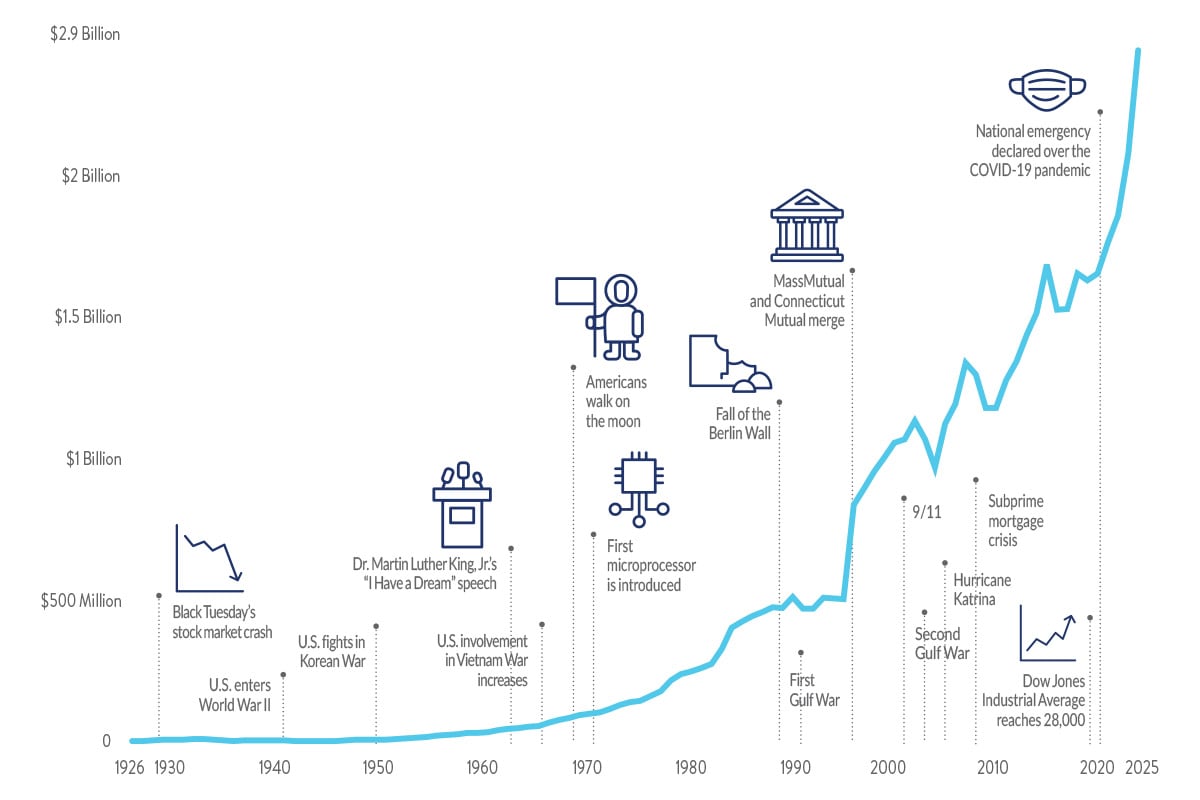
Source: Massachusetts Mutual Life Insurance Company Statutory Annual Statement, Year-End — Summary of Operations — Dividends to Policyowners: These numbers reflect incurred dividends to policyowners. Incurred dividends equal amounts paid to eligible participating policyowners plus any change in liabilities.
_______________________
So, how are dividends paid out by a mutual insurance company determined each year?
In general, insurance companies take in money through premiums from policyowners. They are required by law to keep a certain amount of that money in reserve to cover their long-term commitments to policyowners. Insurance companies generally invest these reserves in very conservative assets like high-quality public bonds and short-term investments.
Each year, an insurance carrier calculates the amount of its surplus to set aside to be distributed to eligible participating policyowners as dividends. This is called divisible surplus. This is the amount paid out after the carrier has set aside the funds required to meet all contractual obligations, particularly reserve requirements for its policies, as well as what it expects for operating expenses, contingencies, and general business purposes.
Generally, dividends depend primarily on three components:
- Mortality experience (death claims)
- Expenses
- Investment results
Each eligible participating policyowner receives that policyowner’s equitable share of the divisible surplus that results when the overall actual experience of these components is better than the experience that was originally assumed in setting premiums and guaranteed elements for that policy.
Dividends are declared and paid annually. However, because a company cannot guarantee that divisible surplus will be achieved each year, the payment of dividends cannot be guaranteed. It depends on the company’s performance in these three areas.
Mortality
The mortality component is based on the actual death claims experience compared with what the insurance company estimated when it issued policies and priced premiums.
Performance in this area reflects how well an insurance company calculates and selects risk in its underwriting operations. A company that is careful about who it agrees to issue life insurance to and how to price the premiums for the policy is likely to have a more positive mortality experience over time. So, at the policy level, the mortality component of the dividend in any year is based on the age, gender, and underwriting class of the insured (their health and habits, like smoking), as well as the net amount of life insurance (face amount less the cash value) in that year. (Related: How a personal health record can lower your costs)
Expenses
Additionally, an insurance company, like any other business entity, will incur expenses to operate, from administration costs to investment fees to salaries. As mentioned above, a company will price premiums with those costs in mind and set aside funds to cover them.
The expense component of the dividend reflects the difference between the actual expenses that were incurred in issuing and administering policies over time as compared with the expenses that were assumed in setting the premiums.
A spike in costs or a decline in efficiency, therefore, will also subtract from the overall surplus. That’s why those considering a whole life insurance policy may want to research an insurance carrier’s corporate performance over time, to see how well it has controlled costs over time.
Investment
The third major element in determining dividends is investment performance. It is based on actual investment results for an insurance carrier that are more favorable than what is required to support policy reserves and guaranteed cash values.
When determining the premiums and guaranteed elements of an eligible participating whole life policy, insurers use conservative assumptions (guaranteed interest rates and mortality rates) to ensure that the company collects enough money to pay all benefits in the future, even under adverse financial scenarios. Favorable investment results occur when the company’s actual investment returns exceed the guaranteed interest rates required to meet its contractual obligations to policyowners.
This rests in large part on the carrier’s financial portfolio, which is typically made up of bonds, stocks, and other types of market-based investments.
This is why it’s important for those shopping for whole life insurance to examine an insurance carrier’s holdings and investment philosophy, especially with regard to risk and stability. For instance, MassMutual’s investment goal is to generate competitive long-term results while maintaining the ability to weather downturns in financial markets.
The chart below is a snapshot of MassMutual’s holdings, which consist primarily of high-quality fixed-income securities, but also invest in equities, commercial mortgages, real estate, and other assets.
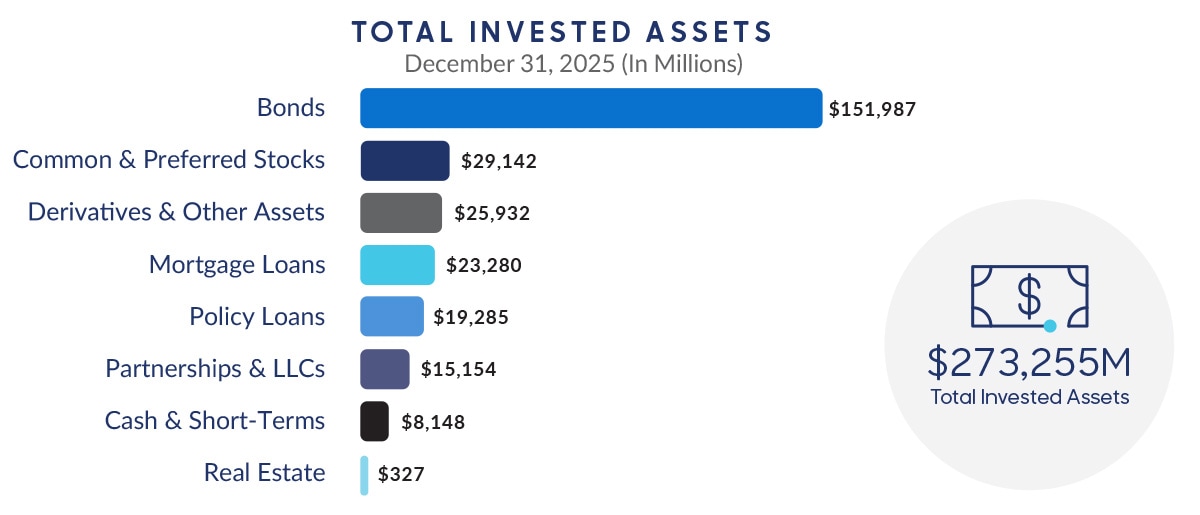
Invested Assets exclude $25.2 billion of funds withheld given that 100% of the associated investment risk is reinsured. The funds withheld investment portfolio has counterparty protections in place including investment guidelines that were established to meet MassMutual’s risk management objectives. Bonds exclude $21.6 billion of funds withheld given that 100% of the associated investment risk is reinsured. The funds withheld investment portfolio has counterparty protections in place, including investment guidelines that were established to meet MassMutual’s risk management objectives. Policy loans are loans taken by policyowners against the cash surrender value of their policies and, as such, are secured by the cash surrender value of those policies.
You can find out more about MassMutual’s performance, financial holdings, and investment philosophy here.
Other business earnings
Beyond financial instruments, an insurance carrier can also achieve returns by investing in related business lines, third-party businesses, and other enterprises. Profits from those types of investments and operations can also add to a company’s overall surplus.
For instance, MassMutual offers a variety of insurance products beyond whole life insurance, such as annuities. Revenues from those areas help add to its surplus. And MassMutual has ownership stakes in global asset management companies and wealth management operations, which entitle it to a share of the profits those outfits produce.
These kinds of business lines and investments not only can directly add to a company’s surplus, but they can also diversify sources of income. That can soften the blow of a downturn in other types of investments or businesses.
The overall returns from the investment portfolio and other business earnings help support a company’s dividend interest rate (DIR)*, which is set by a company’s board of directors each year. The investment component of the dividend is the difference between the DIR and the policy’s guaranteed interest rate. So, hypothetically, if the guaranteed interest rate is 3.75 percent and the DIR is 6.60 percent, then the investment component of the dividend will be based on 2.85 percent (6.60 percent – 3.75 percent).
Comparing dividends and other returns
There is a temptation to compare life insurance dividend payouts with returns on other types of financial instruments, like U.S. Treasury or corporate bonds. While such comparisons can be interesting and informative about relative performance, they aren’t entirely “apples to apples.” Additionally, dividends for a given policy are influenced by such factors as policy series, issue age, gender, underwriting class, policy year and policy loan rate, as well as changes in a company’s experience.
Each year, insurers declare a dividend interest rate that is a key component used to calculate dividends paid in the next calendar year. Dividends and the dividend interest rate are determined annually, are subject to change and are not guaranteed.
For instance, the graph below shows MassMutual’s DIR in comparison with three common fixed-income measures over an extended period of time. Each measure reflects some calculations specific to that measure itself. For instance, the investment component of the dividend reflects the difference between the guaranteed interest rate used to calculate the policy cash value and the DIR. This graph compares the historical stability of MassMutual’s Dividend Interest Rate (DIR) with three common fixed income measures over an extended period of time. The comparison is for illustrative purposes; the DIR is not a fixed income measure or bond yield and should not be interpreted as the rate of return on a policy. The DIR is used in determining the investment component of policy dividends and primarily reflects the net investment return on assets supporting the reserves and cash values of certain policies. The values plotted in the graph are for each year from 1995–2027.
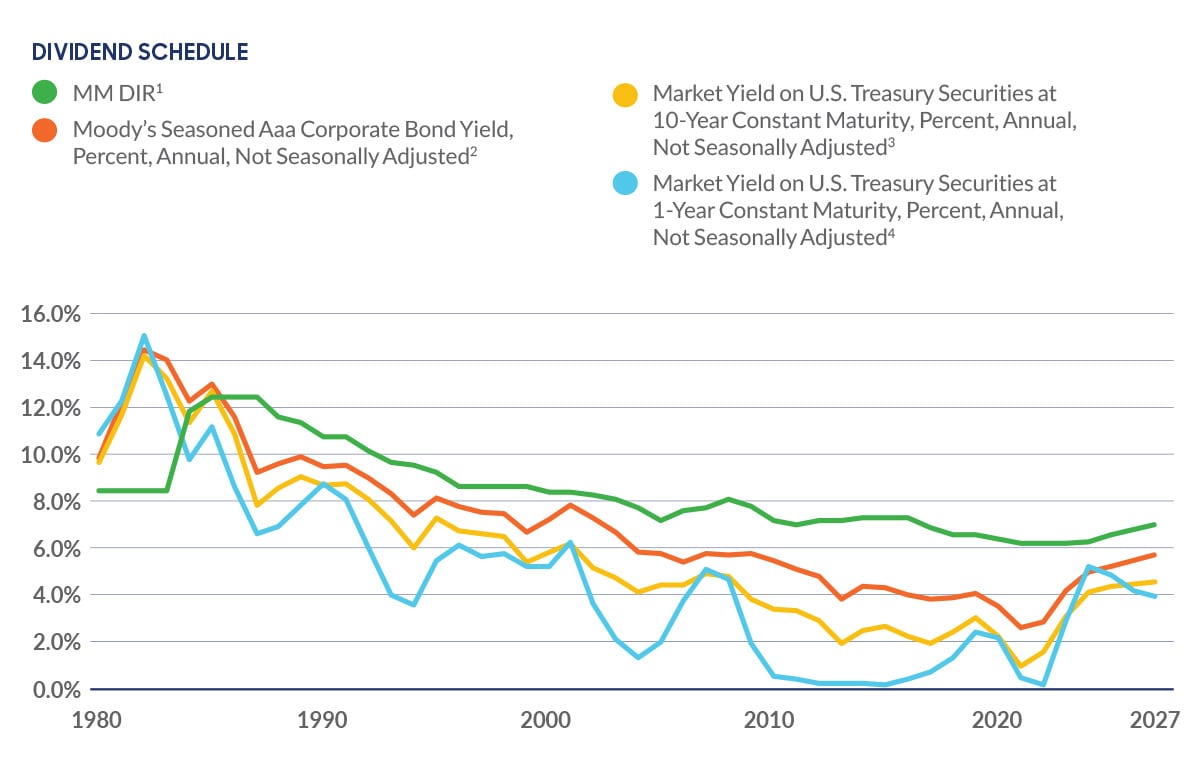
The dividend and dividend interest rate (DIR) are determined annually, are subject to change and are not guaranteed. The DIR is not the rate of return on the policies. The actual rate of return will be less due to the cost of the life insurance protection and other charges associated with each type of policy. There may be little or no cash, account or surrender value available in the early policy years, and it may take a number of years to realize a positive return on premiums paid into the policy. The way companies quote and apply Dividend Interest Rates varies. For example, some quote their DIR before investment expenses and some, like MassMutual, quote their DIR net of these expenses. Therefore, Dividend Interest Rates should not be used as the sole basis for comparing one whole life policy to another.
1Refers to the MM-block of business, which comprises policies issued prior to the merger of Massachusetts Mutual Life Insurance Company and the former Connecticut Mutual Life Insurance Company in 1996. Starting with the 2012 dividend schedule, there is a single Dividend Interest Rate for all blocks. 2Moody’s yield on seasoned Aaa corporate bonds for all industries, quoted for the year preceding the Dividend Interest Rate shown; for 2027, the rate is the average monthly rate from January to September for the preceding year. Moody’s Aaa rates through December 6, 2001, are averages of Aaa utility and Aaa industrial bond rates. As of December 7, 2001, these rates are averages of Aaa industrial bonds only. 3Market yield on U.S. Treasury securities at 10-year constant maturity, quoted for the year preceding the Dividend Interest Rate shown; for 2027, the rate is the average monthly rate from January to September for the preceding year. 4Market yield on U.S. Treasury securities at 1-year constant maturity, quoted for the year preceding the Dividend Interest Rate shown; for 2027, the rate is the average monthly rate from January to September for the preceding year.
___________________
Who gets a dividend?
As mentioned at the outset, those who purchase eligible participating whole life insurance policies are eligible to receive a dividend. The size of each individual policyowner’s payout depends on how much their policy has contributed to the company’s divisible surplus. So long-standing policies with large death benefits will generally receive larger dividend payouts than smaller policies put in place more recently.
Policyowners typically have several different dividend options to choose from which include receiving dividends in cash, or use them to:
- Purchase paid-up additional whole life insurance.
- Reduce the following year’s premium payment.
- Leave on deposit to accumulate with interest.
Many policyowners go with the first option, which can increase the policy’s death benefit and cash value.
Conclusion
Dividends are an important part of the overall value that participating whole life insurance offers. But it’s important to know how dividends are determined and what may or may not affect their issuance and payment level.
________________________________
Frequently Asked Questions about whole life insurance dividends
Q. Are whole life insurance dividends guaranteed?
A. No. Dividends are not guaranteed and depend on the insurance company's annual operating experience, including mortality, expenses, and investment results. MassMutual, however, has paid dividends to eligible participating policyowners every year since 1869.
Q. What's the difference between a mutual and a stock insurance company?
- A. A mutual life insurance company doesn’t have shareholders. Instead, it has members and participating policyowners that are often described as sharing in the ownership of the company. As an example, this generally means that, if a person is insured under one of a mutual company’s individual, participating whole life insurance policies, they are a member entitled to vote for the Board of Directors. And if they also own that participating policy, they may be eligible to share in any dividends that are declared.
- A publicly traded life insurance company is owned by stockholders — who may or may not actually be customers of the company and who may or may not own that company’s participating insurance products.
(Related: Advantages of a mutual life insurance company)
Q. Do I have to pay taxes on whole life insurance dividends?
A. Dividends are generally treated as a return of premium and are not taxable as income as long as they remain within the policy's cost basis. You should consult your own tax advisor for guidance on your specific situation. (Related: How whole life insurance helps diversify your taxes)
__________________
Discover more from MassMutual …
The different types of permanent life insurance
Whole life insurance: Criticisms and rebuttals
What premium plan will work for you?
This article was first published in November 2019. It has been updated.
____________________________________
Participating whole life insurance policies issued by Massachusetts Mutual Life Insurance Company (MassMutual), 01111-0001.


