
| ||||||||||||

There is a vessel that defies logic. It is the MSC Irina, and it makes no sense that it floats.
Imagine you're out in a small recreational boat when the Irina passes by. The first thing you notice is the height — nearly 300 feet tall. Then the width — roughly 200 feet across. And then the length. It just doesn't end. At nearly 1,300 feet long, the ship stretches longer than four football fields.
The Irina carries more than 24,000 shipping containers, stacked 26 high. It weighs over 240,000 tons, costs roughly $200 million to build, and can carry cargo worth billions of dollars. Somehow, it floats. Somehow, it moves. And somehow, this floating city crosses oceans every day.
Now imagine you're the captain.
You must navigate storms, schedules, congested waterways, other vessels, and eventually the most dangerous obstacle of all — land. Specifically, ports. Massive, complex ports in places like Shanghai, Busan, and Antwerp.
How does one person possibly know how to navigate all of them? The answer is fascinating.
In short, they don't.
When a ship like the Irina approaches port, the captain hands over the keys.
Waiting offshore is a harbor pilot. These remarkable and often unheralded professionals spend their careers mastering a single harbor — every channel, current, tide, shoal, and turn. They race out by boat, climb aboard via a ladder swinging against the hull, walk into the pilot house, and guide a vessel worth billions safely to its destination.
And that, ladies and gentlemen, is the jumping-off point for today's analysis.
What follows is an exploration of the value of our own harbor pilots. Financial advisors (or simply “advisors,” as I’ll call them throughout the rest of this paper) are not for everyone. But understanding who they are for — and how they can help — may enable many more people to reach the harbor of their choosing.
The cost of being your own harbor pilot
Let us begin with perhaps the most obvious question: Do advisors actually create value?
The answer, of course, depends on what one means by value.
If all an advisor did was help you purchase a low-cost index fund and then disappear for 40 years, it would be difficult to call that valuable. But that is not generally the role of a good advisor.
Advisors certainly help construct portfolios. But portfolios are often only a small piece of the overall equation.
Advisors help create plans. They help clients define goals, calibrate risk, and establish realistic expectations. They help clients remain disciplined when emotions threaten to overwhelm logic and perspective when uncertainty becomes uncomfortable.
More important, they help clients navigate a series of interconnected decisions that can meaningfully influence financial outcomes over a lifetime.
Consider just a few examples:
- Helping investors remain committed to a long-term strategy during bear markets and periods of extreme market volatility.
- Determining an appropriate asset allocation based upon a client’s goals, risk tolerance, time horizon, and cash flow needs.
- Deciding which assets belong in taxable accounts and which belong in retirement accounts to improve after-tax outcomes.
- Coordinating retirement withdrawal strategies to potentially extend portfolio longevity.
- Evaluating Social Security claiming decisions.
- Harvesting tax losses when appropriate.
- Managing concentrated stock positions and diversification challenges.
- Structuring charitable giving in a tax-efficient manner.
- Evaluating insurance and risk management needs.
- Planning for retirement income and sequence-of-return risk.
- Coordinating estate planning strategies with attorneys and tax professionals.
- Assisting with business succession planning and liquidity events.
- Helping families navigate generational wealth transfers.
- Serving as a sounding board during major life decisions such as retirement, inheritance, divorce, the sale of a business, or the loss of a spouse.
Looking at that list, one observation becomes immediately apparent: None of these activities is impossible for an individual investor to perform on their own.
In theory, every investor could learn the tax code. They could study Social Security claiming strategies. They could understand asset location, withdrawal sequencing, estate planning, charitable giving, insurance analysis, behavioral finance, and portfolio construction. They could read the books, attend the seminars, run the spreadsheets, and devote hundreds or even thousands of hours to the effort.
Some do.
The question is not whether it can be done. The question is whether it is the highest and best use of one's time.
Most people have careers, families, hobbies, passions, and responsibilities that compete for their attention. Becoming proficient in wealth management requires knowledge across investments, taxation, retirement planning, estate law, risk management, behavioral psychology, and a host of other disciplines. It is rarely learned all at once and seldom mastered without experience.
Put differently, one can absolutely choose to become their own harbor pilot. But doing so requires years spent learning every current, every channel, every hazard, and every safe passage along the way. Many people ultimately conclude that while they are capable of doing the job themselves, they simply have other places where they would prefer to invest their time and energy.
None of the actions listed above are particularly exciting. Most will never make financial headlines. Few will be discussed on financial television.
Yet, collectively, they can have a meaningful impact on long-term financial outcomes.
That is one of the more curious realities of wealth management. Clients often judge value by what they can easily see — investment returns, market forecasts, and stock recommendations. Yet many of the greatest sources of advisor value occur quietly, away from the spotlight, and often during moments when markets are doing absolutely nothing at all.
In many ways, the advisor's role is less about providing information and more about helping clients avoid costly mistakes, make better decisions, and reclaim time they would otherwise spend attempting to master a remarkably complex field.
In the pages that follow, we will explore several of these sources of value. Some are behavioral. Some are tax related. Some involve retirement income, estate planning, or risk management. Others are less tangible but equally important.
Individually, each may appear modest. Together, however, they can mean the difference between simply accumulating wealth and successfully navigating the journey from earning it, to preserving it, to ultimately transferring it to the people and causes that matter most.
Or said another way: The value of a harbor pilot is rarely measured by how fast the ship travels. It is measured by how successfully it arrives at its destination.
The gap between knowing and doing
Let us start with the human element.
Before we do, however, it is worth acknowledging a challenge that accompanies every discussion of investor behavior.
Many people believe they are more disciplined than the average investor. Many people believe they will stay calm during a market decline. Many people believe they will buy when others are fearful and remain rational when headlines become alarming.
And, to be fair, many genuinely intend to do exactly that.
The problem is that investment decisions are rarely made in calm environments. They are made during bear markets, recessions, financial crises, geopolitical conflicts, and periods when the future feels unusually uncertain.
It is one thing to say you will remain invested after a 30 percent decline. It is another thing entirely to watch years of accumulated savings disappear on a monthly statement and do nothing.
To illustrate the point, let us consider two hypothetical investors. 1
- We'll call the first Ms. H.A.P. (short for Has A Plan).
- We'll call the second Mr. D.I.Y. (short for Do It Yourself).
Both are 25 years old. Both begin with $100,000. Both are intelligent, hardworking, and fully capable of managing their own affairs.
Ms. H.A.P. sits down with an advisor and develops a long-term plan. They discuss retirement, risk tolerance, goals, cash reserves, and investment strategy. More important, they can help establish a framework for making investment decisions when markets inevitably become frightening.
Because they will.
Mr. D.I.Y. decides to go it alone. He reads articles, watches financial television, listens to friends, and follows social media personalities. Sometimes he feels optimistic, sometimes terrified. He has a strategy, but it tends to evolve with the headlines.
For a while, both investors do reasonably well.
Then comes the first bear market.
Mr. D.I.Y. becomes uncomfortable. The losses feel real. The news becomes alarming. Experts predict disaster. Convinced that "this time is different," he sells. A year later, after markets have recovered substantially, he feels better and buys back in.
Then another correction arrives. He repeats the process. And then another.
Over the course of four decades, Mr. D.I.Y. does not make one catastrophic mistake. Instead, he makes dozens of small ones. He is human after all.
- A sale during a panic.
- A purchase after a rally.
- A decision driven more by emotion than by planning.
Meanwhile, Ms. H.A.P. follows the plan. Not perfectly. Not comfortably. But consistently.
She remains invested through recessions, wars, political turmoil, financial crises, pandemics, bubbles, corrections, and countless predictions of the world's imminent demise.
Does it matter?
After all, Mr. D.I.Y. saved an advisory fee every year. Surely that counts for something.
Fortunately, we do not need to speculate. Researchers have spent decades measuring the impact of investor behavior.
One of the most widely cited studies of investor behavior found that for the 30 -year period ending December 31, 2021, the average equity fund investor earned 7.1 percent annually, while the S&P 500 returned 10.7 percent annually over the same period.2 The study was never intended to identify winning investments or evaluate advisor performance. Its purpose was far simpler. It examined what happens when investor behavior enters the equation. While the study's methodology has been debated over the years, the central lesson remains difficult to dispute: Investors often struggle less with selecting investments than with staying invested.
Let us assume, for a moment, that Ms. H.A.P. earns 10.7 percent annually, less a 1 percent advisory fee. Her net return is therefore approximately 9.7 percent annually.
Meanwhile, Mr. D.I.Y., despite his best intentions, earns approximately 7.1 percent due to a lifetime of poorly timed entries and exits.
After 40 years, the results are remarkable.
- Ms. H.A.P.'s $100,000 grows to approximately $4.1 million.
- Mr. D.I.Y.'s $100,000 grows to approximately $1.6 million.
- The difference is approximately $2.5 million.3
The advisor did not discover a secret investment. The advisor did not predict recessions. The advisor did not know where interest rates, inflation, or stock prices would be next year.
The advisor simply helped a client avoid becoming their own worst enemy.
Said differently, the advisor charged 1 percent per year to help the client stay on course when uncertainty made changing direction seem like the safer choice. Now, to be fair, this example is intentionally simplified. Not every advisor creates extraordinary value, and not every self-directed investor makes poor decisions. There are certainly disciplined investors who do very well on their own. But the broader point remains. Investing success is often less about brilliance and more about behavior.
The greatest threat to long-term wealth creation is frequently not the market.
It is ourselves.
Experience has a curious way of arriving before wisdom. Harbor pilots gain their knowledge by navigating thousands of arrivals and departures. Investors, unfortunately, often have only one financial lifetime in which to learn the same lessons.
Which brings us back to our harbor pilot.
The harbor pilot does not make the ship larger. They do not make the engines more powerful or change the destination.
Their value comes from helping ensure that a vessel carrying precious cargo arrives safely where it intended to go.
Likewise, the advisor's greatest contribution is often not selecting the perfect investment. It is helping clients navigate uncertainty, remain disciplined, and stay focused on the harbor they chose many years before.
The $1 million social security decision
At first glance, Social Security seems like a surprisingly simple decision. You reach age 62 and become eligible to claim benefits. The question becomes: Should you take the income now, or should you wait?
For many retirees, the answer appears obvious. If the government is willing to send you a check, why not start collecting as soon as possible?
Yet what appears to be a straightforward decision often becomes far more complicated once it is viewed within the context of a broader financial plan.
Consider Susan, a hypothetical retiree. She is 62 years old, recently retired, and eligible for a Social Security benefit of approximately $2,100 per month. She has accumulated sufficient savings to support her retirement and does not need Social Security to fund her lifestyle.
Her initial reaction is simple: Start taking benefits immediately and invest every dollar. After all, if those payments are invested and allowed to compound over time, the results can be significant.
Before filing, however, she sits down with her advisor. What begins as a Social Security conversation quickly becomes a retirement planning conversation.
The advisor reviews her assets, spending goals, tax situation, health, family history, and life expectancy. They discuss the possibility of claiming immediately, but also the benefits of waiting until age 70. Suddenly, a decision that seemed obvious is no longer quite so simple.
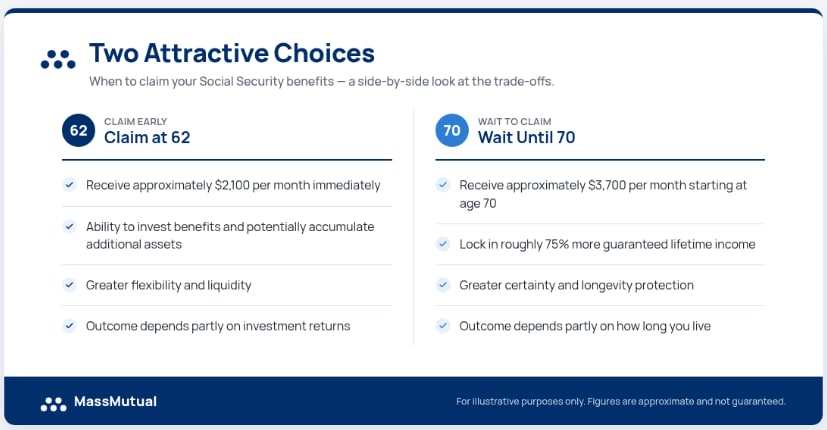
Notice that neither option is inherently superior. Each solves a different problem. Claiming early provides immediate cash flow that can be spent, saved, or invested. Delaying provides a significantly larger stream of lifetime income backed by the government.
The challenge is determining which choice is more valuable for a particular individual. And that answer will be different for different retirees.
The power of compounding
To illustrate, let’s assume Susan claims benefits at age 62 and invests every payment, earning an average annual return of 6 percent.4
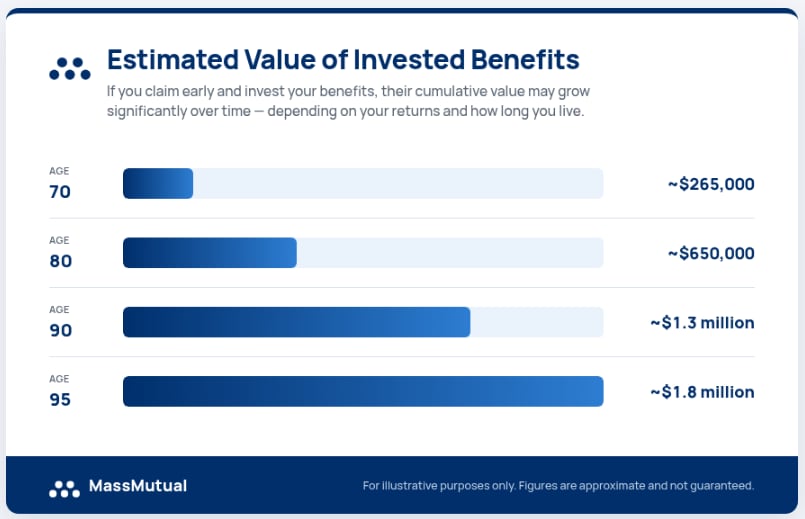
Ergo, what started as a decision about a monthly check has turned into a decision that may influence hundreds of thousands — or even millions — of dollars over a retirement.
Yes, there are many assumptions in the analysis above, including the massive assumption that Susan consistently invests every payment rather than spends it. It also assumes she remains invested through bear markets, recessions, and periods of volatility (and we all know how difficult that can be), and of course, that markets cooperate.
On the other hand, delaying benefits until age 70 increases her monthly income by roughly 75 percent. That larger benefit arrives every month for the rest of her life, regardless of what happens in the stock market.
All in, for some, the opportunity for long-term portfolio growth may be attractive. For others, the confidence that comes from a larger guaranteed income stream may be worth far more.
Where advisor value emerges
So, what should Susan do?
The honest answer is that it depends (that was anti-climactic, wasn’t it?!).
It depends on her health, life expectancy, marital status, tax considerations, investment assets, spending needs, and tolerance for risk. A client with substantial assets and a long time horizon may reasonably choose one path. Another may place greater value on predictability and guaranteed income. Both decisions can be perfectly rational.
Which is where advisor value emerges.
The advisor is not creating additional Social Security benefits. Nor are they attempting to predict future market returns. Instead, they help clients understand the trade-offs and determine which choice best aligns with the retirement they are trying to build.
The real value comes from helping clients ask a better question: How does Social Security fit into my overall retirement plan?
The lesson is not that everyone should claim early. Nor is it that everyone should wait. Both approaches could very well be reasonable depending on an individual's circumstances and objectives.
The lesson is that a seemingly simple decision often contains layers of complexity beneath the surface. A good advisor helps clients navigate that complexity, evaluate competing risks, and make informed decisions with confidence.
And that is a recurring theme throughout this analysis. Advisor value is often less about selecting investments and more about helping clients make better decisions when the right answer is not immediately obvious.
The tax bill hiding in retirement
And, with that, ladies and gentlemen, we have arrived at our final example. Let us now imagine the quintessential American savers: Robert and Claire. Robert and Claire, our proverbial retired couple, have done almost everything right.
- They saved consistently.
- They lived within their means.
- They took full advantage of their retirement plans.
- And, after decades of work, they have entered retirement with several million dollars, much of it held in traditional IRAs.
They have looked forward to this moment of lazy Tuesdays, iced tea on the porch, and more time to spend in the ways they choose.
And, as expected, for the first time in years, their taxable income drops significantly.
- No salaries.
- Modest portfolio income.
- No need to touch the IRAs.
Their plan has always seemed obvious: Leave the retirement accounts alone. Let them grow. Defer the taxes for as long as possible. It sounds prudent. And it often is. But it may also be a mistake.
Their advisor runs the numbers forward rather than looking only at this year’s tax return, and the picture changes quickly.
You see, eventually, Robert and Claire will be required to take distributions from their retirement accounts. Those distributions are planned and expected. The problem is those distributions will arrive on top of Social Security, investment income, and any other sources of cash flow. What looks like a low-tax retirement today could become a much higher-tax retirement later. And the consequences do not stop with federal income taxes.
Larger distributions can affect Medicare premiums. They can make more of their Social Security taxable. If one spouse dies, the survivor may inherit much of the same income while filing as a single taxpayer. If money remains in the IRAs at death, their children may be required to distribute those assets over a relatively short period, potentially during their own highest-earning years.
In other words, Robert and Claire do not have a tax problem today. They may have a much larger one waiting for them tomorrow.
An astute advisor would help consider a series of partial Roth conversions during the years when their taxable income is unusually low. While the details are a tad complex, a Roth conversion essentially moves money from a traditional retirement account into a Roth IRA, creating a tax bill today in exchange for the potential for tax-free qualified withdrawals in the future. Not one enormous conversion. Not an attempt to eliminate the IRAs entirely. Just a deliberate amount each year, sized within the context of the broader plan.
The strategy requires them to do something deeply unnatural: Pay taxes before they have to. And that unnatural instinct is often followed by the question: “Why would I voluntarily write the government a check?”
It is a fair question. The answer is that deferring a tax is not the same as eliminating it. Robert and Claire do not own every dollar in their retirement accounts. Some portion belongs to the government. The only questions are when that bill will be paid and what the tax rate may be when it arrives.
A thoughtful conversion strategy could reduce future required distributions, build a pool of tax-free assets, provide greater flexibility during high-spending years, and leave the surviving spouse with more control over taxable income.5
Could future tax rates fall? Certainly. After all, a Roth conversion, by definition, requires paying taxes today in exchange for the possibility of tax benefits in the future…and those benefits ultimately depend on factors that no one can know with certainty. Could Robert and Claire die earlier than expected? Unfortunately, yes. Could tax laws change again? Almost assuredly. There is no perfect answer because the decision involves variables no one can know. But doing nothing is still a decision.
That is where the advisor earns their keep.
- The advisor is not simply asking, “How can Robert and Claire pay the least tax this year?” That question is easy.
- The better question is: How can Robert and Claire manage taxes over the rest of their lives, for both spouses and eventually for their children?
The value may not appear on an investment statement. There is no ticker symbol for it. No one will discuss it on financial television.
But a series of thoughtful decisions made during a quiet window early in retirement may shape the family’s finances for decades. The hazard was never directly in front of the ship. It was farther down the channel.
In closing
And with that, ladies and gentlemen, we have reached the end. If you’ve tolerated my nautical metaphors and parables this long, I certainly hope I have offered some perspective that may be of value. Harkening back to the opening quote, French philosopher Simone Weil believed attention was the purest form of generosity. Perhaps that is the advisor’s real offering: Sustained attention to a financial life that is complicated, changing, and deeply personal.
The ultimate value of an advisor is not found in a single recommendation, investment, or perfectly timed decision. It is found in the compounding of many decisions made a little better, risks recognized a little earlier, and mistakes avoided when they matter most. The fee is visible. The crises that never happen, the taxes never unnecessarily paid, and the panic never acted upon are not.
Harbor pilots do some of their best work when, to everyone else aboard, it appears that nothing happened at all.
Discover more from MassMutual …
IPO analysis: Scale, timing, and valuations
War with Iran: Analyzing the market challenges
How much money do you need to work with a financial advisor?
___________________________
1The example is hypothetical and provided solely for illustrative purposes. It does not reflect the experience of any actual investor or client and should not be interpreted as a guarantee or prediction of future results.
2DALBAR, Quantitative Analysis of Investor Behavior (QAIB), 2022. QAIB measures the impact of investor purchase, sale, and exchange decisions on long-term investment outcomes.
3Assumes no additional contributions or withdrawals and reinvestment of earnings. This illustration does not reflect the impact of taxes, transaction costs, or investment fees. If these factors had been reflected, the ending values shown would have been lower. This illustration is hypothetical and is not representative of any specific product or investment. Actual results will vary.
4Assumes all earnings are reinvested and no withdrawals are made. This example is hypothetical and provided solely for illustrative purposes. It is intended to demonstrate the potential impact of compounding under one set of assumptions and should not be interpreted as endorsing any particular Social Security claiming strategy. Actual results will vary.
5This example is hypothetical and provided solely for illustrative purposes. It is not intended to predict or guarantee any particular tax outcome. Actual results will vary.