
Imagine you are just steps from the Mediterranean Sea, up the path from a remarkably soft sandy beach. You’re sitting at an adorable and reputed restaurant called Manos Tavern. It is known for its mezze spread, which is essentially a collection of small dishes to be shared. Think of dips and spreads, grape leaves, fresh seafood, and maybe warm bread or pita for dipping. For those inclined, perhaps a bottle of white wine chills on ice.
Idyllic, right?
Well, as you sit in your idyllic spot, you may gaze across the water. Within view sits the even more idyllic island of Crete. And on the northwest side of Crete rests Souda Bay, which just so happens to be a logistics hub for the U.S. military.
Just yesterday, that same Souda Bay was placed on emergency alert, because it is within the outside range of Iranian missiles.
Manos Tavern is now at risk and shut down. Schools, hospitals, offices, military bases, businesses. All shut down. Hundreds of thousands are fleeing, at risk, or both. The same is true across parts of Israel, Bahrain, Qatar, Kuwait, the United Arab Emirates, Jordan, Saudi Arabia, Iraq, Crete, and yes, Iran.
This is war, ladies and gentlemen, and war is both horrific and unpredictable.
And yet, it is our job and hope to understand, and help guide through, what is happening, what could happen, and how to navigate such uncertainty.
As such, what follows is a perspective of what has occurred and perhaps some perspective on how to think about what could occur.
And with that, let us begin.
The road to escalation
We think the best way to understand where we are currently is to think about what has occurred in three phases:
1. The (recent) historic context.
2. The U.S. militaristic build-up.
3. The initial actions of the war.
Historical context
The current conflict did not emerge suddenly, nor is it the product of a single provocation. Rather, it is the culmination of a slow burn escalation that began more than two years ago and has repeatedly crossed thresholds once thought unlikely to be breached.
The modern phase of this conflict traces back to Oct. 7-8, 2023, when Hamas launched its attack on Israel, prompting Israel’s response in Gaza and opening a second, northern front as Hezbollah began sustained hostilities from Lebanon. Hezbollah, critically, does not operate independently; it is funded, trained, and armed by Iran. What followed was a widening shadow war, largely fought outside Iran’s borders, as Israel intensified strikes throughout late 2023 and early 2024 against Iranian Islamic Revolutionary Guard Corps (IRGC) and Quds Force assets embedded in Syria.
That shadow war became overt on April 1, 2024, when Israel struck an Iranian consulate compound in Damascus, killing senior IRGC commanders. This marked a meaningful escalation: a direct attack on Iranian diplomatic facilities. Less than two weeks later, Iran responded in unprecedented fashion.
On April 13-14, 2024, Iran launched its first ever direct attack on Israel, firing drones, cruise missiles, and ballistic missiles toward Israeli territory. While the vast majority were intercepted — with critical support from the United States and allied forces — this marked a material turn in the conflict. For the first time, Iran and Israel had engaged one another openly.
Israel’s response, a limited retaliatory strike near Isfahan on April 19, 2024, was deliberately restrained, signaling both capability and a desire to avoid immediate escalation. But that restraint proved temporary. In June 2025, what had been episodic became explicit: a 12-day direct Iran–Israel war. Israel struck Iranian nuclear and military sites; Iran responded with large scale missile barrages; and the United States, for the first time, struck Iranian nuclear facilities directly. A ceasefire followed after nearly two weeks —b ut the precedent was set. Direct confrontation was no longer theoretical.
By early 2026, the region was no longer in a state of uneasy deterrence. It seemed to be living on borrowed time.
The U.S. military build up
On Jan. 26, 2026, the United States initiated its largest Middle East military buildup since 2003, redirecting naval, air, and missile defense assets into the region.
Within days, the USS Abraham Lincoln Carrier Strike Group was redirected from the Indo Pacific to the Arabian Sea, removing a major naval asset from one theater to reinforce another. Shortly thereafter, between Feb. 17 and 20, the USS Gerald R. Ford Carrier Strike Group departed the Caribbean, transited the Strait of Gibraltar, and moved toward the eastern Mediterranean.
In parallel, between Feb. 18 and 26, the United States moved dozens of additional fighter jets, aerial refueling tankers, and surveillance aircraft into the region, expanding not only strike capacity but endurance, intelligence, and command and control capabilities.
Perhaps most telling, in late February the U.S. moved a hospital ship into the broader Middle East theater. Historically, hospital ships are not deployed in anticipation of limited engagements or short duration operations. They are deployed when casualties are expected, and when a conflict is expected to persist.
Taken together, these actions suggested a clear assessment by U.S. leadership: escalation was not merely possible—it was increasingly probable.
Conflict begins. again.
And so, with the context and build-up as background, that now brings us to what actually occurred.
At approximately 1:15 a.m. ET on Feb. 28, 2026, the United States and Israel launched coordinated air and missile attacks inside Iran aimed at senior leadership targets, air defenses, and missile infrastructure. These were designed to degrade Iran’s command structure and reduce its ability to respond.
Unsurprisingly, Iran retaliated almost immediately. Over Feb. 28 and March 1, Iran launched dozens of ballistic missiles and drones toward Israel and toward U.S. military facilities across the Gulf. Within 24 hours, Iranian strikes expanded well beyond Israel itself, targeting U.S. bases in Bahrain, Qatar, Kuwait, the United Arab Emirates, Jordan, and Saudi Arabia. While many incoming projectiles were intercepted by layered air defense systems, the geographic scope of the conflict widened dramatically.
The scale of firepower employed was significant. Over the first 48 hours, Iran launched hundreds of missiles and drones, while Israel and the United States conducted multiple waves of strikes inside Iran, hitting hundreds of military targets. What had begun as a bilateral confrontation rapidly evolved into a regional conflict.
At least 11 countries are now directly involved or have been struck: Iran, Israel, the United States, Bahrain, Qatar, Kuwait, the United Arab Emirates, Jordan, Saudi Arabia, Cyprus, and Iraq.
At this point, the conflict is no longer defined by isolated exchanges or limited objectives. It has crossed into a multi-theater war with regional participation, uncertain duration, and inherently unpredictable outcomes.
Black gold
Which brings us to the economic impact—and the clearest lens through which to view it: oil.
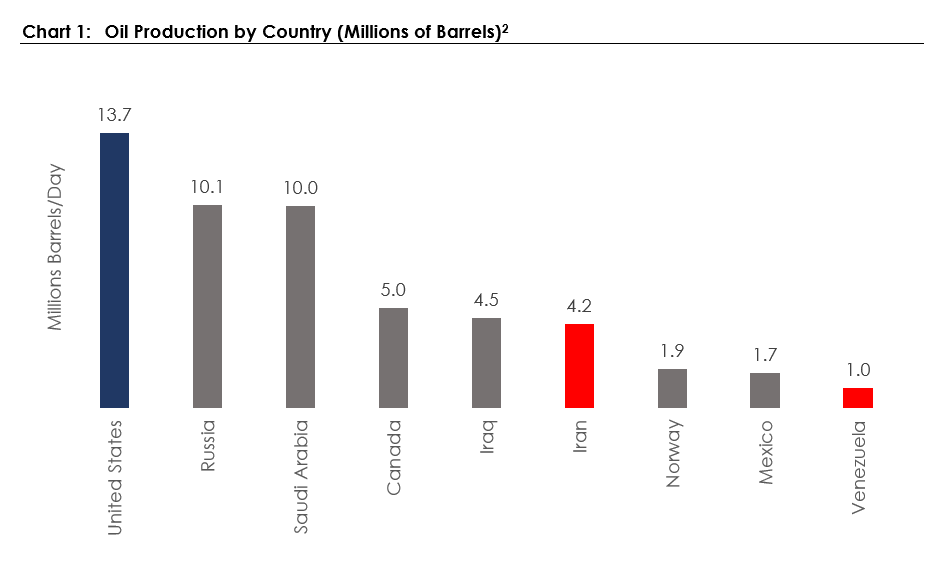
Iran is a large, but not dominant, producer of oil. They’re the fourth largest producer in OPEC and produce far less than the United States.
And so, logic goes, if a country is at war, perhaps the oil normally being produced will not be produced in the same manner. And further, the primary path by which that oil is exported (the Strait of Hormuz) is now closed or on a path to being so.
All in, given the region’s importance to the production of oil, it will clearly hurt supply and, at the margin, put upward pressure on prices (which, of course, affects inflation).
And yet, the impact isn’t necessarily the same across countries … which brings us to Chart 2.
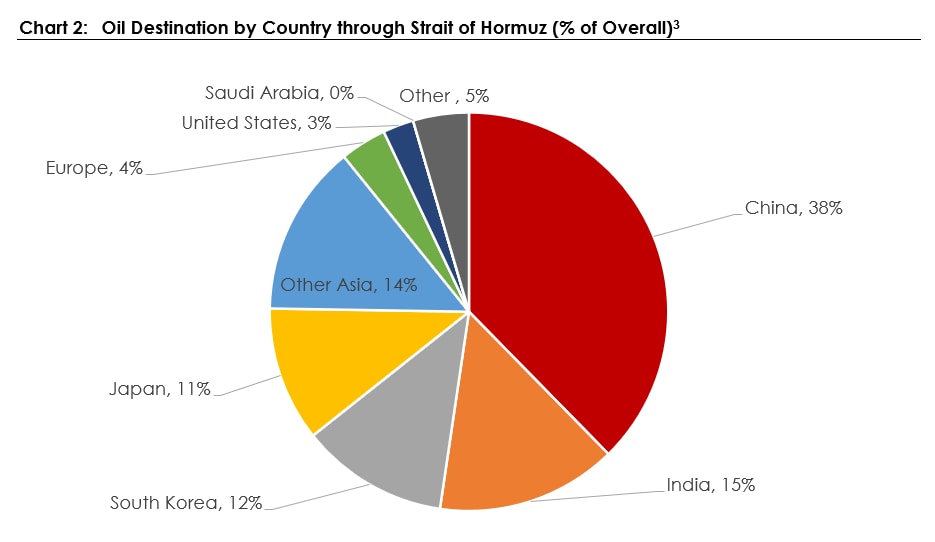
China, it’s worth noting, is the primary destination for oil moving through the Strait; the United States is not. While we can’t know whether that reality played into the decision making around a potential closure, it does materially reduce the economic downside for the U.S. and its allies relative to countries like China.
And this observation (that this puts upward pressure on oil), is an observation we can generally make across large military conflicts.
Historically, those conflicts have been
- Positive for commodities and gold.
- Negative for cash and bonds (particularly if a country needs to issue more bonds to finance the war, or if increasing prices move inflation higher).
- Varied for equities though outcomes have not been consistent and are not predictive of future outcomes.
On the latter point, whether it is good or bad for equities depends on many different variables…including how the central banks respond and how liquidity transpires.
Chart 3 is a typical representation of what happens.
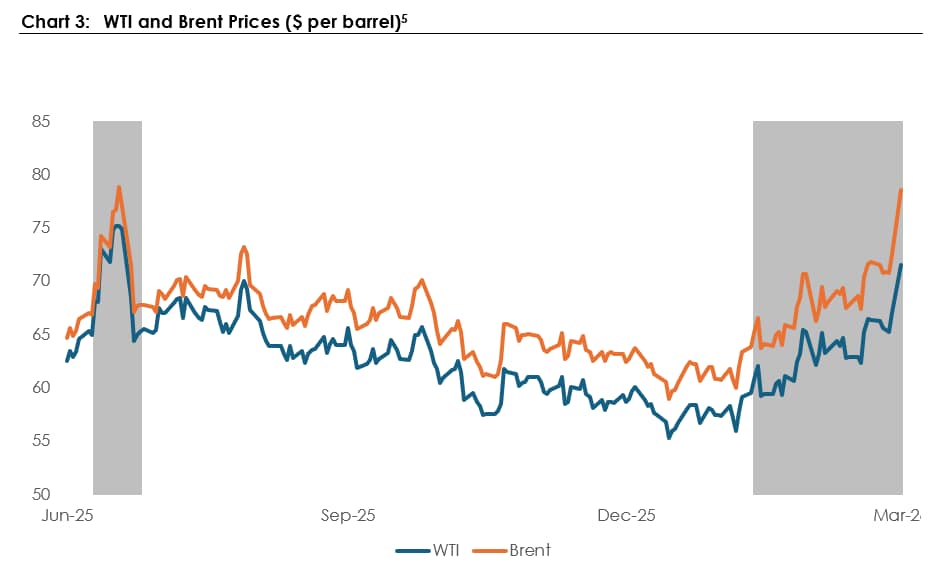
The grey box on the left is what happened during the 12-day conflict between the U.S., Israel, and Iran in 2025, and the grey box on the right is what occurred as the U.S. military apparatus began to build in the Middle East and Mediterranean. Keep in mind that, even with the recent increases, these prices are nowhere near the $120 per barrel prices that occurred in 2022 following the Russian invasion of Ukraine.
Okay, so where does that leave us? Is this abject crisis and disaster? Are doom and misery certain to follow?
Well, first and foremost, war is atrocious. There is no way around that reality. The list of countries involved and casualties continue to grow, and the outcomes from prolonged military conflict can truly be horrific.
From a markets perspective , however, assuming this stays relatively contained, history tells us a fairly benign story. Which leads us to the finale, Chart 4.
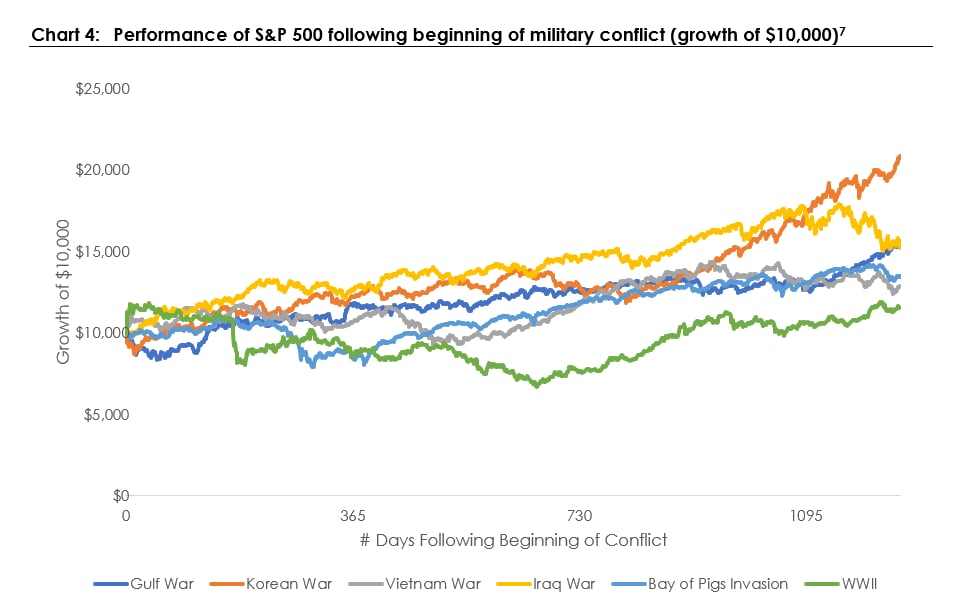
While each conflict is different, Chart 4 tells a very important, and somewhat reassuring, story. In general, over a reasonably long period, markets tend to move higher. As we have discussed before, where humans are involved, incentives drive behavior, and those incentives are the same whether or not a war is underway. Tech companies this morning are still trying to figure out how to gain market share and innovate, and manufacturing companies are still trying to figure out how to manage inventories, stay relevant, and increase capacity without increasing costs. Those incentives remain consistent because the principles of capitalism demand so.
And with that, if you’ve remained with me this long into what was meant to be a brief update, you deserve my apologies (and appreciation).
Let us summarize what we have explored thus far:
1. War is horrific and unpredictable. Full stop.
2. This 2026 Iran conflict is much broader and more comprehensive in scope … which increases the risk of it becoming more prolonged.
3. War is generally positive for commodities and gold, and generally bad for cash and bonds (depending on issuance and inflation). Equities have varied outcomes.
4. Over the last handful of large military conflicts the United States was involved with, most were positive for U.S. equity markets (this is also partially attributable to the fact that the U.S. was mostly successful in its military pursuits).
So, what are we to do?
Well, first and foremost, don’t act rashly. Humans have a terrible track record of adjusting their portfolios to news or recent events and accomplishing anything productive (our brains just aren’t built for those adjustments). (Related: 3 tips to avoid locking in investment losses)
Second, diversify, diversify, diversify. Across asset classes, time periods, geographies, industries, and the like. We don’t know for certain what the best performers or worst performers will be and, as such, we are better off allocating to many assets with positive expected returns. Bet on capitalism, not on our guts. (Learn more: Knowing which financial eggs are where)
Third, stare closely at your portfolios and make sure you have the right level of risk. If markets are down, will you be comfortable with the outcomes? If not, you likely have too much risk and may want to consider adjusting accordingly. Use the current environment as a litmus test and alter course if that litmus test tells you something you hadn’t previously contemplated. (See: What is your risk tolerance in investing?)
Lastly, and perhaps most importantly, ladies and gentlemen, remain calm. We have gone through pandemics, wars, skirmishes, conflicts, poor policies, good policies, and everything in between. And yet, despite all of those challenges, the principles of capitalism continue to generate positive returns by providing capital for productive purposes and do so in exchange for a return. We believe those principles are alive and as healthy as ever.
Discover more from MassMutual …
The market’s lighthouse in 4 charts
Understanding the basics of investing
How to increase your net worth
__________________________________
1 And of course, as with any rapidly evolving situation, what follows reflects the information available at the time of writing and may change as events develop.
2 Source: WMIT; Bloomberg; as of March. 2, 2026.
3 Source: WMIT; U.S. Energy Information Association as of March 2, 2026; by Destination; 1Q 2025
4 Though outcomes have not been consistent, and are not necessarily predictive of future outcomes.
5 Source: WMIT; Bloomberg; as of March 2, 2026
6 I am acutely aware that for those touched by war, moving from human tragedy to economic impact can feel harsh. Nonetheless, helping navigate these realities is an essential part of our role.
7 Source: WMIT; U.S. Energy Information Association as of March 2, 2026; by Destination; 1Q 2025.