
| ||||||||||||

Do you need to have a specific amount of money to work with a financial advisor or professional? The answer is not necessarily.
But it’s a myth a lot of people believe.
According to MassMutual's 2026 Financial Habits Report:
- 83 percent of Americans believe there is a minimum amount of investable assets required to make working with a financial advisor worthwhile.
- 52 percent peg that threshold at $50,000 or more.
- 68 percent say you need at least $10,000 before it makes sense.
The actual answer? There is no universal minimum. And waiting until you hit some imaginary number could cause you to miss opportunities.
“Every person, at every stage of life, has goals to pursue, risks to manage, and financial decisions to make,” Curran continued. “Planning creates a framework that helps turn that complexity into clear, actionable steps. Whether the priority is managing cash flow, building savings, paying down debt, protecting a family's income, saving for education, or preparing for retirement, planning provides a road map.”
Planning can take many forms. For some people, it may involve a formal written financial plan. For others, it may be a series of conversations with a financial professional about their goals, priorities, and the financial decisions they face at different stages of life.
The value proposition
Working with a financial advisor or professional can potentially benefit you in three ways, Curran noted.
- Clarity — “Clients work with a financial advisor or professional to help define what matters most and determine how to get there.”
- Confidence — “Working with a financial advisor or professional can help reduce stress and help clients feel prepared for the unexpected.”
- Potentially better decisions — “Every client has goals to achieve and decisions to make. A financial advisor or professional can help clients understand the trade-offs, evaluate their options, and make informed decisions that support their goals.”
These broad benefits come into play when you want help managing varying degrees of financial challenges.
For instance, do you:
- Have multiple or unusual income streams, like stock option grants or an inheritance?
- Own or have partial ownership in a business?
- Have large debt obligations, such as student loans, while trying to meet savings goals?
Or, more often than not, people need professional financial help when facing a life change, like:
- Navigating a job change with a 401(k) rollover decision.
- Buying a home for the first time.
- Starting a family.
- Handling the passing of a loved one.
These situations involve trade-offs and timing decisions that can have long-lasting consequences — and they do not require a minimum balance to justify a conversation.
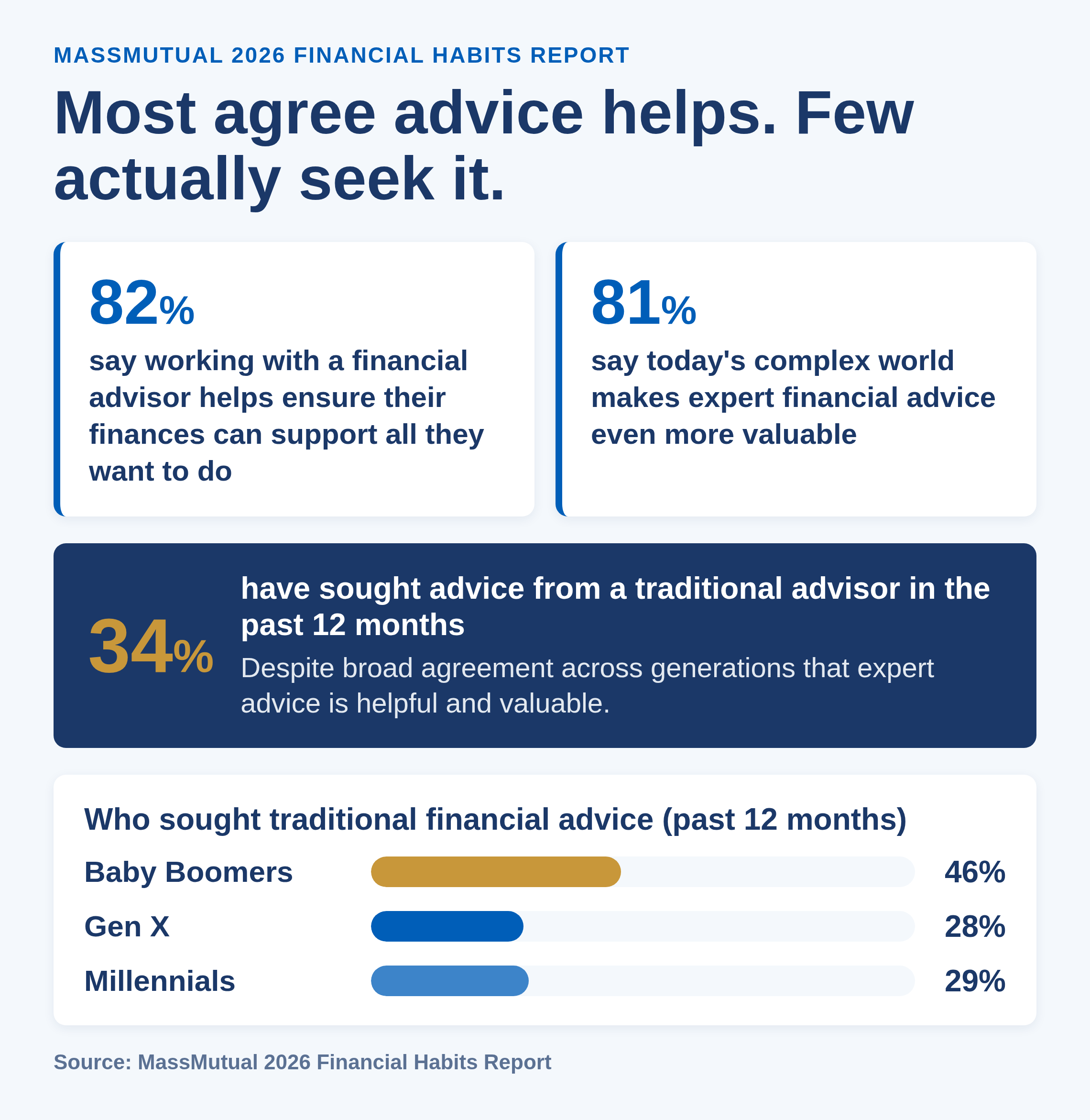
"You do not need a minimum balance to deserve a plan," Vaughn Bowman, chief executive officer of MML Investor Services and head of wealth management at MassMutual, observed in a recent review of the MassMutual survey results. "Many people have an 'all-or-nothing' mindset, when in fact, some level of professional guidance is oftentimes better than none at all. Breaking up the planning process into digestible, specific steps can help small accomplishments lead to a sense of satisfaction — and a desire to keep going and do more."
That last point matters. Starting small, with targeted guidance on one piece of your financial picture, often helps build the habits and momentum that can contribute to building wealth over time. (Related: How to budget and build your financial pyramid)
Fee structures have changed the equation
A common advisor compensation model has been charging roughly 1 percent of assets under management per year, creating a practical incentive for advisors to focus on larger accounts. If you only have $10,000 to invest, a 1 percent AUM fee generates $100 a year, which may not cover the advisor's time.
But that model is no longer the only one. Today, many financial advisors charge annual financial planning fees, hourly fees, or project-based fees for specific guidance. These structures allow advisors to serve clients who are still building their financial foundation — and they shift the question from "how much do you have?" to "what do you need help with?"
Know what kind of financial professional you need
Your situation will also shape what type of financial professional is the right fit. The difference matters, because some titles and roles among financial professionals can be confusing.
There are three main types.
- Registered representatives and insurance agents typically help clients address financial needs such as budgeting, insurance, and retirement savings. Registered representatives may also assist with investment allocation decisions.
- Investment adviser representatives (IARs), acting on behalf of registered investment advisers (RIAs), provide investment advisory services, which can include managing investment portfolios. They are held to a fiduciary standard, meaning they are legally required to act in your best interest when providing those services.
- Financial planners may provide financial plans or financial planning services for a fee. Depending on their licenses and qualifications, they may also act as an IAR, registered representative, or insurance agent and assist clients in implementing elements of a financial plan, such as investment-, retirement-, or insurance-related recommendations.
Financial professionals like registered representatives and insurance agents can generally provide what most people need in terms of financial guidance and retirement planning. And beyond basic financial know-how, they can also provide the coaching and encouragement many find helpful to stay on plan.
And the intermittent cost of their services may be more economical than the ongoing fees associated with investment advisory relationships, depending on products and services selected. (Important to know: Two types of investment professional: Which is right for you?)
Those with significant amounts of assets or wealth to manage or in need of ongoing investment advice may want to consider someone more along the lines of an investment adviser representative. (Learn more: Who is a financial advisor, and who isn’t?)
Connect with a MassMutual financial professional
Signs you may benefit from guidance
Here are some circumstances where professional input may be particularly valuable, even if your financial assets are modest:
- You are starting your first job and need to understand your benefits and retirement contributions.
- You recently got married or had a child and need to revisit your insurance coverage and beneficiaries.
- You inherited money or received a windfall and want guidance before making any moves.
- You are carrying debt and unsure whether to pay it down aggressively or save simultaneously.
- You feel anxious about money and want a clearer, structured plan. (Related: What is your risk tolerance when it comes to investing?)
The common thread is not asset level. It is uncertainty, complexity, or a transition where decisions — especially financial ones — compound over time. And many of these situations need some appreciation and understanding beyond simple number crunching. (Related: Why AI can’t replace your financial professional)
The bottom line
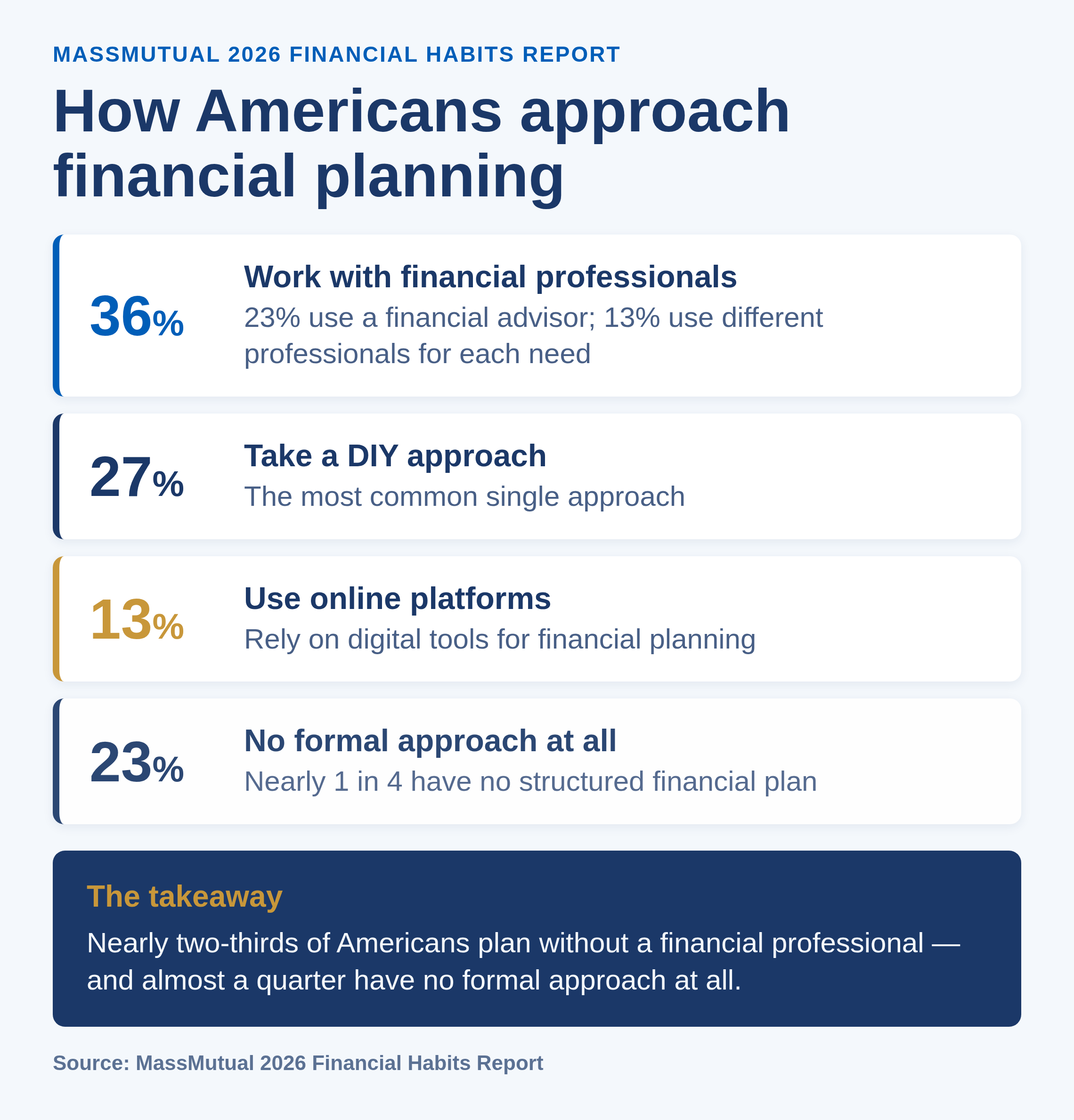
The belief that you need a certain amount of money before a financial advisor or professional will take you seriously is a widespread misconception — and one with real consequences. The 83 percent of Americans who think a minimum threshold exists may be delaying professional guidance at exactly the moment they need it most.
What actually merits professional guidance is not a balance sheet milestone. It is the complexity of your situation, the decisions in front of you, and the steps you have not yet taken to plan financially.
___________________________
Frequently asked questions
Q. Do financial advisors or professionals have minimum asset requirements?
A. Some do, some don't. Traditional wealth managers and RIAs focused on portfolio management often set minimums ranging from $100,000 to $1 million or more. However, many financial planners and fee-for-service advisors have no minimum — they charge annual financial planning fees, hourly fees, or flat fees, which can make professional guidance accessible regardless of your current account balance.
Q. Can I benefit from a financial advisor or professional even if I have debt?
A. Yes. In fact, carrying debt is one of the clearest signals that a structured plan could help. A financial professional can help you weigh payoff strategies against other priorities — like building an emergency fund or not leaving an employer retirement match on the table. (Related: How to build wealth in midlife)
Q. Is one conversation with a financial advisor or professional worth it?
A. It often is. Even a single session can help you clarify priorities, identify gaps in your protection needs, and set you on a more deliberate path. Many financial advisors and professionals offer complementary initial consultations.
____________________
Discover more from MassMutual …
When do you need a financial professional?
Should I use a financial professional or do it myself?
Preparing to meet your financial professional
_________________________