
| ||||||||||||

We would not judge you if you woke up recently, looked at your local newspaper and wondered if you were in the heyday of the late 90s with the sudden burst of IPOs. We would also not judge if the words, “hey honey, there’s a typo in this darn newspaper again…” echoed through your hallways after looking at some of the estimated valuations.
Unfortunately, yes, those valuations may happen, and yes, a burst of IPOs is occurring.
What follows is a quick synopsis of what is happening, why it’s giving wise investors pause, and then we end with a bit of perspective.
What’s actually happening
After a very quiet stretch from 2022 through 2024, the IPO market has reopened, and it’s reopening with some weight behind it. Activity picked up meaningfully last year and the pipeline for 2026 is as full as it’s been in several years.
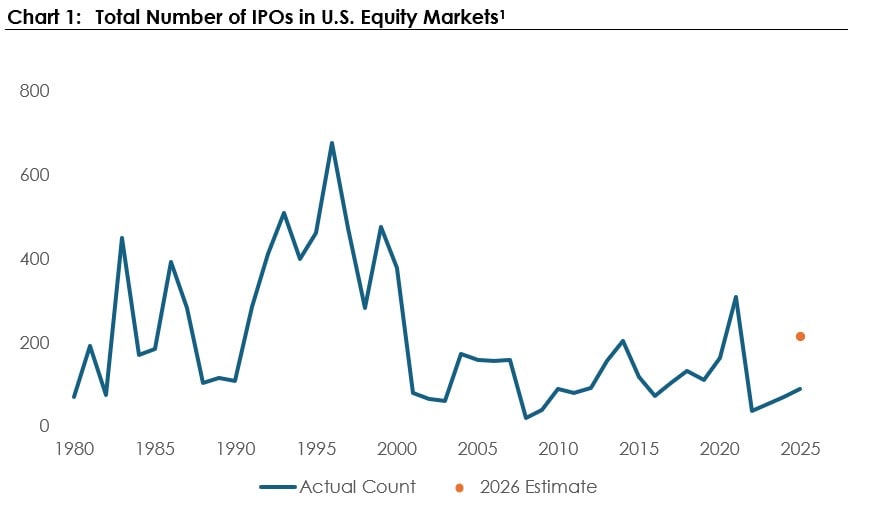
Perhaps what’s more unique about this round, however, is the sheer size. Several private companies have stayed private longer, raised enormous amounts of capital, and are now lining up to go public at valuations that would immediately place them among the largest companies in the S&P 500.
While the companies below haven’t yet gone public, the estimates are staggering:
- SpaceX is being discussed in the ~$1.5 — $2 trillion range.*
- OpenAI is being discussed in the ~$800 billion — $1 trillion range.
- Anthropic is being discussed in the ~$800 billion — $1 trillion range.
If those ranges hold, these would not be typical IPOs. They would be among the largest equity offerings ever. In fact, they would be among the largest market capitalizations in the world.
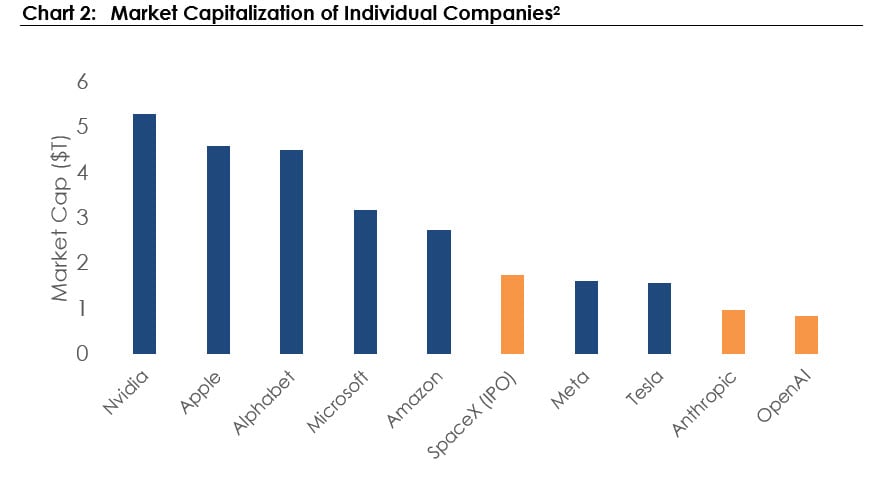
So, in very simple terms, we could see multiple companies come public at sizes comparable to companies that have long been in existence.
Things that make you go, hmmm
None of this is entirely new — but the scale, timing, and valuations are getting attention.
When companies come public at this size, expectations are already high. There isn’t much room for disappointment, and public markets tend to test that pretty quickly.
Consider SpaceX, analysts are expecting earnings growth of about 26 percent annually through 2035. If that occurs, it would be among the best earnings performance for a company that size in history. Is it possible? It’s anyone’s guess. Is it likely? Let’s just say, it would truly be remarkable.
What matters even more is what’s priced in. For example, at the published initial public offering price, SpaceX’s price to EBITDA ratio (earnings before interest, taxes, depreciation, and amortization) will be about 250. As a thought exercise, let’s assume SpaceX achieves the lofty earnings growth target through 2035. What return will you get? It depends on how its valuation changes over that period. We generated a range of estimates by assuming its ratio changed to be in line with the market and other large cap giants by 2035. The following table summarizes the results:
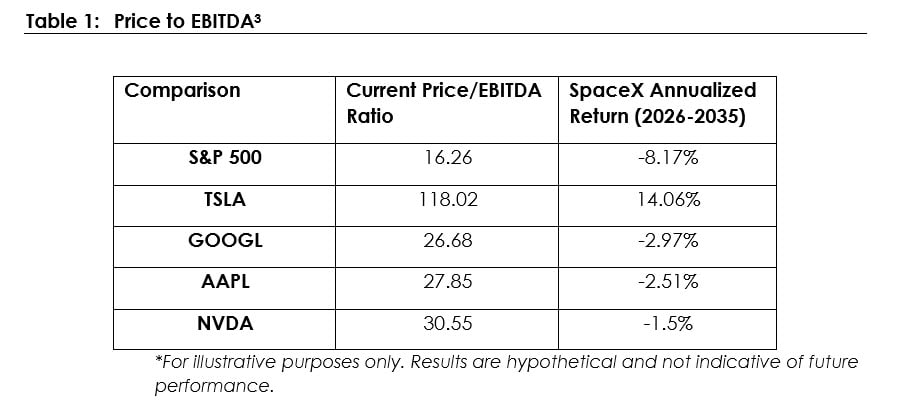
So, if everything goes right for SpaceX (it achieves its lofty earnings target and ends with a sky-high valuation), returns can be positive. If anything goes wrong, investors may be disappointed for a long time.
Investors inevitably respond with “but yes, SpaceX is so different than other companies!”
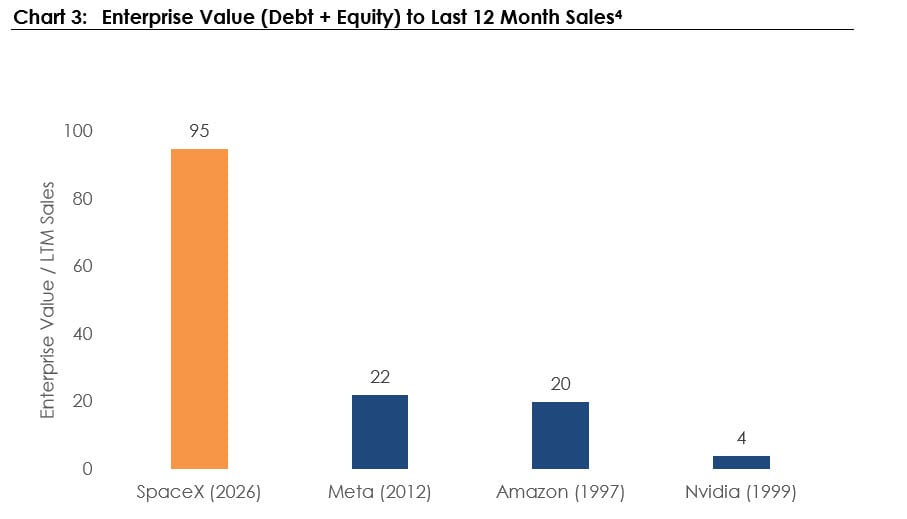
Perhaps, therefore let’s compare SpaceX’s valuation to other notable big-tech companies at their IPO. The chart below compares SpaceX’s price-to-sales ratio versus Meta, Amazon, and Nvidia at their respective IPOs. The summary: it is at least four times as expensive as Meta and Amazon, and more than 20 times as expensive as Nvidia!
There’s also the simple issue of supply. If several large deals hit the market at the same time, that’s a lot of new stock that investors have to absorb. That capital doesn’t appear out of nowhere.
And right now, most of the attention is focused on the same areas — AI, data, and infrastructure. When money crowds into a narrow set of themes, things can move quickly in both directions.
The question isn’t whether these are strong businesses (many of them are). The question is how much of that future may already be priced in before the first trade even happens…and with this much pomp and circumstance…let’s say there’s a remarkable amount of hype on a couple of these.
A bit of perspective
It’s tempting to jump straight to the late 90s comparison. There are some similarities — big innovation cycle, big narratives, big valuations.
But there are some differences as well. Most of these companies have real revenue, real scale, and, in many cases, real cash flow. They’re not coming public as concepts — they’re coming public as established platforms.
Still, the broader lesson hasn’t changed much over time:
- New technologies attract capital.
- Expectations often run ahead of reality at some point.
- A handful of companies often end up driving most of the long-term value.
- The rest tend to be far less predictable.
For investors, this is usually a reminder, not a call to action. It is easy to get caught up in the frenzy, but remember, these cycles tend to come and go.
Staying diversified matters. Keeping position sizes in check matters. Not chasing whatever happens to be the most talked-about opportunity in a given moment matters.
We believe in the tried and tested principles of capitalism and, as an extension, capital markets. The price you pay matters, and with the prices currently being quoted, we do not believe this is the time to rush into unproven stories.
The long-term story — owning a broad set of businesses and allowing for compounding over time — has historically been a lot more durable than any single IPO wave.
We remain at your service and watching closely.
Discover more from MassMutual…
War with Iran: Analyzing the market challenges
The market’s lighthouse in 4 charts
Need a financial professional? Find one here
________________________________________
* The IPO for SpaceX took place on June 12, 2026.
1 Source: Bloomberg; as of June 9, 2026; Bloomberg estimate.
2 Source: Bloomberg; as of June 9, 2026.
3 Source: Internal analysis based on Bloomberg data; as of June 9, 2026.