
| ||||||||||||

For families raising a child with a disability, every savings decision involves more than investment growth. It often means balancing financial security with the need to preserve eligibility for important government benefits such as Supplemental Security Income (SSI) and Medicaid.
A new savings vehicle, known as a Trump Account, may provide families with another way to save for a child's future. While these accounts offer potential tax-deferred growth and a government-funded contribution for some children, they also raise important special needs planning considerations that families should understand before opening an account.
What Is a Trump Account?
Trump Accounts were created to help eligible children begin building savings early in life. The accounts are established for children under age 18 who have a valid Social Security number and are designed to encourage long-term investing.
For eligible U.S. citizen children born between January 1, 2025, and December 31, 2028, the federal government may provide a one-time $1,000 contribution after the account is established and required elections are completed. Families, grandparents, employers, and others may also contribute, subject to annual limits ($5,000 for 2026, adjusted for inflation annually).
During childhood, any investment earnings accumulate tax-deferred and funds are invested in broadly diversified U.S. equity index funds. The account generally remains invested until the child reaches adulthood.
Why special needs families should pay attention
For many families, the appeal of a Trump Account is clear: an opportunity for long-term growth combined with an initial government contribution for eligible children.
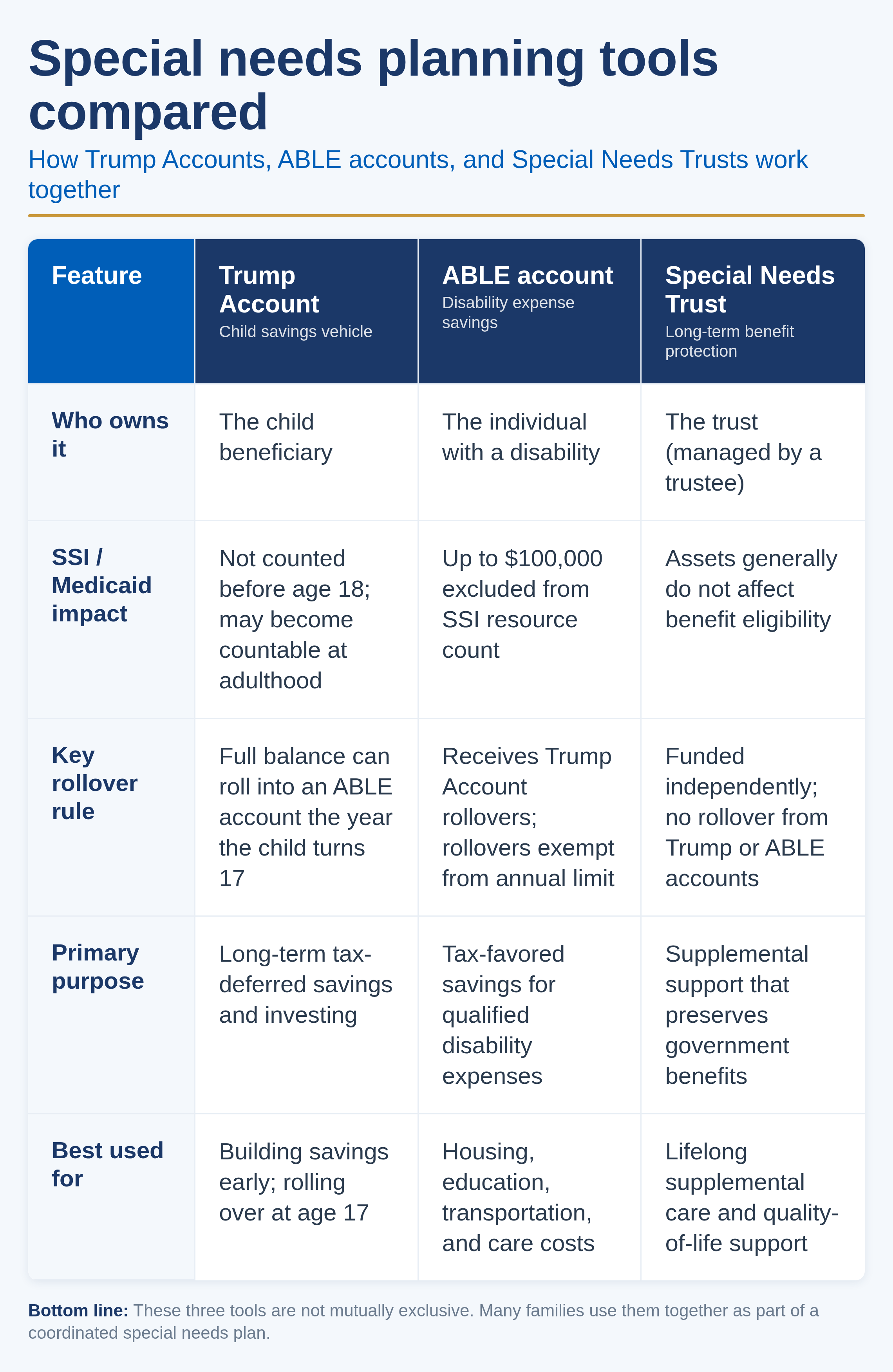
However, unlike a Special Needs Trust, the account belongs directly to the child.
That distinction matters.
Many means-tested government benefit programs, including SSI, have strict resource limits. Once the account holder reaches adulthood, assets held in a Trump Account could potentially be considered a countable resource when determining eligibility for certain public benefits.
As a result, families should carefully evaluate how these accounts fit into their overall special needs planning strategy before making significant contributions.
"Families often focus on accumulating assets, which is important," said Piacenti. "But for individuals who may rely on SSI, Medicaid, or other supports, equal attention should be given to how assets are owned and how they may affect future eligibility for government programs."
An important planning opportunity: ABLE Account rollovers
One feature of Trump Accounts may be particularly meaningful for special needs families.
Current rules permit a full rollover from a Trump Account into an ABLE (Achieving a Better Life Experience) account during the calendar year the child turns 17, provided specific requirements are met. The transfer must generally be completed as a direct trustee-to-trustee rollover and include the entire account balance.
This provision creates a potential planning opportunity because assets held in ABLE accounts receive favorable treatment under SSI and Medicaid rules, subject to applicable limits and regulations.
For eligible individuals, this could provide a pathway to move assets from a potentially countable resource into a vehicle specifically designed to support individuals with disabilities.
Trump Accounts vs. Special Needs Trusts
A common question families may ask is whether they should contribute to a Trump Account or a Special Needs Trust.
The answer depends on the family's goals.
A properly drafted Special Needs Trust remains one of the most effective tools for preserving government benefits while providing supplemental support throughout an individual's lifetime. Trust assets can often be managed by a trustee and structured specifically to complement public benefits.
Trump Accounts, by contrast, are owned by the child beneficiary and are primarily designed as a long-term savings vehicle.
Rather than viewing these options as mutually exclusive, families may benefit from evaluating how they can work together as part of a coordinated plan.
For example:
- A Special Needs Trust may serve as the primary long-term planning vehicle.
- An ABLE account may provide flexibility for qualified disability-related expenses.
- A Trump Account may offer an additional opportunity for long-term savings and investment growth.
- Life insurance and retirement planning strategies may help support future caregivers and provide funding for trusts. (Learn more)
The right combination depends on the family's unique circumstances, goals, and anticipated benefit needs. (Related: Financial advice for special-needs families)
Questions families should ask
Before opening or funding a Trump Account, consider:
- Will my child likely rely on SSI or Medicaid as an adult?
- How might Trump Account ownership affect future benefits eligibility?
- Would contributions to a Special Needs Trust better support our goals?
- Is the child eligible for an ABLE account?
- What is our plan for the account once the child approaches age 17 or 18?
- Are all members of our planning team coordinating their recommendations?
These questions can help families make informed decisions and avoid unintended consequences.
The bottom line
Trump Accounts represent a new savings option for many families. For those raising a child with a disability, however, the decision to use one should be evaluated through the lens of special needs planning.
While the potential for tax-deferred growth and government-funded contributions may be attractive, families must also consider future SSI and Medicaid eligibility, the role of ABLE accounts, and how Trump Accounts interact with Special Needs Trusts and other planning tools.
The best outcomes typically occur when financial professionals with special needs planning experience and credentials, special needs attorneys, tax advisors, and families work together to create a coordinated strategy that supports both financial security and long-term quality of life.
As Kelly Piacenti noted, "special needs planning is most effective when families take a comprehensive view. New tools can create valuable opportunities, but they should always be evaluated within the context of a family's overall vision for their loved one's future."
________________________________
Frequently Asked Questions about Trump Accounts and special needs planning
Q. Can a Trump Account affect my child's SSI or Medicaid eligibility?
A. Yes. Because a Trump Account is owned directly by the child, any funds not rolled into an ABLE account could be counted as a resource once the child reaches adulthood, potentially affecting eligibility for means-tested benefits like SSI and Medicaid.
Q. What is the Trump Account to ABLE account rollover?
A. During the calendar year your child turns 17, you can roll the entire Trump Account balance directly into an ABLE account through a trustee-to-trustee transfer. This can help preserve eligibility for SSI and Medicaid, since up to $100,000 in an ABLE account is excluded from SSI resource counting.
Q. Should I choose a Trump Account or a Special Needs Trust?
A. They are not mutually exclusive. A Special Needs Trust is often the primary long-term planning vehicle for preserving government benefits, while a Trump Account can serve as an additional savings tool. Depending on a family's goals and circumstances, these tools may be used together along with an ABLE account as part of a coordinated plan.
__________________
Discover more from MassMutual …
Estate planning tools for special care
Caring for a loved one with special needs entails SpecialCARE
How to find family balance with a child with special needs
______________________________