
| ||||||||||||

The government is taking a look at allowing 401(k) savings plans to hold new classes of investments beyond stocks and bonds, including real estate, cryptocurrency, and private equity vehicles. So, if you have a 401(k), the question is, should you add such holdings if allowed?
Like most investment questions, the answer depends on your tolerance for risk. Because, while these additional asset classes can offer the opportunity for attractive rewards, they can also carry significant risk. Understanding those risks is important to making an informed decision.
“Risk tolerance is like picking a roller coaster,” observed Kelly Kowalski, head of investment strategy for MassMutual. “Thrill-seekers go for the wildest ride, similar to high-risk investors choosing more volatile asset classes. Others prefer smoother, safer tracks, valuing stability over big swings. The key is knowing which ride fits both your comfort zone and your investment objectives.”
Retirement versus speculation
The first point to understand is that 401(k) plans and similar qualified plans are first and foremost about building retirement savings. To that end, they get special tax treatment, with rules about when funds can be accessed and used. They are not intended as vehicles for straight-out market speculation.
That’s why administrators of such plans must follow rules about what can and cannot be offered as investments. In fact, the sponsors of such plans are legally obligated to provide sound and reputable investment choices.
That’s why 401(k) plan sponsors and administrators typically steer offerings to a range of mutual funds or ETFs that are professionally managed and associated with established, regulated financial institutions. The funds are based on stocks, bonds, or a mix that can offer various levels of risk and return for asset allocation strategies. And, recently, annuities have been introduced to the mix as a way to help savers secure guaranteed retirement income.
But criticism has grown that 401(k) account holders may miss out on investment opportunities that have historically offered higher returns because of the limitations in what qualified retirement plans typically offer.
Indeed, the average annual returns for 401(k) participants reached about 8 percent for the five-year period ending December 31, 2024, according to one study. Meanwhile, various cryptocurrencies, like bitcoin or ethereum, have seen their values surge to all-time highs, median U.S. home prices have climbed significantly, and private equity continues to make headlines about profits.
Hence the move to possibly give 401(k) administrators more leeway and legal protection to introduce investments in private equity vehicles, cryptocurrency, and real estate.
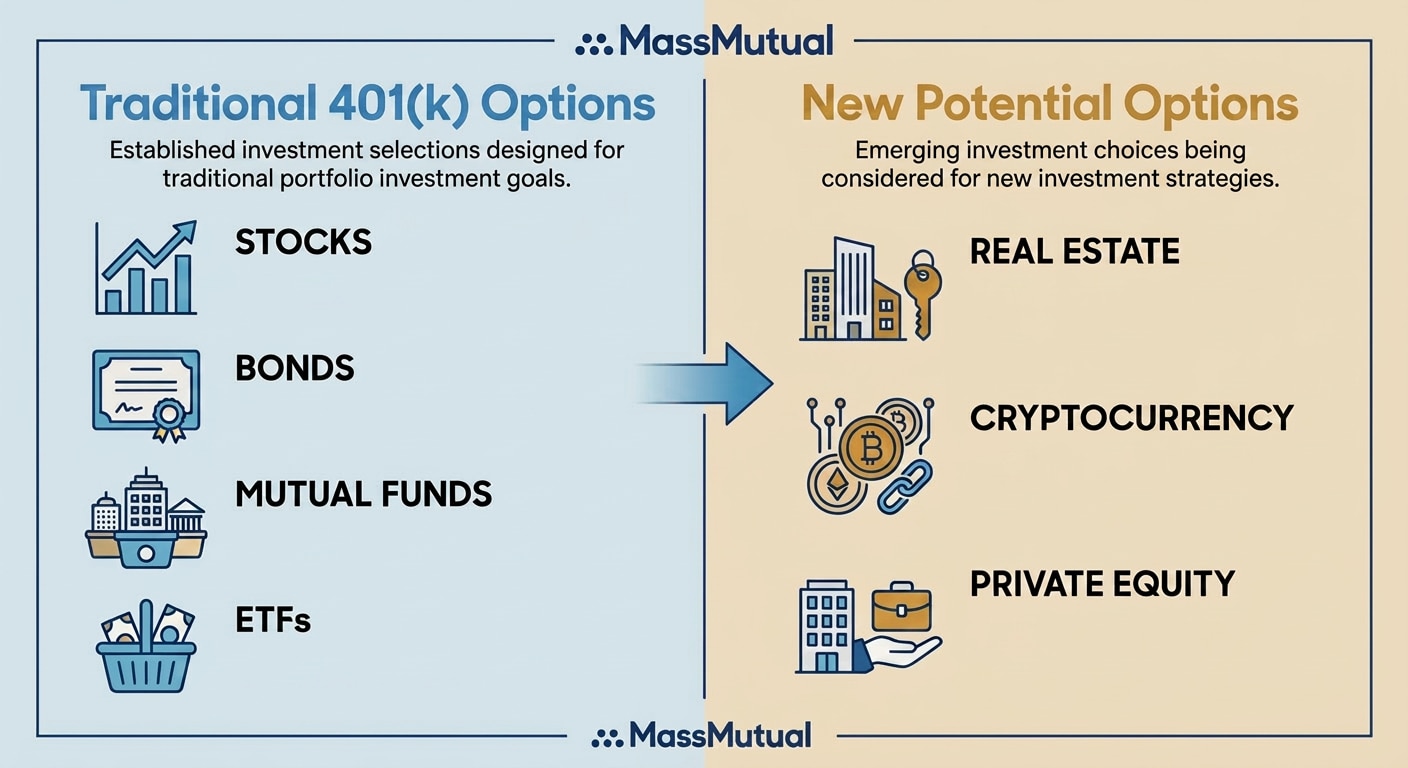
The Department of Labor is reviewing the effort, because 401(k) plans are offered through employers to their workers.
Private equity
Perhaps the criticism that 401(k) investors are missing out is no more apparent than in comparison to private equity (PE) — investment outfits and funds that use money raised from select qualified investors and institutions.
Such PE ventures are blamed for taking the most promising investment opportunities off the table.
In fact, the number of publicly traded companies in the United States has declined by 50 percent since the mid-1990s. Meanwhile, the number of private-equity-backed companies in U.S. markets has grown from 2,000 to more than 11,500 in the past 24 years.
PE funds have historically been available only to wealthy and institutional investors, because they were considered too complex, expensive, and opaque for most individual investors. Indeed, an investor must meet minimum wealth and income requirements to qualify as a “sophisticated investor” who is eligible to directly invest in private equity vehicles.
However, there are suggestions that 401(k) holders could invest in intermediary vehicles that qualify to invest in PE ventures. This would allow average investors to participate somewhat in the opportunities private equity enjoys.
That, of course, would also expose them to high-stakes risks private equity ventures also face. Various studies claim a high risk of failure in private equity, with one study showing that PE-backed companies are about 10 times more likely to go bankrupt than non-PE-owned companies. And, because PE operations are not public, there is less transparency for investors to make their own evaluations about risk.
“Since much of the U.S. economy is powered by privately held businesses, private equity offers investors unique access and diversification beyond public markets,” Kowalski noted. “That said, many private-equity backed firms carry significant leverage, and in areas like venture capital, returns can be highly variable.”
Cryptocurrency
Cryptocurrency — digital tokens traded through online systems — are another attention-getting category in the investing world. But it, too, has not been available to 401(k) investors.
Proponents argue that crypto offers a cheap, speedy, decentralized channel for inflation protection. Additionally, some investment companies, banks, and other established financial institutions added cryptocurrency to their portfolios to varying degrees. And the recent moves by the U.S. government are helping to give particular cryptocurrencies an air of legitimacy.
But amid the enthusiasm have also come some high-profile bankruptcies among cryptocurrency platforms, accompanied by government investigations, lawsuits, trials, and convictions.
Beyond such nefarious concerns, cryptocurrencies are subject to a wide range of risks, including:
- Obsolescence
- Extreme volatility
- Indeterminate value
- Hacking
- No cash flow
For these reasons, many experts have suggested that average investors steer clear of cryptocurrencies in large part. (Learn more: Should cryptocurrency be in your portfolio?)
“Although adoption has increased, cryptocurrencies remain an emerging asset class, and their role in portfolios continues to spark debate,” said Kowalski. “Investors considering crypto should take time to understand both the investment rationale and the associated risks.”
Real estate
401(k)s and other qualified plans have largely steered clear of offering chances to directly invest in real estate, albeit some plans allow for participation in real estate investment trusts. (Related: Should REITs be in your portfolio?)
Some argue that prohibition robs savers of the chance to tap into higher potential returns offered by private real estate funds that pool investor capital to buy and manage properties or take direct stakes in property development projects. Real estate investment could also help savers as a hedge against inflation, proponents of the change point out.
But real estate investment is long term and speculative in nature. Money in such investments can be locked up for years and subject to risks beyond the basic ebb and flow of markets. Fees and maintenance for property projects could also eat into returns. For those on the cusp of or in retirement, such issues present significant risks.
It’s about your risk tolerance
So, all three of these investment categories, while holding out the possibility of significant gains, also come with risks beyond the typical back and forth of equity and debt markets.
If the opportunity to invest in them through your workplace retirement plan presents itself, then you need to consider where you stand in terms of your savings, age, and willingness to suffer a loss.
Beyond that, educate yourself more about the particular offerings that may come up in your plan and consult a financial professional — who can help you assess your goals and risk tolerance — so you can make an informed decision that aligns with your comfort level.
Connect with a MassMutual financial professional
“As regulations and market dynamics evolve quickly, staying informed is essential,” Kowalski said. “A trusted professional can help you navigate complex investment choices, filter the noise, and provide the information you need to help you select a strategy that aligns with your goals.”
_____________
Frequently Asked Questions about 401(k) investment options
Q. What is the primary purpose of a 401(k) plan?
A. 401(k) plans are first and foremost designed for building retirement savings, not market speculation. They receive special tax treatment with specific rules about when funds can be accessed and used. Plan sponsors are legally obligated to provide sound and reputable investment choices, which is why traditional offerings typically focus on established mutual funds or ETFs with traditional stock and bond holdings.
Q. What new investment options might become available in 401(k) plans?
A. The government is considering making it easier for 401(k) plans to hold three new asset classes beyond traditional stocks and bonds: real estate, cryptocurrency, and private equity vehicles. These options would provide plan participants with more diverse investment choices, though they come with different risk profiles than traditional offerings.
Q. How do I determine my risk tolerance for 401(k) investments?
A. Risk tolerance reflects both your comfort zone with market volatility and your investment objectives. Consider factors like your age, years until retirement, existing retirement savings, other income sources, and your emotional response to market fluctuations. The key is matching your investment choices to both your personal comfort level with risk and your long-term retirement goals.
_________________
Discover more from MassMutual …
Investing in collectibles: Realities and risk
The three keys to choosing your investments
_________________________________