
| ||||||||||||

It’s a common bit of advice celebrity market mavens and TV pundits throw out. Instead of getting a whole life insurance policy, which tends to cost more, buy a cheaper term policy and invest the rest (i.e. the premium difference between the two types of policies).
That suggestion may look good on paper. But, like many theoretical cure-alls, it can fall short on a practical level.
Such curveballs include the realities of:
Compounding these problematic realities is a basic misconception many make: equating the purchase of life insurance with making an investment. It is not. A life insurance policy is a contract issued by an insurance company. You are buying a product, not making an investment. In the case of whole life insurance, its primary purpose is to provide lifetime death benefit protection but it also offers the accumulation of cash value at a guaranteed rate, plus the possibility of a dividend.1
Proponents of the term/invest option argue that the combination is the same — the term policy provides death benefit protection while investment provides the potential for growth.
But the comparison is not apples to apples because of the reasons above.
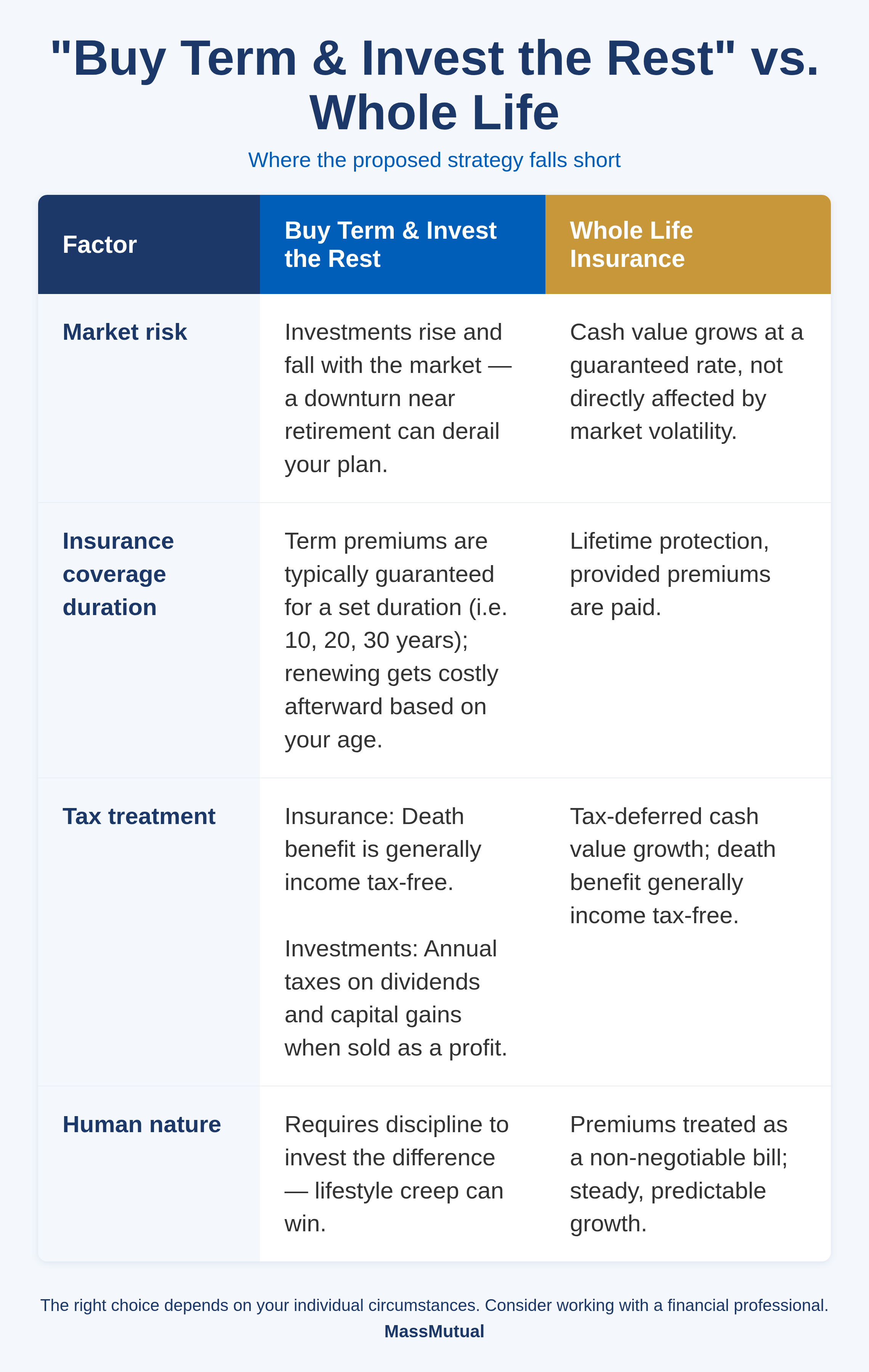
Here’s a closer look at how each of these areas may make “buy term and invest the rest” impractical.
Market risk and timing
Markets – be they stocks, bonds, commodities, alternative investments – go up and down. Sure, over the very long term they have historically tended to produce growth over time. That’s why investing with long -term objectives in mind can be a successful strategy. (Related: Why long-term strategies work)
But markets do go down. Sometimes drastically. And that wallops investments associated with those markets. That’s a risk you generally don’t face with a whole life policy.
And then there’s the timing. A market downturn can be problematic if you are on the cusp of retirement or in retirement and relying on those market investments to provide income. Sure, those investments may recover over time … but do you have the time?
If you don’t, and need the income, then you get hit with the sequence of returns risk problem. Taking money from your investments before they have time to recover will, in fact, hurt their ability to fully recover.
The same sort of need-the-money-now situation can materialize before retirement too.
- Family emergency?
- Unexpected major repair?
- Business opportunity?
Do you tap your investment portfolio before it has time to bounce back from a bear market?
Whole life policies build a tax-deferred cash value, at a rate guaranteed by the insurance company, that you can borrow against or withdraw from while you are still alive, functioning as a predictable buffer against volatility that affects market investments. That can be useful for sudden cash needs or retirement income. 2
Additionally, for participating policies from mutual insurance companies, dividends — while not guaranteed — can further increase both cash value and the death benefit over time. (Related: What goes into whole life insurance dividends)
Yes, the growth rate of cash value in a whole life policy, even with possible dividends, will likely be less than a market-based growth rate over time. But the risk is different, especially when dealing with a reputable established carrier, and the protection for your beneficiaries is in place.
“Investors know that diversification is key, but in a bad market often times there is no way to hide,” said Collins. “When asked what positions he liked during the global financial crisis, a CNBC contributor famously answered ‘there’s only two positions to be in in this market: cash and fetal.’ Neither are a long-term investment strategy, so why not transfer some of your risk onto the balance sheet of an insurance company?”
Term insurance limitations
Term life insurance can be an ideal solution for specific needs, be it immediate family protection to defined debt obligations (like a mortgage or business loan) or even divorce settlements. (Related: Four times when term insurance is the answer)
But term life insurance has limitations. First and foremost, term life insurance premium guarantees expire after a set period (such as 10, 20, or 30 years).
Some term policies do offer a conversion option to permanent insurance, but that comes at a higher premium. (Related: Pros and cons of converting term life to whole life)
Indeed, if you outlive the guaranteed period of a term policy, renewing or converting it may become substantially more expensive due to your older age. If you have developed health conditions, new coverage will likely cost even more or perhaps be unavailable.
By contrast, a whole life insurance policy provides protection for your whole life, provided you meet your premium obligations, of course.
And while you may have purchased a term life insurance policy with a specific obligation in mind — getting the mortgage paid off or the kids on their own — life brings new challenges and responsibilities.
- Perhaps caring for a disabled dependent or aging parent.
- Or maybe you need to plan for high-net-worth estate and inheritance taxes.
Buying a whole life policy gives you the flexibility down the road to address such situations. That “buy term and invest the rest” strategy? Not so much, at least when it comes to providing permanent insurance protection.
Adding to the flexibility difference between term and whole life insurance is cash value. Whole life has it, but term life does not. Which brings up the next major difference area between whole life insurance and the “buy term and invest the rest” approach: taxes.
Connect with a MassMutual financial professional
The tax difference
There are tax-treatment differences between whole life insurance and an investment portfolio.
The cash value inside a whole life policy grows at a rate guaranteed by the carrier on a tax-deferred basis, meaning you do not pay annual income taxes on the increases in your cash value each year.3 You can tap the cash value through withdrawals or policy loans, generally without current income tax, although there are some risks to consider in doing that.2 And the death benefit typically goes to beneficiaries tax-free.
In an investment portfolio that is not part of a qualified retirement plan, you may owe taxes annually on any dividends from your stock holdings or capital gain distributions if mutual funds sell underlying assets. Of course, if you sell holdings yourself, you could trigger a capital gain which would be taxed at up to 20 percent, depending on your income tax bracket. On a more positive note, investments held in a taxable brokerage account may benefit from a step-up in cost basis when inherited. So, your heirs' cost basis is "stepped up" to the market value of the assets at the time of your death, which may eliminate capital gains taxes on growth that occurred during your lifetime.
While neither whole life insurance nor an investment portfolio has uniformly "better" tax treatment, they have different tax treatments. The different approaches offer distinct advantages depending on how and when you access the money. So, which is “better” will depend on your circumstances. Indeed, for some, a combination of the two may be the ideal answer. (Learn more: Tax diversification strategies explained)
Human nature
Successful investing takes work and discipline.
- Researching circumstances and factors affecting specific investments, plus staying abreast of news developments, involves time and concentration.
- Sticking with investment plans in the face of market ups and downs, or perhaps sudden personal money needs, requires willpower and discipline.
Often many people fall short. And there are likely good reasons for that. Career and family, after all, often are the higher priority when it comes to time and money.
So, when it comes to “buy term and invest the rest,” the latter part of the mantra will require more dedication than many people can spare. It may be worth noting that this advice often comes from market observers and commentators who have a vested interest in maintaining a steady audience coming to them for investment advice. Of course, this criticism is coming from a life insurance company, so take all with a grain of salt.
“The vast majority of people do not ‘invest the difference,’” observed Collins. “When a new client comes to me, almost all have a company-sponsored retirement plan that they contribute to, and many own their home. That is what we have been conditioned to do — have an emergency fund, own your home, and optimize your retirement savings. Typically, every other dollar that is earned gets spent.”
And, obviously, even with a large amount of dedicated time and iron-cast discipline, there is no guarantee of success. As noted earlier, markets go up and down. And the returns on your investments will go up and down with them.
But the growth in a whole life insurance policy’s guaranteed cash value is predictable, whether the market goes up and down. Will the growth in cash value be as much as a bull market year? Perhaps not. But it’s steady and predictable growth.
On a more pragmatic level, will people actually invest the expected monthly premium savings? There’s a good chance the extra cash will fall victim to lifestyle creep and get absorbed into everyday spending.
So “invest the rest” is not necessarily as easy or successful a tactic the glib “buy term and invest the rest” advice makes it out to be.
On the other side of the human nature coin, buying a whole life insurance policy can be viewed as a “one and done” kind of exercise at the outset. And since policyowners are likely to view premium payments as a critical, non-negotiable bill, they may be more likely to stick to the protection and long-term wealth accumulation plan. That assumes, of course, that you can continue to make the required premium payments.
“I have found that most people look at insurance as a bill, and people pay their bills,” Collins agreed. “Through a sort of magic that cannot be created through spreadsheets and models, those policyowners who commit to a whole life strategy make it happen and save those dollars into their cash value policies.”
Additionally, for policies with contractually level premiums, those premiums are locked in when you buy the policy and won’t increase due to changes in your age or health.
And more whole life advantages
As touched on briefly above, whole life insurance can play a role in estate planning that a combination of term life insurance and stock portfolio may not address in the same way.
This is due in large part to tax advantages. Death benefits from a whole life insurance policy are generally received by beneficiaries free of income tax, cash value grows tax-deferred, and policy loans are generally not taxable while the policy remains in force.
So whole life insurance may be useful for handling possible estate tax or estate equalization situations.
Additionally, usually through the addition of riders, whole life insurance can provide living benefits that can help with longevity challenges. (Related: What are living benefits in a life insurance policy?)
Conclusion
So, in the face of market volatility, term life insurance limitations, tax treatment, and human nature the idea of foregoing whole life insurance in favor of “buy term and invest the rest” has potential disadvantages.
As noted, whole life insurance can provide cash value accumulation not directly affected by market ups and downs, permanent coverage, different options on taxes, and a pragmatic structure for avoiding human foibles when it comes to finances. Of course, whole life generally also has higher premiums than term insurance, and cash value may be limited in the policy’s early years.
Does all this mean term insurance and investment are useless? Certainly not. As noted at the outset, term insurance can be the answer for specific needs. Indeed, some people ladder in different types of life insurance to solve for different personal coverage and estate planning challenges. And investing is a central part of any long-term wealth building plan.
“Getting one's house in good order with a moat around the castle and a clicker for the draw bridge is peace of mind,” said Scruggs. “It will give you confidence and is the right thing to do for yourself, family, company employees, and the community. Not having a plan in our capitalist system, with ‘i's’ dotted and ‘t'’s crossed, is unfair to everyone.”
So that overall financial plan should include both investing and protection, where perhaps the coverage offered by whole life insurance may offer a suitable solution. For some, there may be no substitute for permanent protection that whole life insurance provides.
_____________________
Frequently Asked Questions about "buy term and invest the rest" vs. whole life insurance
Q. What does "buy term and invest the rest" mean?
A. It's a strategy where you buy a lower-cost term life insurance policy and invest the premium savings (the difference between term and whole life costs) in the market. The idea is that your investments may grow enough to replace the cash value that whole life would have built.
Q. Is "buy term and invest the rest" a good strategy?
A. It can work in theory, but it may fall short in practice due to market volatility, the expiration of term coverage, tax differences, and the discipline required to consistently invest the savings. Depending on an individual’s circumstances, an appropriate approach may be a combination of term and permanent coverage instead.
Q. What is the main problem with buying term and investing the rest?
A. One potential obstacle is human nature — some people don't actually invest the savings, and those who do face market risk and timing issues that can derail their plan, especially near retirement. Whole life insurance, by contrast, offers guaranteed cash values and lifetime protection provided required premiums are paid and the policy remains in force.
___________________
Discover more from MassMutual …
Life insurance and annuity alternatives in investing
Whole life insurance benefits through every life stage
Is your financial plan holistic? 6 questions you should ask
________________________
1 Guarantees are subject to the terms of the policy, payment of required premiums, and the claims-paying ability of the issuing insurance company. Dividends are not guaranteed.
2 Accessing the cash value of a life insurance policy reduces its cash value and death benefit and increases the chance the policy will lapse. If a policy lapses with an outstanding loan in excess of the cost basis, the excess is taxable. Cash value may be limited, particularly in the policy’s early years.
3 This assumes a policy that has not been turned into modified endowment contract, which would change its tax treatment.