
| ||||||||||||

Filing a life insurance claim is an essential step in securing the financial benefits owed to beneficiaries after the policyowner’s death. The process begins when the beneficiary or another entitled party informs the life insurance company of the policyowner’s passing and submits the necessary documentation. The insurance company then reviews the claim and, if validated, pays out the designated death benefit.
Understanding this process can help ensure a timely and successful outcome.
Why is timely filing important for life insurance claims?
Time is of the essence when filing a life insurance claim. Prompt and accurate submission ensures that beneficiaries receive funds when they likely most need them and reduces the risk of claim denial. Late or incomplete filings can result in unnecessary delays or, in rare cases, even the forfeiture of benefits. Diligence in gathering documents and following the insurer’s guidelines will help avoid common pitfalls.
A financial professional can be helpful in this process, both in terms of helping guide the claim as well as how to handle the death benefit.
Connect with a MassMutual financial professional
Who can file a life insurance claim?
Named beneficiaries. Most life insurance policies designate one or more beneficiaries, who are the primary individuals authorized to file a claim. The beneficiary may be a person, trust, or organization named in the policy documents. These individuals or entities generally have the direct legal right to request the death benefit.
Trustees, executors, and legal guardians. If a trust is the beneficiary or if the named beneficiary is a minor, a trustee, executor, or legal guardian may file the claim on their behalf. These representatives handle the process to ensure that the proceeds are distributed as intended by the policyowner.
Other legally entitled parties. In rare cases where no beneficiary is named, or if all beneficiaries have predeceased the policyowner, the proceeds may go to the policyowner's estate. In such situations, the executor of the estate can file a claim. State laws and the policy's terms determine who is legally entitled to file.
Documentation
You will need to have certain documents ready when filing your claim. These include …
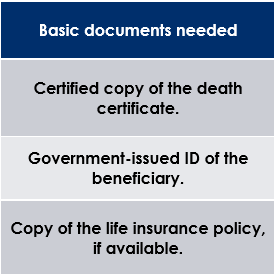
Additional Documents for Special Cases: Depending on the policy or circumstances, you may also need medical records or a coroner’s report (particularly for accidental deaths), the policyowner’s proof of age (birth certificate), proof of legal authority (for trustees, executors, or legal guardians), or marriage certificates or divorce decrees (if marital status impacts the claim).
Filing the life insurance claim
Locating the policy and insurer. Begin by locating the most recent version of the life insurance policy and identifying the insurance company. This information is often found among the policyowner’s important documents, with their attorney, or through the employer if it’s a group policy.
Obtaining certified death certificates. Most insurers require one or more certified copies of the policyowner’s death certificate as proof. These can be requested through the vital records office in the state where the death occurred. It’s typically wise to order several copies for multiple claims and related estate matters.
Completing and submitting claim forms. Many insurers have online options for filing a claim. Or you can reach out to the insurance company to obtain their claim packet, which includes required forms and instructions.
You can find MassMutual’s online claim form here or contact 1-800-272-2216.
Accurately complete the forms, attach the certified death certificate, and provide any additional information requested by the insurer. Submit all materials according to the insurer’s guidelines, either online, by mail, or via your financial professional.
How long does a life insurance claim take? Most life insurance claims are processed within 30 to 60 days, though simple claims can be resolved faster. However, if the death occurred during the policy's contestability period (typically the first two years), the review may take longer as the insurer conducts additional verification related to application accuracy.
How beneficiaries receive payouts
When filing a claim, beneficiaries may need to select how they wish to receive the payout. Options typically include a lump-sum payment, installment payments, or an annuity, depending on the policy. Be sure to review each option with your financial needs in mind, and consult a financial professional if necessary. (Learn more: You received a life insurance benefit: 8 ways to use it wisely)
Lump sum, installments, and annuities. Beneficiaries can usually choose to receive the death benefit as a one-time lump sum, as set installment payments, or as an annuity providing income over time. Review the options offered by the insurer to select the best fit for your financial situation. Here, too, a financial professional can offer some guidance.
Multiple beneficiaries and estate payouts. If multiple beneficiaries are named, the payout is divided according to the policyowner’s instructions, either equally or by specific percentages. If the estate is the beneficiary, the payout goes through the estate settlement process and may be subject to probate. (Related: How to help heirs)
Tax implications of payouts
Generally, life insurance death benefits received by individuals are tax-free. However, interest earned on delayed benefits or proceeds paid to estates can be taxable.
Consult a tax advisor or the IRS website for guidance on your specific situation. (Learn more: Exceptions to the tax-free treatment of life insurance)
Common reasons for claim denial
Incomplete or incorrect information. Mistakes or omissions on claim forms are a common reason for delays or denials. Double-check all information and ensure that required documents are attached. (Related: Common beneficiary mistakes)
Late filing and reporting issues. Most policies request prompt notice of the policyowner’s death. Delays in filing may complicate or invalidate claims, so start the process as soon as possible.
Coverage and documentation problems. Claims can be denied if the policy lapsed due to unpaid premiums, if the death occurred during a contestability period, or if required documentation is missing. (Related: The danger of lapses)
Review the policy and ensure that all supporting documents are provided.
Appealing a denied claim
If your claim is denied, request a detailed explanation in writing from the insurer. Gather any missing information, correct errors, and submit an appeal following the insurer’s process. If necessary, seek professional or legal assistance. (Related: What happens if you lie on a life insurance application?)
What to do if your claim is delayed
Contacting the insurer and providing missing documents. Delays often happen when documents are missing or incomplete. Immediately contact the insurer to ask what is needed and supply any outstanding paperwork.
Keeping records and following up. Keep detailed records of all correspondence, forms submitted, and phone conversations with the insurance company. Follow up regularly to track your claim’s status.
Escalating within the company and filing complaints. If the delay continues, escalate your concerns to a supervisor or the insurer’s customer advocacy team. Each state’s insurance commissioner’s office can help you file a formal complaint if necessary.
Considering legal assistance. If all else fails, consult an attorney experienced in insurance disputes. Legal intervention can sometimes expedite the claim process or resolve unjust denials.
Next steps after an insured’s death
Filing a life insurance claim is only one part of handling the passing of a loved one.
There may be other needs. The deceased may have multiple life and supplemental insurance policies. And if the payout is directed to an estate, you may have to coordinate closely with the executor to handle claims and distribute proceeds according to the will or state law.
Conclusion
Filing a life insurance claim can seem daunting, but armed with the right information and documents, beneficiaries can ensure a smooth and timely process. Always check with your insurer for specific requirements and seek professional advice if challenges arise.
__________________
Frequently Asked Questions about filing life insurance claims
Q. What happens if I miss a document when filing?
A. Missing documents are one of the most common reasons for claim delays. If your submission is incomplete, the insurance company will contact you to request the missing items. Respond promptly to avoid unnecessary delays. Keep detailed records of all communications and follow up regularly if you don't hear back within two weeks of submitting additional documents.
Q. Can a life insurance claim be denied after years of paying premiums?
A. Yes, claims can be denied even after years of premium payments, though this is relatively uncommon. The most frequent reasons include policy lapse due to nonpayment, material misrepresentations on the application discovered during the contestability period, or death resulting from policy exclusions (such as specific high-risk activities). Maintaining current premiums and keeping beneficiary information updated helps prevent most claim issues.
Q. How long does it take to process a life insurance claim?
A. Most life insurance claims are processed within 30 to 60 days after the insurance company receives all required documentation. Simple, straightforward claims may be resolved even faster, sometimes within two weeks. However, claims during the policy's contestability period (typically the first two years) may take longer due to additional verification requirements.
Discover more from MassMutual …
What to do when your mom or dad dies
Parents to adult kids: Estate planning matters
What happens to a person's debt when they die?
_____________________________