
| ||||||||||||

Want to give up the protection and security you gained when purchasing a life insurance policy? Let it lapse.
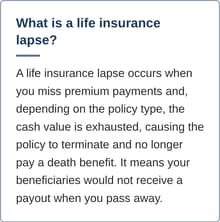
Simply put, a lapse occurs when premium payments on a life insurance policy are missed and, depending on the type of insurance, the cash value is exhausted. “Lapse” is shorthand for a “lapse in coverage,” which means the policy will no longer pay a death benefit for the insured person.
At the other end of the spectrum is a paid-up policy, where all the premium obligations have been met and the policy remains in force for the rest of the insured’s life. We have a 76-year-old example below.
Grace periods for lapsed life insurance
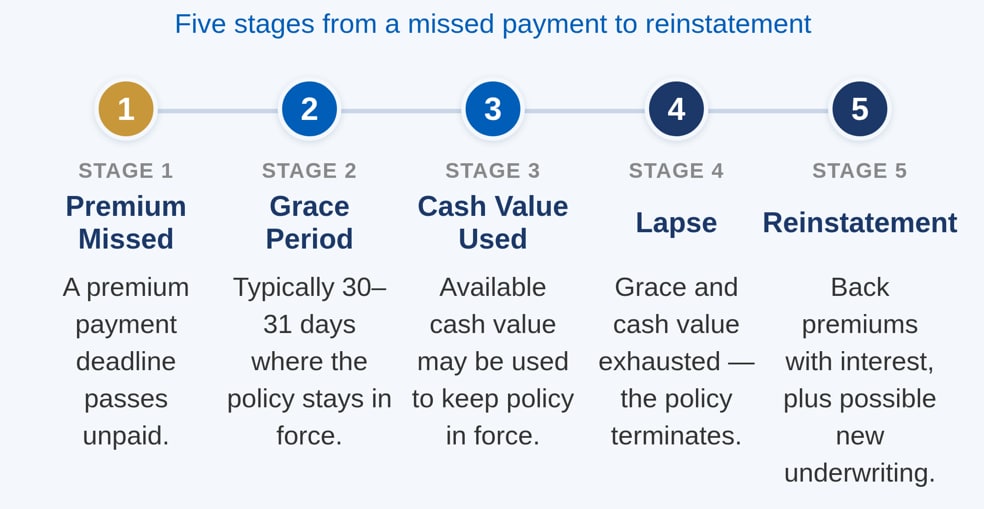
A missed payment doesn’t necessarily mean immediate termination of a policy. Life insurance policies often have a grace period — typically about 30-31 days — after a missed payment where the policy is still in force or at least offers some limited benefit.
For whole life insurance policies, missed premium payments are sometimes automatically covered by loans from the cash value to keep the policy in force. These are called automatic premium loans and typically have to be elected when the policy is purchased. Other types of insurance, like universal life, will generally also tap into any account value to keep the policy in effect. (Related: Understanding different types of permanent insurance)
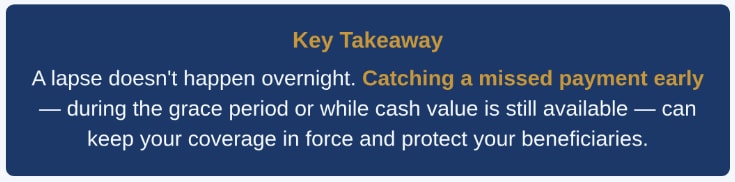
But once grace periods have passed and possible cash value is used up, a lapsed policy will terminate and the life insurance benefits will be gone. If a policy lapses while a loan from the cash value is still outstanding, the amount of the loan above what you paid in premiums could be taxed as income. (Related: Exceptions to the tax-free treatment of life insurance)
Setting up automatic premium payments or working with a financial professional to review your coverage annually can help you avoid missing payments. (Related: Life insurance premium options: Which one is right for you?)
Can a lapsed life insurance policy be reinstated?
Sometimes, depending on the type of life insurance and its terms, there are opportunities to reinstate the policy.
How does that happen?
- At a minimum, missed premiums have to be made up with interest.
- Also, depending upon when the policy is reinstated, new underwriting may be required, meaning that the insurance company will reassess your insurability.
Given age and possible health changes, the underwriting process could affect your ability to reinstate the policy. In fact, the situation might amount to simply buying a new policy with a higher premium.
So, a lapse not only can result in a loss of protection, but it can also mean having to pay more to get that protection back.
Life insurance lapses by the numbers
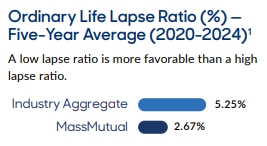
Nevertheless, lapses do occur. One recent analysis put the ratio of overall life insurance lapses at about 5.6 percent, a decline from previous years.
The lower a lapse ratio, the better, since it indicates, in part, that fewer people may have been dissatisfied with their policy or the carrier’s service.
Of course, sometimes there are justifiable reasons for letting a policy lapse.
For instance, term policies, which offer coverage for a specific period of time, are sometimes used to protect against a specific risk, like a mortgage or business loan. Once that obligation is over — the mortgage paid off or the loan repaid — that insurance may no longer be necessary. (Related: 4 times when term insurance may be the answer)
That’s why certain types of insurance have different lapse rates.
Life insurance policy longevity
A study of historic data by LIMRA, a life insurance industry group, and the Society of Actuaries found that the lapse rate of whole life insurance was about half that of term policies.2
“Whole life insurance is a powerful tool for so many reasons,” said J. Todd Gentry, a financial professional with Synergy Wealth Solutions in Chesterfield, Missouri. “It is a guaranteed contract, and as long as premium commitments are met, it will not lapse. Of course, this necessitates that wise decisions at purchase be made, like staying within your budget and building a plan that can grow with you.”
Connect with a MassMutual financial professional
Indeed, as of December 31, 2024, the latest tabulation available, almost 125,000 life insurance policies have been with MassMutual for more than 50 years. If you think a family member may have had a life insurance policy that lapsed or was lost, there are ways to track it down. (Related: Lost life insurance policy? Here's how to find it)
In fact, MassMutual as recently as 2021 paid a death claim on a policy written back in World War II. It was bought in 1943 by a mother for her 17-year-old son, who soon joined the U.S. Army’s 42nd Infantry Division, commonly known as the “Rainbow Division.” That unit ended up being one of the primary units driving into Germany and Austria in 1944 and liberating the infamous Dachau concentration camp in April 1945.
“He was a 93-year-old guy and pretty cool,” said Brandon Jordan, a financial professional with the Arch Advisory Group in Atlanta, Georgia. “He was a veteran and served his country bravely, winning two Bronze Stars and a Purple Heart. And he was devoted to his family. He had over 70 years to surrender the policy and take cash, but he cared more about his family than doing so. And not too many insurance companies have policies that are more than 76 years old.”
The policy originally had a face value of $1,000. But, owing to dividends over time, ended up paying out about $15,000.
And all because the policy didn’t lapse.
__________________________________________
Frequently Asked Questions about life insurance lapses
Q. What is a life insurance lapse?
A. A life insurance lapse occurs when you miss premium payments and, depending on the policy type, the cash value is exhausted, causing the policy to terminate and no longer pay a death benefit. It means your beneficiaries would not receive a payout when you pass away. (Related: A complete guide to understanding life insurance)
Q. How long is the grace period for a life insurance policy?
A. Most life insurance policies offer a grace period of 30 to 31 days after a missed premium payment, during which the policy remains in force or provides limited benefits. If you pay the missed premium within this window, your coverage continues without interruption.
Q. How can I prevent my life insurance policy from lapsing?
A. Setting up automatic premium payments, budgeting for your premiums, and reviewing your coverage annually with a financial professional can help you avoid a lapse. If you're struggling to make payments, contact your insurer to explore options like adjusting your coverage or using cash value.
______________________________
Discover more from MassMutual …
Single? Reasons you might still need insurance
Understanding life insurance policy riders
Estate planning and keeping a farm in the family
This article was originally published in October 2021. It has been updated.
_________________________________________
1 “Ordinary life,” in statutory annual statement terminology includes individual life insurance policies but excludes industrial, credit life, and group life policies. Ordinary life lapse ratio is the five-year average of lapses and surrenders as a percentage of average face value of life in force. Lapses and surrenders occur for a variety of reasons, including failure to pay premiums, cancellation of a policy, etc. Ordinary life lapse ratio compares the amount of ordinary life insurance face value lapsed or surrendered during a time period to the average amount of face value in force during that time period. Source: NAIC Statutory Insurance data, sourced from S&P Capital IQ Pro (as of 12/31/2024) on a group basis which includes parent and life subsidiaries adjusted with eliminating entries by SNL where relevant.
2 LIMRA, “2015-2022 Term and Whole Life Insurance Policy Surrender/Lapse Experience Study Report,” December 2024.