
| ||||||||||||

Each year, the Social Security Administration (SSA) announces changes to its system. The announcements about these changes come at different times.
- Some major changes were made in 2026 and are in place now, with ramifications for the year ahead.
- Other changes will be in place announced in October that will start 2027.
Here’s a review of the significant moves.
2026 changes to know
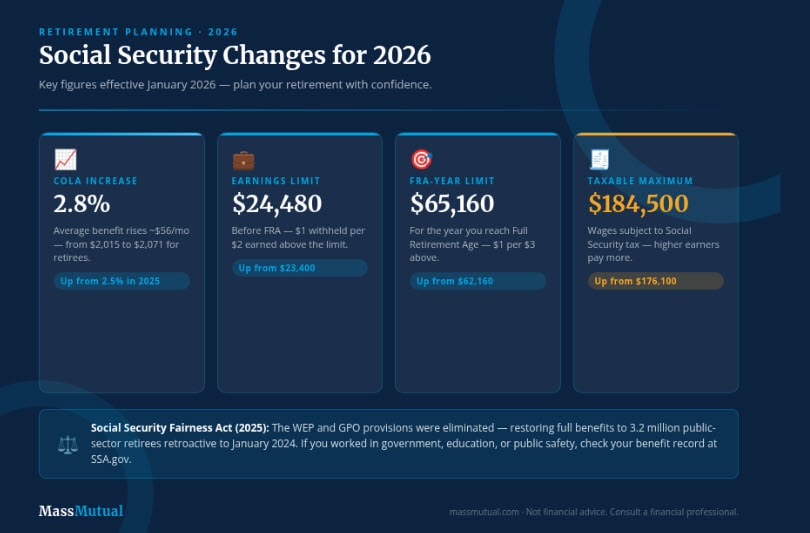
By far the most significant change to Social Security started on January 5, 2025 when the “Windfall Elimination Provision” and “Government Pension Offsets” were sunset into history. The Social Security Fairness Act dramatically changed benefits and increased payments for millions of people across the country. (Learn more: Worked for government? Check your Social Security benefits)
Connect with a MassMutual financial professional
Still many workers might not know if they qualify for these enhanced benefits and will need to apply in 2026 to be sure. If you need more information about this gigantic change in the rules, visit this page on SSA.gov.
There were also some calculation changes that may have boosted benefits for some recipients in the fall. (Related: Did your Social Security check just go up?)
In September the SSA converted to direct bank deposit payments for people collecting their benefits via physical paper checks. For those few who do not have bank accounts, the SSA now provides a Direct Express card.
Additionally, the SSA has a reengineered web site, www.ssa.gov. This new design is super helpful because it is goal based and makes the site easier to navigate.
Changes for 2026: COLA
One of the most watched announcements SSA makes for the coming year is the cost-of-living (COLA) benefit increase. For 2026, it’s 2.8 percent. The initial projection for 2027 is something north of 3 percent.
It is important to not look at the 2026 COLA increase as a one and done single-year event. Rather it is helpful to look at the past five years of COLA increases to realize how important the COLA increase are to retirees, disabled workers, and dependents.
- In 2022 the Social Security COLA increase was 5.6 percent.
- In 2023 it was 8.7 percent.
- In 2024 it was 3.2 percent.
- In 2025, it was 2.5 percent.
- In 2026 it was 2.8 percent.
This represents a significant increase in benefits over the past six years. Very few sources of income for retirement, disability, or dependent benefits have increased by these amounts.
By contrast, regular defined benefit pensions offered by private companies rarely offer any type of COLA increase and if they do, the increase might hover in the 1 percent to 2 percent range. When you compare a private-company pension 6-year increase of 2 percent a year (if any increase exists at all) to the increases to Social Security, it is easy to see the tremendous value of Social Security to all of its recipients.
The deferment equation
- In addition, this COLA increase is always made on top of any delayed retirement credits earned by retirees who defer their start dates passed their full retirement age.
- The formula for delayed retirement credits is 8 percent per year simple interest between full retirement age and age 70. These increases are not market dependent.
- For workers who elect to defer their payments, the lift in benefits is greatly enhanced by the COLA increases which last for a lifetime.
- Plus, these increases are passed on to survivors who qualify for those benefits. Social Security payments either stay the same or go up. They never go down.
More 2026 changes
The maximum taxable earnings test is higher in 2026. The new amount is $184,500 which means that higher income earners will be paying more into the Social Security system.
That might sound like bad news for some higher earners because they are going to pay more FICA taxes, but this increase is offset by higher benefits in retirement. Remember that the size of retirement benefit is calculated based on the highest 35 years of a worker’s career contributions to the system. As the maximum taxable earnings limit is increased, 35-year average will also increase which in turn will increase the size of the retirement check.
To qualify for retirement benefits a worker must have earned 40 credits over a 10-year period of time. In 2026 to earn a credit a worker must earn $1,890 in reportable income. This is up slightly from the $1,810 required in 2025.
Without the 40 credits needed, a worker cannot receive any benefits based on their own work record. So, it pays to track your credits and be sure you are on track to 40.
Finally, one of the most often asked questions asked about taking Social Security benefits focuses on the “Retirement Earning Test Exemption” amounts. These amounts will index up in 2027.
- The earning test exemption increases in 2026 to $24,480 starting at age 62.
- The year a worker turns full retirement age the earnings test increases to $65,160.
When a worker reaches the month of their full retirement age the earnings test is no longer an issue.
The “Retirement Earnings Test Exemption” is an effective block to workers who want to start their Social Security benefits early before full retirement age yet continue to work. (Related: Can I work and still receive Social Security benefits?)
Here is a link to the specifics on the Earnings Test Exemption.
Conclusion
The Social Security system will continue to evolve in 2027 as it did in 2026. As with other government programs, it will be subject to changes. It will be interesting to follow the progress of changes into the New Year. If you have questions about your benefits and need help, be sure to ask the SSA or your financial professional. As the saying goes “It is always best to make informed important decisions on purpose and not by accident.”
______________
Frequently asked questions about Social Security changes
Q: What is the Social Security Fairness Act, and does it affect me?
A: If you spent part of your career as a teacher, police officer, firefighter, or other public-sector employee, this change could be significant. Signed into law on January 5, 2025, the Social Security Fairness Act eliminated two long-standing rules — the Windfall Elimination Provision (WEP) and the Government Pension Offset (GPO) — that had reduced or eliminated Social Security benefits for millions of Americans who also received a government pension.
Q: Where should I start if I want to understand how these changes affect my retirement plan?
A: Start by confirming your own FRA at SSA.gov and reviewing your Social Security statement, which estimates your benefit at various claiming ages based on your actual earnings history. Certain types of public-sector workers may qualify for enhanced benefits under the Fairness Act, check whether an adjustment has been applied to your record — and apply in 2026 if you haven't already.
Q: What is Full Retirement Age, and has it changed?
A: Full Retirement Age (FRA), the point at which you receive your complete, unreduced Social Security benefit, is continuing to phase up to age 67 for anyone born in 1960 or later. Claiming Social Security before your FRA locks in a permanently reduced benefit, while delaying past FRA (up to age 70) earns you delayed retirement credits that can meaningfully increase your monthly payment for life.
Discover more from MassMutual …
Preparing for the Social Security funding dilemma
Understanding Social Security benefits for spouses
How much Social Security will you get? The 4 big drivers
_________________