
| ||||||||||||

Are you 50 or older and have FICA wages of more than $150,000 in 2025? And do you make catch-up contributions to a 401(k) or 403(b) qualified retirement plan?
You are in for a change. Starting in 2026, those catch-up contributions will have to be made to a Roth 401(k) or Roth 403(b) with after-tax dollars.
High earners in their peak retirement savings years should consider taking this time to review their contribution options and evaluate the tax planning impact of this new rule with their financial professional and tax advisor.
Connect with a MassMutual financial professional
In 2025, if you were 50 or older you could maximize your 401(k) contributions to $23,500, and $7,500 in additional catch-up contributions. Those contributions were made on a pre-tax basis, meaning the money is directed into your qualified plan from your paycheck before taxes. Any earnings accumulate on a tax-deferred basis, until you take them out. Then comes the tax bill.
Additionally, because those catchup contributions come out of your paycheck before taxes, it reduces your income taxes today.
But starting in 2026, if you are 50 or older and wages more than $150,000 in 2025, any catch-up contributions you make must become Roth 401(k) or Roth 403(b) contributions. So, your qualified retirement plan will now have a Roth component along with your pre-tax holdings.
Workers aged 60–63 can make a higher "super catch-up" contribution of $11,250 in 2026 (above the base limit), but this must be a Roth contribution if they are considered a high earner.
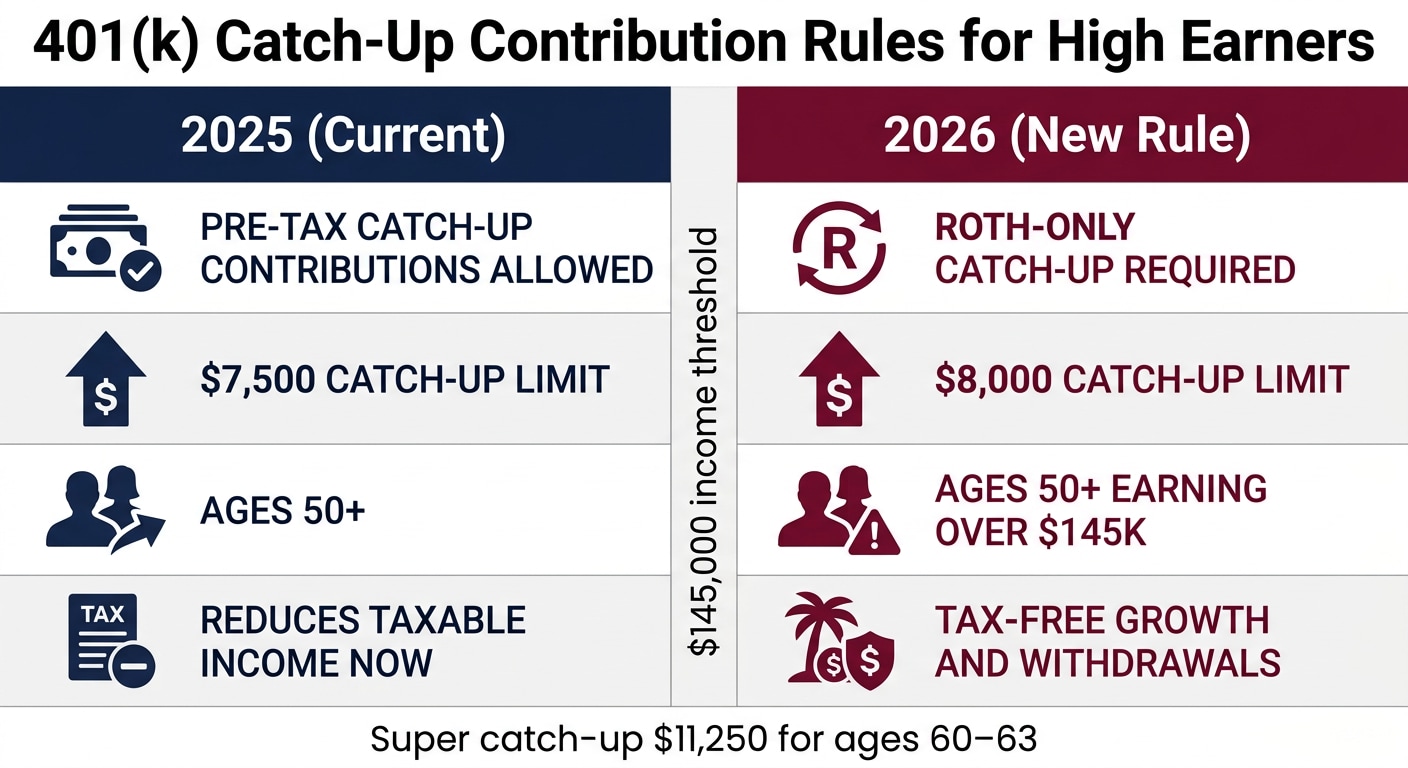
With Roth 401(k) accounts, the contribution gets taxed first. But any earnings on those after-tax contributions accumulate tax free and qualified withdrawals – typically made after age 59 ½ and a five-year holding period – can be tax free.
So, what is the overall effect of this change?
- It’s bad news in terms of your tax treatment today. Why? It means you are required to pay taxes on part of your retirement savings now when you’re likely in a higher tax bracket than you would be in during your retirement years. And, because you will not receive an upfront tax deduction on your catch-up contribution, it means more of your income will be subject to ordinary income tax starting in 2026. That essentially reduces your immediate income.
- On the positive side, those catch-up contributions making up the Roth portion of your retirement plan have the potential to grow tax free and can be withdrawn tax free once you meet age and holding period conditions for retirement. Another plus is that Roth accounts don’t have required minimum distribution requirements, so your savings can continue to potentially enjoy tax-free growth for longer.
“Many individuals with significant retirement account balances find that it is beneficial to make some or all of their retirement contributions into a Roth account whether or not required by the tax laws,” noted Al Kingan, an expert in estate and business planning for MassMutual.
Many workplace retirement programs offer a Roth option. But if your plan does not, you won’t be able to make catchup contributions if you are a high earner, even if you are over 50 years of age.
The catchup contribution change is the result of the Secure Act 2.0 retirement legislation that passed Congress in 2022, which contained numerous adjustments to the tax treatment of retirement savings.
This change will apply not only to 401(k) programs, but also to other qualified retirement programs like 403(b), 457(b), Simplified Employee Pension Plan (SEP) plans.
The $150,000 income figure is based on wages subject to Social Security and Medicare taxes in 2025, indexed for inflation in future years.
Despite the change in immediate tax treatment, the addition of Roth-based savings may prove to be a boon for some retirees.
“Post-retirement planning opportunities are enhanced when you have a choice to take some of your retirement plan distributions out of a non-taxable account,” Kingan noted.
_________________________
Frequently Asked Questions about the new catchup requirement
Q. Does the high-earner income threshold apply to my total household income or just my salary?
It applies only to your individual FICA wages — specifically the Social Security wages shown in Box 3 of your W-2 — from the same employer sponsoring your retirement plan. Your spouse's income, investment income, or wages from a second job at a different employer don't count.
Q. What happens if my employer's 401(k) plan doesn't offer a Roth option?
If your plan doesn't include a Roth 401(k) feature and you earn over the threshold, you simply cannot make catch-up contributions at all starting in 2026 — there is no pre-tax workaround.
Q. Is switching to Roth catch-up contributions actually bad for me financially?
It depends on your time horizon and anticipated tax situation in retirement. The immediate downside is real: you lose the upfront tax reduction on the catch-up amount, which raises your taxable income today. But the long-term upside can outweigh that cost. Because qualified Roth withdrawals are tax-free, high earners who expect to stay in a high bracket in retirement — or who want to leave tax-free assets to heirs — can come out ahead. A financial professional can model both scenarios against your specific tax profile to compare hypothetical after-tax outcomes over time.
_________________
Discover more from MassMutual …
How is annuity income taxed? It depends
6 year-end tax-planning strategies worth trying
How life insurance can help supplement retirement income
This article was originally published in November 2025. It has been updated.
____________________