
| ||||||||||||

Receiving an early retirement offer means that you’ve been presented with a life-changing decision.
- Should you take the offer and stop working for good?
- Decline it and hope layoffs aren’t on the horizon?
- Negotiate for a better deal?
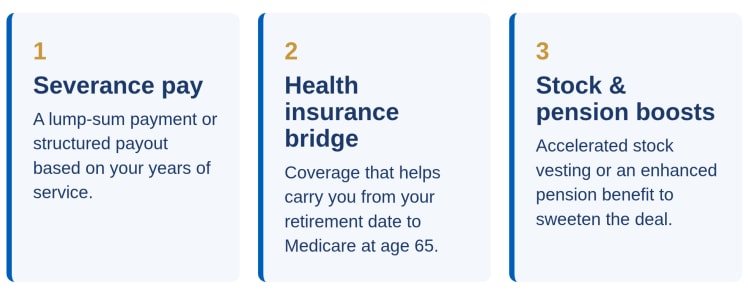
The answer obviously depends in large part on what’s in the early retirement offer. A typical early retirement package may include:
Whether you’re wowed or disappointed by the offer, and whether you were expecting it or it came out of nowhere, there’s an emotional component to all of these answers, for sure. But the emotions may be easier to manage if you first determine the financial answers to these questions.
“If you don’t have any personal financial projections, then you cannot make an educated decision — it’s like flipping a coin,” said Juan Diego Ramirez, CEO and wealth advisor with Ram Capital Group in Peachtree Corners, Georgia. “It’s important to evaluate the offer with real data and account for your cost of living, health care, Social Security, retirement accounts, taxes, and insurance.”
Why do companies offer early retirement?
“Typically, an early retirement offer is an opportunity that an employee can choose to accept or decline when a company wants to incentivize employees to take retirement from employment,” said Robert Bird, professor of business law at the University of Connecticut. “It’s a carrot instead of a stick.”
Many people who have received these early retirement offers wonder how much choice they really have. They wonder if by declining, they will just end up getting laid off, and if this offer could be the best one they ever get.
“That's a reasonable concern,” Bird said. “Employers may prefer early retirement offers to preserve company morale or to have the employee agree to specific terms and conditions in exchange for receiving the retirement package. It can also be an extra nudge for employees who have been contemplating retirement anyway.”
An early retirement package is not only better for the people receiving it; it can be better for the company as a whole.
“A layoff sends a strong and negative signal to other employees at the company that maybe they will be next,” Bird said.
At the same time, “It’s fair to think you might get laid off anyway if they are offering you early retirement,” said Seth Kamens, CPA, managing member of Kamens & Associates, a full-service accounting and consulting firm based in Livingston, New Jersey. “There’s most likely a reason they’re offering it to you. If they’re getting rid of a division, your job will be in jeopardy one way or another.”
Can you negotiate an early retirement offer?
“If they are asking you for early retirement, to a degree there is leverage on your end and to a degree there is leverage on theirs,” Kamens said.
Your ability to negotiate “depends on the rationale for the severance and how long you’ve been there,” he said.
“Most people don’t think they can negotiate it,” Kamens said. “Not that you should be pushing too hard, but you’re allowed to have conversations, especially if you’ve been there a long time. Worst-case scenario, you’re no worse off.”
Here are some points you might want to negotiate if not already included in the early retirement package being offered to you:
● Health insurance coverage: To narrow the gap between your early retirement date and Medicare eligibility, you might request employer-paid COBRA premiums, a health reimbursement arrangement, or a later departure date that makes you eligible for the company’s retiree health benefits. Note that this may have income tax implications for you.
● Stock compensation: Depending on corporate policy and plan details, your employer may be able to accelerate vesting or adjust your termination date so you become eligible for more stock compensation or more favorable tax treatment.
● Waiver of noncompete or restrictive covenant clauses: Even if you plan to stop working, you don’t want to be limited by a noncompete clause if a new opportunity comes along, Kamens said.
● Timing of severance payments: A lump sum received in a year when you’re already working can be heavily taxed as ordinary income. Depending on the plan, receiving your severance pay the year after you leave your employer could lower your tax bill.
● Recipient of severance payments: By starting an LLC and having your employer pay your severance to your LLC as consulting income rather than employee wages, Kamens explained, you (and possibly your spouse) may be able to make a large contribution to a small-business retirement account that gives you significant tax savings. Of course, tax strategies depend on individual circumstances and often a tax expert should be consulted.
● Outplacement services: If you are willing to leave your job but aren’t ready to retire, outplacement services, such as career coaching, interview coaching, resume help, and access to recruiters, could help you plan your next move.
● Payout of employee benefits: Ask if accrued PTO, bonuses, commissions, or incentive compensation will be paid as part of the early retirement package. Ask about options to continue or convert any existing group life insurance, disability coverage, or legal benefits.
Keep this in mind: Employers must carefully structure their voluntary separation programs to avoid discrimination claims. These legal concerns may limit what they’re willing to negotiate.
Calculating your monthly retirement paycheck
Whether it’s your entire retirement savings or an early retirement payout, a large amount of money can feel like an abstract concept.
“Few people understand how to translate a lump sum into a reliable retirement income without the risk of running out of money,” said Richard Sterling Price, a financial planner and investment advisor with Coastal Wealth in Fort Lauderdale, Florida.
These projections involve assumptions about how long you will live, how healthy you will be, what your cost of living will be, what investments you’ll be comfortable holding, and how those investments will perform over time. (Related: Portfolio withdrawal strategies)
A financial professional uses their specialized training, years of client experience, and professional software to stress-test different scenarios, show you a range of possible outcomes, and suggest solutions to potential shortfalls so you can enjoy the retirement lifestyle you want.
Connect with a MassMutual financial professional
“I help my clients evaluate their situation with real data so when they have seen the numbers, they can make a good decision — they can say yes, no, let’s negotiate, let’s work for a couple more years and renegotiate down the road,” Ramirez said.
Planning for taxes and health insurance
The best outcomes often come from working with both a CPA and a financial professional who will talk with each other.
“In my experience, CPAs and accountants are more like historians — they document what you have already done and fill out the tax forms in a way to hopefully reduce your taxes due in any given year,” Price said. “It’s important to meet with a good financial planner who can help you know what to do to reduce your future taxes.”
One of the biggest concerns people have about leaving the workforce is health insurance. How much will it cost, and how will that plan’s benefits compare with those they currently receive through their employer? Barring a serious disability, Medicare eligibility doesn’t begin until 65, so accepting an early retirement offer means solving the health insurance puzzle.
Your best options might include:
● Staying on your employer’s plan through COBRA, often at a much higher cost than you’re accustomed to.
● Getting coverage through a spouse or partner’s employer.
● Buying a policy through the ACA marketplace at Healthcare.gov.
It is important to understand all the options available.
Some early retirees may qualify for premium tax credits. The key is likely some combination of funding expenses from sources that don’t count as income for premium tax credit purposes, and taking advantage of strategies that reduce taxable income.
The early retirement distribution penalty dilemma
Withdrawing money from a 401(k) or traditional IRA before age 59½ typically means paying a 10 percent early withdrawal additional tax. These distributions are also taxed as ordinary income (as they would be later in life) and may reduce premium tax credits.
Early retirement in your 50s thus requires extra planning around how you will pay for your living expenses.
- Besides severance benefits, you could sell investments you hold outside of retirement accounts or withdraw Roth IRA contributions.
- You could borrow against your home or your securities. Note that borrowing against your home may introduce several significant risks: variable interest rates, reduced home equity available for other future expenses, a downturn in the housing market, and the stress of taking on debt in retirement.
- There are also ways to tap retirement accounts while avoiding early retirement penalties. For instance, the Rule of 55, also known as the separation from service exception, allows penalty-free withdrawals from your employer’s 401(k) in or after the year you turn age 55 (50 for certain public safety employees) if the plan permits it.
- Another option may be substantially equal periodic payments under IRS Section 72(t). This section allows penalty-free withdrawals from IRAs or retirement plans before age 59½. The payments must generally be calculated using one of the IRS-approved methods and must continue for at least five years or until you reach age 59½, whichever is longer.
- If you have permanent life insurance, you could look to its cash value for possible support.1
There are plenty of opportunities for major mistakes here, even for those with a long history of successful DIY investing. Professional guidance can help save you from what you don’t know.
Emotional considerations
Before accepting an early retirement offer, it’s important to “stop, wait, and consider the nonfinancial impacts of retiring from an organization,” Bird said.
It may be worthwhile to speak with a career coach or therapist about the emotional aspects of early retirement. They can help you think through what your next steps could be and how you might need to reshape your identity around a future in a different job or not working at all.
It’s also important to consider how it will impact your spouse and your relationships with the coworkers you enjoy. Without the tether of work, those friendships may fray or disappear, Bird explained.
“An employee does not want to leave a company where they feel productive, enter retirement too early, and feel like they are without a compass,” Bird said. “They need to know what comes next.”
Deciding whether to accept an early retirement buyout
Evaluating an early retirement package is part emotional and part financial. In addition to asking your friends, family, and coworkers for input, you may want to bring some professionals into your circle — trustworthy experts who have seen how this scenario plays out in their work with numerous clients.
A therapist who works with pre-retirees could help you evaluate how leaving your job may affect your relationships and sense of self, and offer guidance for navigating the transition. Similarly, a financial professional can help you figure out if the math works — and if not, what your options are for bridging that gap. (Related: Early retirement checklist)
___________________________
Frequently asked questions about early retirement offers
Q. What makes a good early retirement offer?
A. A good early retirement offer provides compensation that you feel is fair and that enables you to bridge the gap until your originally planned retirement date. It may include a lump-sum or structured payout based on years of service, a health insurance bridge to Medicare, and accelerated stock vesting.
Q. Can you negotiate an early retirement offer?
A. You can always try to negotiate an offer. Your success may depend on whether you’re being offered a customized package or a deliberately uniform one. Remember that a larger severance payment is not the only thing you can negotiate; human resources may have more flexibility to waive a noncompete or restrictive covenant clause, subsidize your health insurance, or extend your separation date so your stock grants vest.
Q. What are my options if I receive an early retirement offer?
A. You can, of course, accept the offer as it’s presented, decline it, or try to negotiate a better deal. It may also be possible to stay employed by transferring to another department or reducing your hours and pay. Some early retirees become independent contractors who provide part-time consulting services to their former employer.
______________________
Discover more from MassMutual…
How to plan for health care costs in retirement
Are you overpaying your taxes?
Portfolio withdrawal strategies for retirement
_______________________