| ||||||||||||

During your working years, you’ve probably used strategies to reduce your tax liability: contributing to tax-advantaged retirement accounts, making charitable contributions, or buying municipal bonds, for example. The importance of tax planning doesn’t diminish as you approach and enter retirement. It arguably becomes even more important, as lowering how much tax you owe can help your nest egg last longer.
While tax strategies should always be tailored to your unique situation — ideally, with the help of a financial planner — the concepts below often help retirees save money.
- Max out contributions to tax-advantaged accounts.
- Understand required minimum distributions.
- Take proportional withdrawals.
- Learn about taxes on Social Security benefits.
- Consider a partial Roth conversion.
Connect with a MassMutual financial professional
1. Max out contributions to tax-advantaged accounts
What? If you haven’t been maxing out your contributions to tax-advantaged retirement accounts now is the time to start. For tax year 2026, you may contribute up to $24,500 to a 401(k) or 403(b) plan. If you are 50 or older you can make an additional catch-up contribution of $8,000 to these plans. And beginning on January 1, 2025, a new provision enables those age 60, 61, 62, and 63 to make a higher catch-up contribution of $11,250 (instead of the normal $8,000 catch-up limit) per year. (Learn more: Retirement plan contribution limits: Your need-to-know)
Note that if you had wages of more than $150,000 in the prior year, your catch-up contributions must be made to a Roth account. (Learn more: High earner catch-up changes)
The annual limit for contributions to an IRA is $7,500 in 2026. If you’re 50 or older, you can make an additional catch-up contribution of $1,100 to an IRA.
Why? Pre-tax contributions to qualified retirement plans can help reduce your taxable income now. Contributions to Roth accounts could reduce your taxable income later. Contributions to either account, when invested, are tax-advantaged. They grow tax deferred for a traditional account and tax-free for a Roth. That means you don’t get a tax bill every year if your account increases in value.
Perhaps? You could consider hedging your bets about future tax rates by contributing to both a 401(k) or traditional IRA and a Roth 401(k) or Roth IRA. The two account types get opposite tax treatment when you take withdrawals. (Learn more: Retirement savings catch-up: 3 moves)
2. Understand required minimum distributions
What? For each of your retirement accounts, learn if they are subject to required minimum distributions and how RMDs work. For example, traditional IRAs require you to start taking minimum distributions beginning with the year you turn 73. 401(k)s do, too, unless you’re still working. Roth IRAs don’t require any distributions until the owner dies.
Why? If you don’t take RMDs or if your distributions are too small, you’ll owe an additional tax of 25 percent of the amount you didn’t withdraw (which can be reduced to 10 percent if corrected promptly). So make sure to withdraw the full amount you’re required to each year, which is generally based on your age, life expectancy, and account balance.
You must take your first RMD in the year when you turn 73, but you have the option to delay it until April 1 of the following year; however, delaying the first RMD can cause two taxable RMD’s in one year, pushing income higher. . You might want to delay it if your income will be substantially lower the following year — for example, if you’re still working but about to retire. You may also need to make quarterly estimated tax payments on your retirement account distributions to avoid tax penalties.
Perhaps? Once you are over age 70½, you can make a direct transfer of up to $111,000 (in 2026) from your IRA (other than a SEP IRA or SIMPLE IRA) to a qualifying charitable organization through what’s called a qualified charitable distribution (QCD). A QCD will satisfy part or all of your RMD requirement and reduce your taxable income, even if you don’t itemize deductions on your tax return. (Learn more: A charitable move with tax and RMD benefits)
3. Consider proportional withdrawals
What? It’s common to have retirement assets in three types of accounts: taxable brokerage accounts, tax-deferred retirement accounts, such as 401(k)s or 403(b)s, and tax-free Roth accounts. (Learn more: Asset location strategy: Tame your taxes)
“It is important to time the withdrawals in order to potentially avoid getting bumped into a higher tax bracket and also to limit making Social Security taxable,” said Vincenzo Villamena, the managing partner of the CPA firm Global Expat Advisors in New York, a boutique CPA firm specializing in tax preparation for entrepreneurs, U.S. expats, and others in special situations.
Why? Typically, a retiree withdraws a certain amount from their portfolio each year. How much could vary from person to person, but a rule of thumb is 4-5 percent of the overall portfolio value each year.
The traditional approach is to
- Draw down the money in your taxable brokerage accounts first, incurring little to no tax since the only taxable part of those withdrawals is from capital gains, which are taxed at a lower rate than other kinds of earned income.
- Next would come 401(k) and traditional IRA withdrawals, which will typically incur taxes at ordinary rates.
- When those accounts are depleted, turn to Roth withdrawals, which can generally be taken tax-free.
Overall, this strategy means tax bills are mainly due in mid-retirement years for most people. Also, this overall approach lets money in tax-deferred accounts grow longer.
But a different strategy is emerging where a retiree would withdraw from every account in their portfolio, based on each account’s percentage of their overall savings. So, some money would come from brokerage accounts, 401(K)/traditional IRAs, and Roth accounts each year. This strategy typically incurs a tax bill every year, but the amount can be lower and relatively stable from year to year. And it ultimately may amount to a lower tax bill over the length of your retirement. It could also reduce taxes on Social Security benefits and lower Medicare premiums, since taxable income would be spread out over a greater number of years. (Learn more: Retiring in 12 months or less? What to do)
Which strategy makes the most sense will depend on personal circumstances and finances. Many people opt to discuss their options with a financial professional or tax specialist. (Related: Beware sequence of returns risk)
Perhaps? For retirees in the 15 percent or 20 percent capital gains tax bracket, combining the traditional and proportional withdrawal strategy could result in greater tax savings. Again, consulting with a financial professional or tax specialist would probably help to see if that option is workable. (Learn more: Four reasons why your 401(k) may not be enough)
4. Learn about taxes on Social Security benefits
What? Learn about Social Security’s rules for provisional income.
Provisional income is a measure used by the IRS to determine whether or not Social Security recipients are required to pay taxes on their benefits.
Why? “More of your Social Security benefit becomes taxable the higher your provisional income is,” said Brandon Renfro, an assistant professor of finance at East Texas Baptist University in Marshall, Texas.
Retirement income such as interest, dividends, and taxable retirement account distributions, combined with your Social Security income, can cause up to 85 percent of your Social Security income to be taxable.
Perhaps? Since qualified Roth distributions are not taxable, they don’t count toward your provisional income. If you can turn more of your retirement distributions into Roth distributions, you can reduce the possible taxes on your Social Security benefits. (Learn more: Filing for Social Security retirement benefits)
5. Consider a partial Roth conversion
What? “Before you retire, and especially right after you retire, it can make a lot of sense to move some of your retirement money into Roth accounts through what is called a partial Roth conversion,” Renfro said.
A Roth conversion involves moving money from a retirement account whose distributions are taxable — such as a 401(k), 403(b), or traditional IRA — into a Roth IRA. The conversion will generally be taxable, and subject to a 10 percent early withdrawal penalty if you’re younger than 59½, unless you follow specific IRS rules.
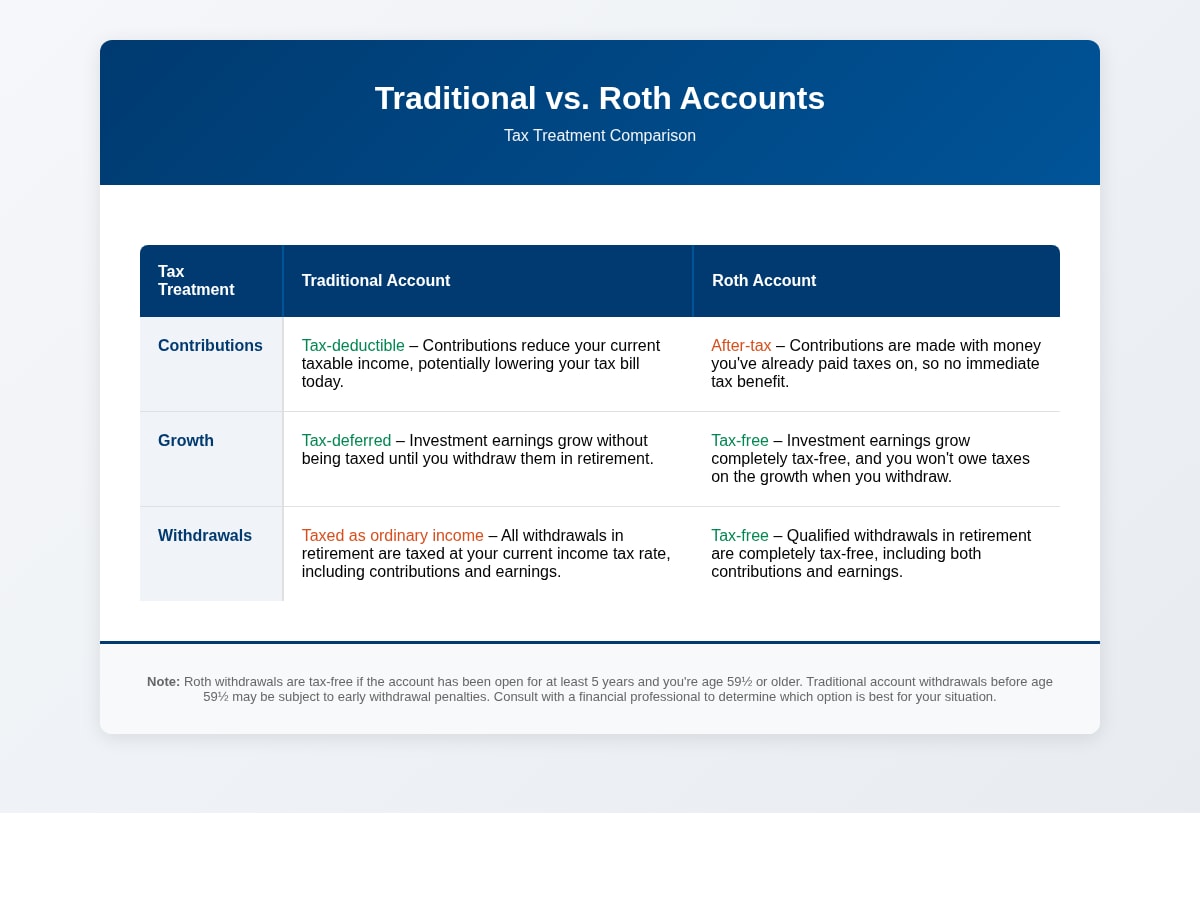
Why? Once your retirement savings are in a Roth IRA, they’re no longer subject to required minimum distributions.
“You’ll have to pay taxes on the conversion, but you won’t pay taxes on qualified withdrawals going forward,” Renfro explained. “This can help smooth out your level of taxable income [in retirement] and potentially drop you into a lower tax bracket.”
Perhaps? You could decide to ladder your conversions before RMDs begin. Instead of making one large conversion of 401(k), 403(b), or traditional IRA funds in a single year, which could trigger a large tax bill — especially if you’re still working — systematically convert smaller amounts over several years. (Learn more: Tips for maximizing your retirement income)
Bottom line
It’s important to preserve your retirement savings by understanding how your decisions about which accounts to withdraw money from and when will affect your tax bill. While taxes are far from the only consideration when dealing with retirement assets, learning the tax rules and savings strategies ahead of time can make a big difference in how much you owe and how much you’re able to keep.
Remember to also factor in state taxes, as the tax treatment of retirement income varies significantly depending on where you live.
___________________
Frequently Asked Questions about retirement tax planning
Q. How much of my Social Security is taxable?
A. Depending on your provisional income, up to 85% of your Social Security benefits may be subject to federal income tax. Managing your other retirement income sources can help minimize this tax burden.
Q. What is the penalty for missing an RMD?
A. The penalty for failing to take your full RMD is 25 percent of the amount not withdrawn. However, this penalty can be reduced to 10 percent if you correct the mistake within a timely manner, usually two years.
Q. Can I still contribute to a Roth IRA after I retire?
A. You can only contribute to a Roth IRA if you have earned income from working. However, you can still perform a Roth conversion by moving funds from a traditional retirement account into a Roth IRA, regardless of your employment status.
________________
Discover more from MassMutual...
8 FAQs on Roth vs. Traditional IRAs
Protecting yourself against market fluctuations in retirement
4 simple ways to delay Social Security
______________________________________________