
| ||||||||||||

Trump Accounts, a new type of investment account for minors, are designed to give children a head start on saving.
But the bigger potential payoff could be the role these accounts will play in promoting financial literacy for the next generation, which could pay dividends for decades to come.
Indeed, Trump Accounts offer a dedicated mobile app that features 15 interactive financial education modules (so far) about saving, compounding interest, and how the stock market works — lessons aimed at reinforcing the impact of consistent saving.
“From a practical standpoint, Trump Accounts provide a much-needed attempt by the government to encourage long-term investing, and over time should provide the opportunity for investment growth,” said Daniel Drabinski, founder and CEO of Integrated Strategies in Dallas.
That said, families should be sure that they understand the benefits and limitations of a Trump Account before they contribute. Depending on their goals and timeline, said Drabinski, parents might be better off prioritizing other savings tools instead.
What are Trump Accounts and how do they work?
Created under the One Big Beautiful Bill Act of 2025, Trump Accounts are tax-advantaged investment accounts that aim to give eligible American children up to 18 years of potential compound growth before they reach adulthood.
In general, a Trump Account can be opened for an eligible child who has not turned 18 before the calendar year in which the election is made and has a valid Social Security number. But parents, legal guardians, or authorized relative must initiate the process on their behalf.
They can set one up through IRS Form 4547 or through an online application at trumpaccounts.gov.
Parents, who are the sole custodian of a Trump Account until their child turns 18, can let those savings grow on their own or add up to $5,000 per year to provide additional growth potential. Individual/family contributions are subject to an aggregate annual limit of $5,000. Employer contributions may be made up to $2,500 per year and count toward that $5,000 annual limit. Certain government or charitable ‘qualified general contributions’ may be treated differently and should be reviewed under the applicable guidance.
Connect with a MassMutual financial professional
The “growth period” of Trump Accounts begins when the account is established (potentially at birth) and ends on December 31 of the year before the child turns 18. During this period, contributions are allowed but distributions are generally not permitted, not even for education, medical expenses, or hardship distributions.
By law, Trump Accounts are required to be invested in low-cost, broad-based U.S. equity index mutual funds or ETFs, such as those tracking the S&P 500. Cash and money market funds are not permitted — funds must remain invested in the market. Administrative fees are also kept low to ensure costs do not eat into the account’s potential growth.2
When the account holder reaches age 18, the Trump Account is generally treated like a traditional IRA and can be left to accumulate any earnings for future retirement expenses.
Traditional IRAs can also be tapped penalty-free before retirement under limited circumstances, including to help pay for education or to buy a house. The tax treatment of distributions may depend on the source of the contributions. Individual after-tax contributions create the cost basis, while the federal pilot contribution, certain qualified contributions, and employer contributions may be treated differently. Families should consult their tax advisor before taking distributions or doing Roth conversions”
Withdrawals made before age 59½ for any other purpose, however, would adhere to standard traditional IRA rules. The entire withdrawal would be subject to ordinary income tax, and also subject to an additional 10 percent early withdrawal tax.
How are Trump Accounts different?
Trump Accounts, which officially opened for contributions on July 4, 2026, differ from other savings tools in a number of ways:
- Unlike a Roth IRA, there is no earned income requirement, meaning even a newborn qualifies for contributions.
- There is no restriction that requires the funds to be used exclusively for education expenses, as there is with a 529 college savings plan. (Learn more: Getting the most out of your 529 plan)
- Unlike a standard custodial brokerage account, any growth within the account before the child reaches age 18 is tax-deferred, allowing any investment earnings to compound without the drag of capital gains taxes.
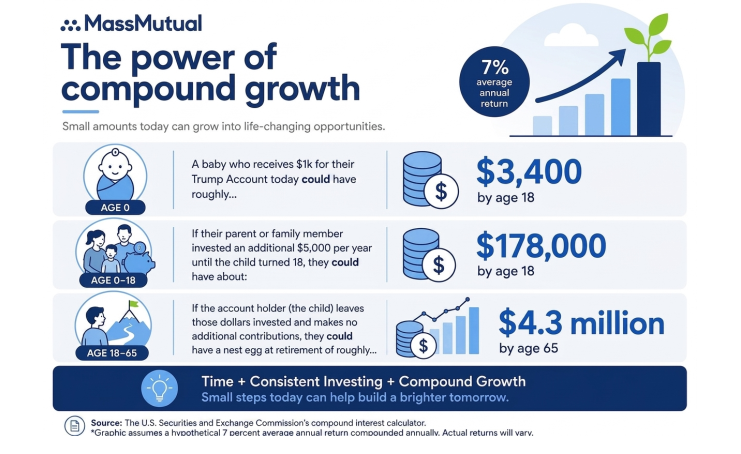
That’s potentially worth more than it seems. According to the U.S. Securities and Exchange Commission’s compound interest calculator: A baby who receives $1,000 for their Trump Account today could have nearly $3,400 by age 18, assuming a 7 percent average annual return. Such a return is hypothetical, but is generally consistent with long-term historical market averages.*
Families who make additional contributions to an account that was seeded with $1,000 and earns 7 percent per year can potentially help secure their child’s financial future in a meaningful way.**
- By contributing $5,000 per year to a Trump Account, their child could have an account value of roughly $178,000 by the time they turn 18.
- If the account holder (the child) leaves those dollars invested until retirement, earns the same 7 percent average annual return, and makes no additional contributions, he or she could have a nest egg worth roughly $4.3 million by age 65.
Does a Trump Account still make sense if my child is older?
But what if your child was born before Jan. 1, 2025, and does not qualify for the one-time $1,000 government contribution? Should you still open a Trump Account?
That depends on your goals, said Drabinski, noting Trump Accounts are not the only savings tools available — nor necessarily the right tool depending on your goals.
“From the perspective of parents with a newborn child, it’s essentially a no-brainer to take the $1,000 federal contribution and seed an account,” said Drabinski. “However, parents with older children should consider whether the benefits of saving will outweigh the downsides of these accounts. Trump Accounts do not provide the same potential tax advantages of a traditional 529, nor the flexibility or liquidity of an UTMA or traditional brokerage account.”
Whole life insurance policies, if purchased by parents for their child, also offer greater liquidity than a Trump Account, said Armando Sallavanti, a financial professional with Vista Wealth Solutions near Philadelphia, Pennsylvania.
Whole life insurance policies are designed to provide a death benefit to beneficiaries while also accumulating cash value over time. That cash value can potentially be accessed tax-free during the policyowner’s lifetime. It is important to note, however, that borrowing against life insurance cash value increases the chances that the policy will lapse, reduces the cash value and death benefit, and may result in a tax bill if the policy terminates before the death of the insured.
“Remember that Trump Accounts are intended for long-term saving,” he said. “That could be a good thing for building wealth for retirement, because they offer a potentially longer period of tax-deferred growth on that money. But retirement may not be the only reason you want to put money away for your kids.” (Important: Trump Accounts and special needs: What families should know)
A financial professional can help you determine which financial options might work best for your family. Currently, Trump Accounts are established and administered through the U.S. Treasury. While future administration through private financial institutions has been contemplated, Trump Accounts are not currently offered through financial institutions.
Trump Accounts vs. 529 college savings plans
If your only goal is to help save for your child’s college education, a 529 college savings account may be the better option, said Drabinski.
529 plans are funded with after-tax contributions, but any earnings grow tax-deferred and withdrawals become tax-free if used for qualified education expenses.3 As a reminder, any earnings in a Trump Account grow tax-deferred, but withdrawals after the account transitions to a traditional IRA are generally taxed as ordinary income and may be subject to an additional 10 percent tax.3
529 plans also offer a more diverse range of professionally managed portfolios than Trump Accounts, including age-based funds that automatically adjust to reduce risk as your child gets closer to college. And they offer higher contribution limits, much higher. According to Savingforcollege.com, each state sets a limit on total lifetime contributions per beneficiary that ranges from $235,000 to more than $600,000. (Related: 529 vs. UTMA: Which is right for you?)
“The lack of investment options and differences in the tax treatment of earnings factor into how a sophisticated investor should view Trump Accounts in comparison to traditional options,” said Drabinski.
There is also the uncertainty of how Trump Accounts may affect college students when they apply for federal financial aid down the road.
“At this time, there is also no clarity on the how Trump Accounts will factor into college financial aid formulas, but many are suggesting that they will be counted as an asset of the child (which could reduce financial aid need-based eligibility),” said Drabinski.
On the other hand, funds held in a 529 plan are reserved exclusively for education expenses. A nonqualified withdrawal from a 529 plan for any other purpose will be subject to ordinary income tax, plus a 10 percent added tax on the earnings portion of the withdrawal.
Your principal, or the contributions you made directly to a 529 plan, is never taxed or penalized. If your child chooses not to attend college or you have funds remaining in your 529 plan after your child leaves school, however, you are able to transfer up to a lifetime limit of $35,000 to a Roth IRA for a beneficiary (i.e. your child.) (Learn more: 529 transfers to a Roth IRA)
Trump Accounts vs. UTMA custodial brokerage accounts
By contrast, an UTMA custodial brokerage account allows adults to set money and property aside for minors until they reach the age of majority (often 18). UTMAs offer no tax deduction on contributions, but you can generally transfer up to $19,000 per year ($38,000 for married couples) without triggering federal gift tax reporting.
Investment earnings, including interest, dividends, and capital gains in an UTMA are reported under the child’s Social Security number. Up to $1,300 of unearned income is tax-free, and the next $1,350 of unearned income is taxed at the child’s (typically lower) tax rate. Any unearned income above $2,700 is taxed at the parent's marginal rate under the Kiddie Tax rules.4
Trump Accounts vs Roth IRAs
If your older child is starting to make money through babysitting, tutoring, or a summer job, and would like to get started on retirement savings, they might also find Roth IRAs to be more tax-friendly than a Trump Account.
There is no minimum age to open a Roth IRAs, but they do require earned income. For 2026, the contribution limit for a Roth IRA is capped at the child’s total earned income or $7,500 (whichever is less).5
Those who invest $3,400 into a Roth IRA at age 18 — the amount their $1,000 seed contribution might grow to in a Trump Account — and contribute an extra $5,000 per year ($416 per month) could have a tax-free nest egg at age 65 of roughly $1.7 million, according to the Roth IRA calculator on calculator.net. That assumes a 7 percent average annual return and a tax rate of 25 percent.
Some financial professionals suggest starting with a Trump Account, especially young children who are eligible for the government’s $1,000 seed contribution, and then converting their traditional IRA to a Roth IRA as soon as possible after they turn 18. They’ll owe taxes on the amount converted at the time, but their tax rate as a young adult may be the lowest they will ever have — potentially zero. (Related: Pros and cons of Roth IRA conversions)
Converting to a Roth IRA offers several potential benefits. For starters, Roth IRAs are funded with after-tax dollars. Earnings are not subject to current income taxes and qualified withdrawals, including earnings, are generally tax free,. There is no tax bill waiting for account owners in retirement. Equally valuable, Roth IRAs are not subject to required minimum distribution rules as they would be with a pre-tax account like a 401(k) or traditional IRA. Roth IRA account holders can leave their money invested as long as they like, which can potentially enhance long-term growth depending on how their portfolio performs.
Conclusion
Trump Accounts offer a valuable new pathway for helping children improve their financial literacy and build wealth.
Parents who are hoping to give their kids a financial head start, however, should consider their goals before they contribute. In some cases, alternative options including 529 college savings plans, UTMAs, whole life insurance, and Roth IRAs might be a better fit.
A financial professional can help you select a savings tool that aligns with your family’s goals..
______________________________________
Frequently asked questions about Trump Accounts
Q: Who is eligible for a Trump Account?
A: Any U.S. child under age 18 with a valid, work-authorized Social Security number may have a Trump Account opened on their behalf by a parent, legal guardian, or other authorized adult. Children born between Jan. 1, 2025, and Dec. 31, 2028, may also qualify for a one-time $1,000 federal seed contribution.
Q: How much can families contribute each year?
A: Parents, grandparents, employers, charities, and other contributors may help fund a child’s Trump Account, but total annual contributions are generally capped at $5,000. Families should keep that aggregate limit in mind if multiple people plan to contribute.
Q: How do Trump Accounts compare with 529 plans or Roth IRAs?
A: Trump Accounts may offer the potential for long-term tax-deferred growth without an earned income requirement, but they are not designed specifically for education expenses and may offer less flexibility and liquidity than some alternatives. Depending on a family’s goals, a 529 plan, custodial brokerage account, or custodial Roth IRA may still be worth considering.
Discover more from MassMutual…
529 college savings plans vs. UTMA custodial accounts.
How to make a financial plan for your family
Need a financial professional? Find one here
________________________________________
*Past performance is no guarantee of future results. **Hypothetical example for illustrative purposes only. Assumes a 7% average annual return compounded annually. Not representative of any specific product or investment. Does not reflect the deduction of fees, expenses, or other charges associated with investing. Actual results will vary.
1 Internal Revenue Service, “Trump Accounts,” July 7, 2026.
2 Internal Revenue Service, “Treasury, IRS issues guidance on Trump Accounts established under the Working Families Tax Cuts; notice announces upcoming regulations,” Dec. 2, 2025.
3 Internal Revenue Service, “529 Plans: Questions and Answers,” Jan. 30, 2026.
4 Internal Revenue Service, “Topic no. 553, Tax on a child's investment and other unearned income (kiddie tax),” June 10, 2026.
5 Internal Revenue Service, “Roth IRAs,” Aug. 26, 2025.