
| ||||||||||||

There are two main types of investment professionals to consider — “registered representatives” (often referred to as brokers) and “investment adviser representatives” (often referred to as financial advisors or IARs). They each have different types of credentials, may play different roles for different investment accounts, and are compensated in different ways.
Your investment professional may be both a registered representative (broker), as well as an investment adviser representative, depending on the role that he or she plays in providing investment services throughout your financial life. This is known as dual registration, and it means the professional may wear different hats — acting as a broker for some transactions and as an investment adviser representative (IAR) for others, with different standards and compensation applying to each role.
In this blended-service regard, the number of financial professionals offering financial planning services, often referred to as financial planners, is on the rise. (Related: 3 ways a financial professional adds value)
Brokers, registered representatives
Many investment professionals are brokers (i.e. registered representatives). These professionals are licensed primarily through the brokerage firms they work for. Individual brokers are regulated by the Financial Industry Regulatory Authority (FINRA), the self-regulatory organization for the securities industry.
Brokers are licensed to buy and sell specific types of securities products on behalf of their clients, depending on the type of license that they hold. Brokers must act in the “best interest” of their client when making recommendations about investments or investment accounts. In other words, products that match a given client’s investor profile – his or her age, risk tolerance, time horizon, etc. (Related: Understanding your risk profile)
When you work with a broker, you are responsible for the decisions: The representative only buys or sells securities that you authorize them to. In most cases, the broker is paid with a commission or sales charge for each product they buy or sell on your behalf. So, the amount of their compensation is directly tied to the product they buy or sell. Generally, there is no separate advisory fee for brokerage services.
Bottom line: If your investment needs are pretty straightforward, and you don’t have a huge amount of investable assets to manage, a broker or registered representative may suit your needs just fine. Working with a registered representative can be a more economical way to go than working with an investment adviser representative, who typically provides a more in-depth and ongoing level of investment advice.
Investment adviser representatives
The regulation and standards for investment adviser representatives are different, as are the services they provide. As a result, they are typically paid differently, as well.
Investment adviser representatives, who are regulated by the Securities and Exchange Commission, (SEC) or state securities regulators, have always been held to a fiduciary standard.
When you work with an investment adviser representative, you are still ultimately in charge of how your investments are allocated and managed, but typically, the day-to-day management of your assets is handled by the adviser, the adviser’s firm, or third-party investment firms with whom the adviser’s firm has agreements, depending on the terms of the advisory program you have invested in.
These activities may include rebalancing or changing the way your assets are allocated based on your age or investment horizon, or in response to market conditions. Your investment adviser representative will communicate with you on an ongoing basis, because the management of the assets in an advisory relationship is a continuous process.
Another key difference between a registered representative and an investment adviser representative is that you typically pay the investment adviser representative an ongoing fee for his or her advice and services, instead of commissions on each investment product bought or sold, as you would with a broker or registered representative. The fee is usually a percentage of the assets under management (AUM), so the adviser’s fee may increase or decrease as the value of the assets being managed changes. (Related: Who is a financial advisor … and who isn’t)
Bottom line: If you have a larger amount of wealth to manage, or your investment needs are more complex, an investment adviser representative might be the right choice for you.
Financial planners
Financial planners may provide holistic financial plans or financial planning services, covering budgeting, tax planning, retirement strategy, and insurance and typically work for a fee. Some planners are “fee-only,” meaning they are compensated solely by client fees, while others are “fee-based,” meaning they may also earn commissions on products they recommend or fees on assets managed.
They may be regulated at the state or federal level, depending on their licensing and the services they provide. If they are a CERTIFIED FINANCIAL PLANNER® professional, they are subject to the CFP Board’s fiduciary standard when providing financial advice.
Depending on their licenses and qualifications, financial planners may also act as an IAR, registered representative, or insurance agent and assist clients in implementing elements of a financial plan, such as investment-, retirement-, or insurance-related recommendations.
Bottom line: If you have a number of intertwining financial issues to keep track of — cash flow, investments, retirement timing, multi-generational wealth transfer (to name a few) — then a financial planner might be a good choice. They concentrate on creating holistic, big-picture strategies for your entire financial life. But fees and costs will likely vary.
Ready to find the right investment professional?
If you’re ready to start working with an investment professional, it’s important to understand the products and services that are being offered and the different obligations of brokers/registered representatives and investment adviser representatives.
Connect with a MassMutual financial professional
And don’t be afraid to ask questions about how they are compensated and what standard they are held to for the products and accounts you are investing in. (Related: Meeting your financial professional for the first time)
Both brokerage and advisory relationships require a Form CRS (Customer Relationship Summary), a brief document that explains their services, fees, and conflicts of interest. You can also research any professional's background through FINRA's BrokerCheck tool.
No matter which type of investment professional you choose, it’s essential to find someone you feel comfortable with — who takes the time to understand your needs, preferences and goals when it comes to managing your finances.
Since 1851, MassMutual has been focused on helping people secure their financial future and protect the ones they love. That mission is why we have thousands of financial professionals to assist you on your journey through insurance, investing, retirement planning, estate management, and more. You can find a MassMutual professional with this tool or you can let us know you’d like to talk to one and we’ll have one of our financial professionals contact you.
______________________________
Frequently Asked Questions about investment professionals
Q. What is the difference between a broker and an investment adviser representative?
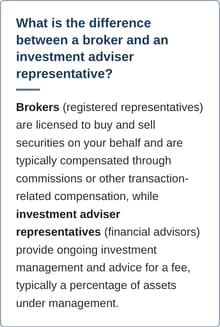
A. Brokers (registered representatives) are licensed to buy and sell securities on your behalf and are typically compensated through commissions or other transaction-related compensation, while investment adviser representatives provide ongoing investment management and advice for a fee, typically a percentage of assets under management. Brokers are regulated by FINRA and subject to Regulation Best Interest, while investment adviser representatives are regulated by the SEC or state securities regulators and are held to a fiduciary standard.
Q. Can a financial professional be both a broker and an investment adviser representative?
A. Yes, many professionals hold dual registration, meaning they can act as a broker for some transactions and as an investment adviser representative for others. The standard they are held to and how they are compensated depends on which role they are playing for a given account or transaction.
Q. How are financial planners different from brokers and investment adviser representatives?
A. Financial planners focus on creating holistic financial plans that may cover budgeting, tax planning, retirement strategy, and insurance, typically working for a fee. Depending on their licenses, they may also act as a broker, investment adviser representative, or insurance agent to help implement elements of your plan.
_________________________
Discover more from MassMutual…
Is group life insurance enough?
Retirement savings: 3 catch-up moves
3 times when you probably need financial guidance
This article was originally published in October 2016. It has been updated.
__________