
| ||||||||||||

As you’re drafting your financial plan for the coming year, you’ll want to be aware of all the usual inflation-based adjustments to deductions, tax brackets, and retirement contributions. You’ll also want to know what’s different because of the One Big Beautiful Bill Act (OBBBA).
Here are the tax numbers to know for 2026. It’s worth considering these changes as you draft your financial plan for the year.
Standard deduction: A bigger-than-inflation increase
Good news: You’re getting a 7.33 percent larger standard deduction in 2026. That increase is more than twice what you’d get from a pure inflation adjustment. The consumer price index was up 3.0 percent year-over-year in September 2025.
Why is the increase so big this year? The OBBB made midyear increases to the 2025 standard deductions on top of the regularly scheduled ones announced in November 2024. The 2026 numbers build on the updated 2025 numbers. (Related: ‘Big Beautiful’ changes to review with your financial professional)
Your standard deduction is the amount of income the federal government lets you keep 100 percent of. Here’s how much it is by filing status:
● For single people and married couples filing separate returns, the 2025 standard deduction was $15,000, but the OBBB increased it to $15,750. For 2026, it will be $16,100. That’s an extra $1,100.
● For heads of household, it increased from $22,500 to $23,625 for 2025, and to $24,150 for 2026. That’s an extra $1,650.
● For married people filing jointly and surviving spouses, it increased from $30,000 to $31,500 for 2025, then it will increase to $32,200 for 2026, a $2,200 increase.
Senior deduction
Due to the OBBBA, taxpayers 65 and older can claim an additional deduction of up to $6,000 per person ($12,000 if married filing jointly) for 2025 through 2028. This bonus deduction is available whether you itemize or take the standard deduction.
It phases out with modified adjusted gross income (MAGI) of $75,000 to $175,000 if you file as single and $150,000 to $250,000 if you file jointly.
This new deduction is in addition to the existing additional standard deduction for seniors who don’t itemize, which will be $1,650 per person (married filing jointly or separately) or $2,050 (single or head of household), up $50 from $1,600 and $2,000 in 2025.
Expanded HSA eligibility and contribution limits
“One under-the-radar tax change for 2026 that I think more people should know about is that the OBBBA made all bronze and catastrophic plans on the ACA marketplace eligible for health savings accounts,” said Logan Allec, a CPA and owner of tax relief services company Choice Tax Relief.
“If all members of your family are relatively healthy and typically only need routine care from medical providers, consider comparing your current health plan with an HSA-eligible one,” Allec said. “If such a plan makes sense for your family's health care needs, you would then be able to contribute thousands of dollars to your HSA on a pretax basis — saving you on your 2026 tax return — that you can then invest just like an IRA. Then, in the future, when a medical need arises, you can take distributions from the HSA tax-free.”
In addition, the contribution limit for a self-only HSA will increase to $4,400 in 2026 (up from $4,300 in 2025). For a family HSA that covers you plus a spouse and/or kids, the limit will increase to $8,750 from $8,550.
New car loan interest deduction
If you take out a loan to buy a new car in 2026, you may be able to deduct up to $10,000 in interest through 2028, even if you don’t itemize on Schedule A (which most people don’t). 1
The vehicle must be:
● Assembled in the United States.
● For personal (not business) use.
● A car, minivan, SUV, pickup truck, or motorcycle.
● Less than 14,000 pounds (for reference, a Ford F-150 weighs 4,000 to 5,500 pounds).
To fully deduct the interest, your MAGI must be:
● $100,000 or less if you file single or married filing separately.
● $200,000 or less if you file married jointly.
The average new car loan these days is close to six years, according to Edmunds. The average loan is around $40,000 with a 7 percent interest rate.
With such a loan, you’d pay about $2,600 in interest in year 1, so this deduction could save you hundreds of dollars, depending on your tax bracket.
Buying a used vehicle or shopping lenders for a competitive interest rate might save you a lot more.
Tax bracket changes: Smaller than inflation
Marginal tax rates won’t change in 2026. The lowest rate will remain 10 percent, and the highest will still be 37 percent.
The amount you can earn within each tax bracket will increase for inflation (although by less than you might expect).
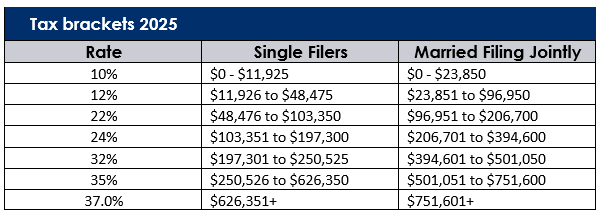
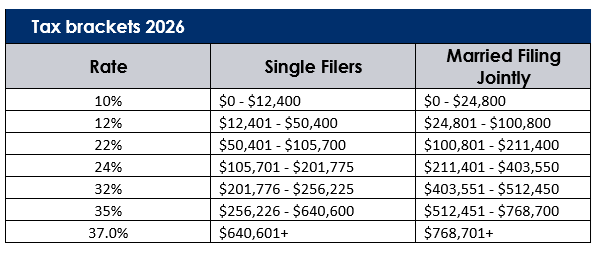
Here’s a simplified example that assumes all your income comes from work:
● If you filed as single in 2025 and earned $103,350, you were at the top of the 22 percent tax bracket.
● In 2026, you could earn $105,700 and still pay the same marginal tax rate of 22 percent.
● In other words, your pay could have increased by $2,350, or about 2.2 percent, without pushing any of your income into the 24 percent tax bracket.
Ideally, you wouldn’t be at risk of being pushed into a higher tax bracket just from getting a modest cost-of-living raise. But for 2026, U.S. companies say they expect to raise salaries by 3.4 percent, according to The Conference Board, a nonpartisan think tank that delivers business insights.This means that if you’re at the upper end of a bracket, you might pay the next highest rate on your last dollars of income next year.
What you’re probably more likely to notice is owing too much at tax time, which can mean late payment penalties and interest. People who receive 1099 income from self-employment or restricted stock units (RSUs) from their employer often find themselves in this situation. (Related: Taking advantage of your employee stock program: 4 tips)
“It’s a good idea to consider if you should update your W-4 withholding form with your employer,” said Annette Nellen, CPA, professor of tax and accounting at San Jose State University. “If you owed taxes when you filed your 2024 return, you might not be having enough taxes withheld from your paychecks, or you might need to make quarterly estimated tax payments.”
IRA contribution limits
The IRA contribution limit for both traditional and Roth accounts increases from $7,000 in 2025 to $7,500 for 2026 (or 100 percent of your earned income, whichever is less).
The deadline to contribute for 2026 won’t arrive until April 15, 2027. However, making regular contributions and automatic investments throughout the year can be more effective than hoping you’ll have a lump sum to contribute at tax time.
● If you want to max out your savings and contribute monthly, you’ll need to set aside $625 per month.
● If you want to align your contributions with your biweekly paychecks, that’s $288.46 every two weeks.
The catch-up contribution amount for individuals 50 and older increases from $1,000 to $1,100 for a total contribution of $8,600 in 2026. That’s an additional $91.66 per month ($716.66 total for both regular and catch-up contributions) or $42.31 every two weeks ($330.77 total). (Related: How to catch up on retirement savings in your 50s)
If you have a SIMPLE IRA through work:
● The annual salary deferral contribution limit will increase by $500, from $16,500 to $17,000. (Some employers have a higher limit of $18,500.)
● The catch-up contribution limit will increase from $3,500 to $4,000.
● If you’re 60, 61, 62, or 63, you’ll be able to make an even larger catch-up contribution of $5,000.
Roth IRA eligibility income limits
The IRS limits how much you can contribute to a Roth IRA directly when your modified adjusted gross income reaches certain levels.
● Single or head of household: You can directly contribute a reduced amount (less than the $7,500 maximum) once your income hits $153,000 (up from $150,000). You can’t contribute directly to a Roth IRA at all if your modified adjusted gross income exceeds $168,000 in 2026 (up from $165,000 in 2025).
● Married filing jointly: The phaseout range is $242,000 to $252,000 in 2026 (up from $236,000 to $246,000).
● Married filing separately:
○ If you lived with your spouse at any time during the year, the phaseout range doesn’t adjust for inflation and will still be $0 to $10,000 in 2026.
○ If you did not live with your spouse at all, the single and head of household range applies.
You can still contribute indirectly to a Roth through a backdoor Roth IRA once your income exceeds these limits.
Traditional IRA deductible contribution income limits
You can make after-tax contributions to a traditional IRA regardless of how high your income is.
To claim a tax deduction, however, your income needs to fall below certain limits if you or your spouse are able to contribute to a workplace retirement plan. Here are the limits by filing status:
● Single or head of household: The phaseout range in 2026 is $81,000 to $91,000 (up from $79,000 to $89,000 in 2025).
● Married filing jointly and you can contribute to a workplace retirement plan: The phaseout range is $129,000 to $149,000 (up from $126,000 to $146,000).
● Married filing jointly and you’re married to someone who can contribute to a workplace retirement plan but you can’t contribute yourself: The phaseout range is $242,000 to $252,000 (up from $236,000 to $246,000).
● Married filing separately and you or your spouse can contribute to a workplace retirement plan: The phaseout range remains at $0 to $10,000.
● Married filing separately and lived separately the entire year: The single limits apply.
401(k), 403(b), most 457, and Thrift Savings Plan contribution limits
If you have access to any of these employer-sponsored retirement accounts, you’ll be able to contribute as much as $24,500 in 2026, an increase of $1,000 (about 4.3 percent) from 2025.
“Check with your employer to be sure your contribution is increased if you are contributing the maximum amount each year,” Nellen said.
If you get paid every two weeks and want to max out your contributions, you’ll have an additional $38.46 withheld from each paycheck, for a total of $942.31 per pay period.
“In 2024, employers gained the option to make matching contributions to an employee’s 401(k) plan tied to their student loan payments,” Nellen said. “Ask your HR department about this option if your student loan payments are making it hard to put enough in your 401(k) to get your employer’s match.”
This student loan matching provision from the SECURE 2.0 Act is designed to help workers save for retirement while repaying education debt.
Workplace plans also let you make catch-up contributions of up to $8,000 in 2026 if you’re 50 or older, or an extra $307.69 per paycheck. This limit is $500 higher than it was in 2025. However, there are some tax treatment changes for catch-up contributions for high-earners, however. (Learn more: High-earner 401(k) catch-up changes: What to know)
If you’re 60, 61, 62, or 63 on December 31, 2026, you’ll be able to make a catch-up contribution of up to $11,500 (up from $11,250 in 2025) under a SECURE 2.0 Act provision that became effective in 2025.
If you can afford to contribute more than that limit for your age bracket, find out whether your employer’s plan would allow you to make mega-backdoor Roth contributions.
Solo 401(k) contribution limits
If you earn a high income as an independent contractor or sole proprietor, you can take advantage of a solo 401(k) to save far more for retirement than most employees are allowed to. (Related: Freelance taxes)
Like employees, you can contribute up to $24,500 to a solo 401(k) in 2026. And instead of the matching contributions that many employees receive, your company can make a profit-sharing contribution of up to $47,500.
That’s a maximum annual contribution of as much as $72,000 (up from $70,000 in 2025) plus catch-up contributions. To contribute the maximum, however, your self-employment income would need to be at least $288,000.
Long-term capital gains taxes
Outside of tax-advantaged retirement accounts, long-term capital gains tax applies when you make money selling an investment you’ve held for more than a year. Unlike short-term capital gains, which are taxed at your top marginal rate, long-term gains are taxed at lower rates.
In 2026, the long-term capital gains tax rate is 15 percent once your income hits these thresholds:
● $49,450 if you’re single or married filing separately
● $66,200 if you’re head of household
● $98,900 if you’re married filing jointly
The respective thresholds in 2025 were $48,350, $64,750, and $96,700.
Below these limits, you don’t owe the tax.
Should your income get into the mid-six figures ($545,500 for singles, $579,600 for heads of household, $613,700 for married couples filing jointly, and $306,850 for married couples filing separately), the capital gains tax rate hits 20 percent. (Related: Preparing for an audit)
If you live in a state that taxes capital gains, be aware that lower rates may not apply to long-term gains.
Lifetime estate and gift tax exclusion
If you have a large estate — meaning a high net worth, not necessarily a gigantic house — you can cancel your appointment with the trust attorney (maybe). The OBBBA made sure the estate tax exemption stays high and will keep being adjusted annually for inflation. In 2025, it was $13.99 million per person, and in 2026, it will be $15 million.
You might think that’s more money than you could ever hope to have, but with enough time in the market and enough bull market years, it could happen.
The annual gift exclusion is still $19,000 per recipient for 2026. So, one person can give as many people $19,000 as they want and it will all qualify. A married couple can likewise give $38,000 gifts to as many individual recipients.
New AMT threshold
If you’re one of the few people reading this article who has any idea what the alternative minimum tax (AMT) is and whether it might apply to you in 2026, here’s the latest.
Far fewer people have to worry about the AMT at all thanks to the OBBB, but the couple hundred thousand people who do might pay more in 2026.
If you’re like most people, you’ll just rely on your tax preparer (or software) to figure it out for you. Ideally, you’ll talk with them about it before the end of 2025, so they can help you make some strategic tax moves to lower your AMT liability.
Student loan debt forgiveness
If you meet the requirements for student loan forgiveness during 2025 but your balance is not forgiven until 2026, you may not have to pay income tax on the canceled debt.
This should be welcome news if the government shutdown and other issues have caused confusion and delays about your eligibility for student loan forgiveness.
The American Federation of Teachers filed a lawsuit against the Department of Education in March, and, in October, it won when a judge ordered the department to resume cancelling student loans for eligible borrowers.
The American Rescue Plan Act of 2021 exempts canceled student loan debt from taxation, but only through the end of 2025. For this reason, the judge also ordered the department not to file tax forms for the canceled debt while acknowledging that decisions about debt forgiveness are ultimately up to the IRS and the Treasury Department.
If you’re in the 24 percent federal tax bracket, you could save $2,400 in tax for every $10,000 forgiven.
Charitable giving
The new floor for itemizing deductible charitable contributions might trip some people up.
“Beginning in 2026, those who itemize deductions on Schedule A can only deduct charitable contributions that exceed 0.5 percent of their adjusted gross income,” Allec said.
Here’s an example showing what that change looks like:
● AGI: $100,000
● 0.5 percent of AGI: $500
● Charitable contribution: $5,000
● Deductible amount in 2025: $5,000
● Deductible amount in 2026: $4,500
“I personally hope that this doesn’t make taxpayers who would otherwise give generously a bit more scroogeish,” Allec said. “If they do the math, I think they’ll discover that the lost deduction amount isn’t that large.”
The other change benefits those who don’t itemize. If that’s you, you can look forward to deducting up to $1,000 per filer for donations starting in 2026.
Other tax changes to discuss with a financial professional
With so many tax changes, we can’t cover all of them in detail, but a financial professional can provide the level of thoroughness and customization you might be looking for. (Don’t have a financial professional? Fill out this form and we’ll have someone contact you.)
Here are a few questions you could ask your financial professional if they might be relevant to your situation:
● Could I benefit from the higher $40,000 state and local tax (SALT) deduction for 2025 through 2029?
● Will my tips be taxable?
● Will my overtime be taxable?
Planning for 2026 and beyond
The tax changes for 2026 are more significant than in recent years due to the OBBBA's passage in July. They might lower your tax bill slightly, giving you more breathing room or helping you save more for retirement.
Want to discuss possible tax-saving opportunities or check to see whether your financial plan is on track? A MassMutual financial professional can help you review your situation and create a personalized strategy to meet your goals.
Discover more from MassMutual…
8 FAQs on traditional vs. Roth IRAs
5 retirement investment strategies
Freelance finances: The tax challenge