
| ||||||||||||

In the wake of a new tax regime being signed into law, it’s a good time to connect with your financial professional to see if any adjustments should be made to your financial plan.
Specifically, you should look at:
While it will take some time for various provisions of the new law, called the One Big Beautiful Bill Act (OBBBA), to be put into effect by the Department of the Treasury and specifically the IRS, having the outline of a plan in place will help you be prepared to take advantage of opportunities and mitigate challenges of the various changes.
Tax provisions
The OBBBA, while keeping the current basic tax structure, makes a number of adjustments to taxable income and deductions:
- It retains the current structure of tax brackets and rates, which would have increased had Congress not acted.
- The income thresholds for every tax bracket will continue to be indexed for inflation, which could lower tax liability.
- Tax brackets below 24 percent will receive an extra year of inflation adjustment starting in 2026.
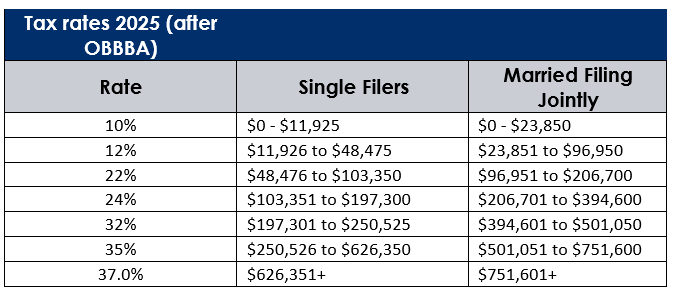
Source: IRS, "Publication 17(2024), Your Federal Income Tax," Jan. 23, 2025.
A key income threshold for high-income filers to watch is:
- $197,300 for single filers
- $394,600 for married couples filing jointly.
That is where the tax rate moves from 24 percent to 32 percent, a significant jump compared with the other tax bracket levels. (Related: How to reduce taxable income and avoid a higher tax bracket)
In 2025, the top marginal income rate of 37 percent will apply to single filers with taxable income above $626,350 and for married couples filing jointly with taxable income above $751,600.
The standard deduction increases to $15,750 for individuals, $31,500 for married couples filing jointly, and $23,625 for heads of household.
Other areas that are changing include:
- Tips and overtime pay.
- Auto loan interest.
- Senior citizen deductions.
- State and Local Tax (SALT) deductions.
- Charitable contributions.
Overall, the changes will likely reduce the number of Americans who itemize deductions, since the standard deduction and allowances for other types of income are relatively large. Additionally, the new law creates a limitation on itemized deductions for high-income wage earners.
How these changes will affect your financial planning obviously depends on your individual circumstances. That’s where a financial professional can help provide guidance. (Related: 3 ways a financial professional adds value)
Estate planning
For 2025 the exemption to the federal estate and gift tax exemption stands at $13.99 million. In 2026 the OBBBA increases the exemption to $15 million per person, with inflation adjustments beginning in 2027.
This will:
- Reduce the number of estates subject to estate tax.
- Provide more opportunity for estate planning.
Additionally, changes were made that will affect gifting of assets to grandchildren.
Under the old law, a 40 percent generation-skipping transfer tax was imposed on wealth transfers to beneficiaries who were beyond the next generation (grandchildren, for example) for any amount above the lifetime estate and gift tax exemption. The new law increases the lifetime exemption to $15 million per person effective for 2026, with inflation adjustments beginning in 2027. This will likely allow more wealth to pass to grandchildren and younger generations.
Speaking of younger generations, effective in 2025, the new law also permanently increases the Child Tax Credit to $2,200. And it creates Trump Accounts — a type of traditional IRA for newborn American children. The federal government will provide a one-time deposit of $1,000 for each child born in 2025 through 2028. Parents or other family members may make nondeductible contributions up to $5,000 annually. Eligible investments include index mutual funds or ETFs with expense ratios of 0.1 percent or less that track the return of an index comprised of U.S. equity investments. No distributions are permitted before age 18.
Conclusion
These are just a few of the new tax law’s changes and possible impacts. But they are areas to start looking at with your financial professional to see if any adjustments need to be made to your financial plan. (OBBBA review)
Since 1851, MassMutual has been focused on helping people secure their future and protect the ones they love. That purpose is why we have thousands of financial professionals to assist you on your journey through insurance, investing, retirement planning, estate management, and more. You can find a MassMutual professional with this tool or you can let us know you’d like to talk with one and we’ll have one of our financial professionals contact you.
Discover more from MassMutual …
How life insurance can help you in retirement
Understanding asset allocation
Asset location strategy: Tame your taxes
___________________________________