
| ||||||||||||

All trusts fall under one of two categories: revocable or irrevocable. But how do you know which one to choose?
Both can keep your assets out of probate when you die and allow your heirs to receive your assets in a structured way. But they differ in how much control you’ll have over trust assets, how they’ll affect your taxes, and how well they’ll protect your assets from creditors.
“Both revocable and irrevocable trusts can be important components of a holistic estate plan,” said Nancy Chin, private client manager and trust officer with MassMutual Private Wealth & Trust in Springfield, Massachusetts. “The use of one or possibly both types of trusts depends on a person’s needs, circumstances, and estate planning goals.”
Because of the complexity, many people opt to consult a financial professional about the options.
Connect with a MassMutual financial professional
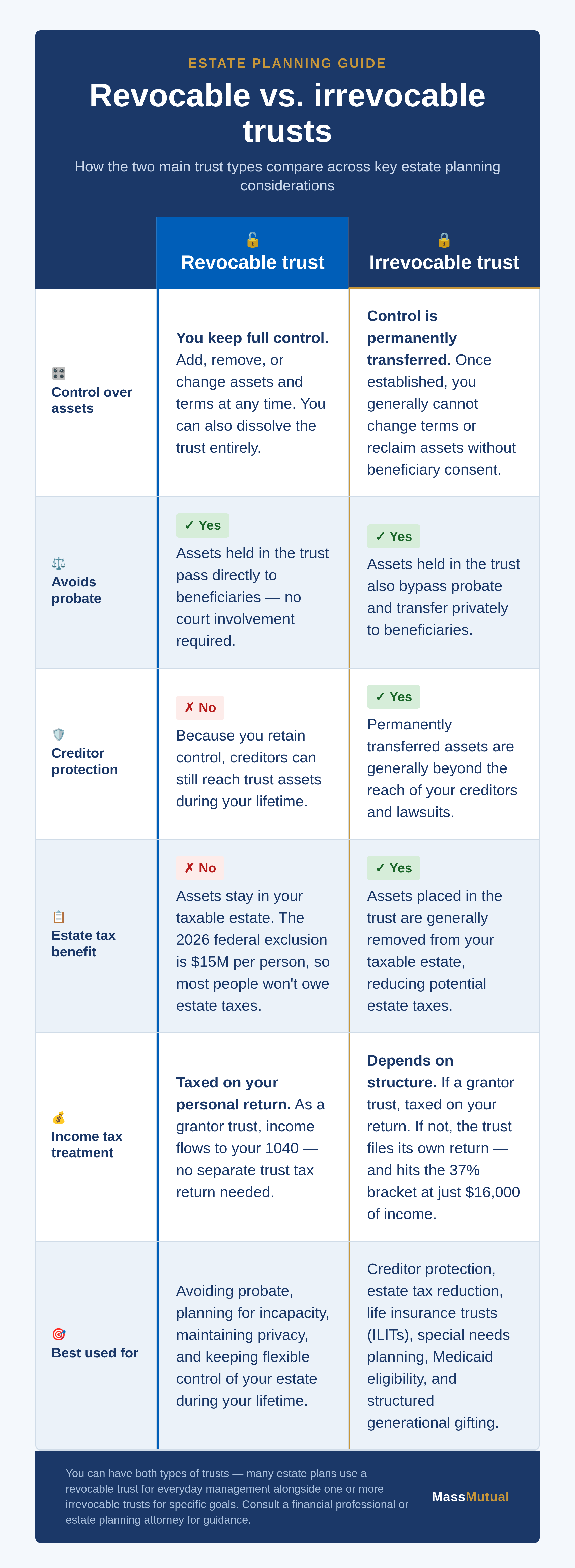
But to begin the discussion, it’s useful to explore the key characteristics of the two main trust categories and when people typically use them. Here is a quick visual summary with more detail below…
Revocable trusts: The basics
More specifically, a revocable trust, sometimes called a revocable living trust, is a legal entity that allows you, as the grantor, to transfer ownership of your assets out of your name and into a trust’s name during your lifetime. A revocable trust is often used in conjunction with a pour-over will, a legal document providing for the automatic transfer of assets to a previously established trust upon your death. (Learn more: Types of wills and what they are used for)
A revocable trust is a type of grantor trust, which means that you are responsible for paying taxes at your personal rate on any income and capital gains generated by trust assets during your lifetime.
A revocable trust allows you to:
- Name yourself as the trustee, the person responsible for managing the trust’s assets.
- Add or remove assets, such as real estate, investments, or bank accounts, as needed.
- Change the trust’s terms and beneficiaries as your circumstances or wishes change.
- Terminate the trust and regain full ownership of your assets at any point during your lifetime.
- Avoid comingling nonmarital assets with a spouse.
After you die, the trust becomes irrevocable. A successor trustee takes over and manages the trust in the best interests of its beneficiaries. The trust documents you created during your lifetime will guide your successor trustee’s decisions.
For example, you could specify that all the trust’s assets be fully and equally distributed among your adult children or your favorite charities when you pass. Someone with minor children might specify that the trustee make distributions to the children’s guardians only for expenses related to the children’s health, education, maintenance, and support.
They might also specify that once the children are of legal age, they will continue to receive only discretionary distributions for the same purposes (which might include paying for college or buying a house).
You might establish a revocable trust for several reasons:
- Avoid probate: Probate can take several months or longer, and it requires your heirs to hire a probate attorney. Unlike a will, a trust takes effect during your lifetime and avoids probate entirely. (Related: What probate is and why people try to avoid it)
- A revocable trust can provide for a smooth transfer of assets to beneficiaries that saves them time and money and preserves privacy by keeping assets out of probate — as long as you retitle your assets to officially transfer ownership to the trust or create a pour-over will for those assets that you did not retitle. (An unfunded trust — one where assets were never retitled into the trust — will not avoid probate, which is why following through on the retitling step is essential.)
- Plan for incapacity: Incapacity can occur without warning and at any age. A living trust can allow someone else to manage your assets if you become seriously ill or disabled on a temporary or permanent basis.
With a revocable living trust in place, your successor trustee can take over with little interruption and without court intervention if you are deemed incapable of managing your own financial affairs, Chin explained. Additionally, naming a durable power of attorney ensures that someone you trust will be able to manage any financial accounts or assets outside the trust, such as individual retirement accounts (IRAs).
“Adding a joint owner to one’s assets and accounts may seem like a simple and convenient solution to manage financial matters during incapacity,” Chin said. However, by law, the joint owner will assume full ownership upon the grantor’s death, which may be a problem if the grantor wants someone else to inherit those assets.
Because you maintain control of the assets in a revocable living trust during your lifetime, you have to accept some trade-offs:
- No creditor protection. Creditors include lenders, ex-spouses, and anyone else who could secure a judgment against your assets in a lawsuit. You may be able to protect against these risks in other ways, including prenuptial and postnuptial agreements, personal liability umbrella insurance, and business liability insurance.
- No estate tax advantage. The trust assets will remain part of your estate and be subject to estate taxes after you die. Most people won’t owe federal estate taxes anyway; the lifetime estate tax exclusion is $15 million per person in 2026 (indexed for inflation starting in 2027). And some states impose estate taxes at lower thresholds.
You don’t need to be wealthy to benefit from establishing a living trust. Many people have assets they want to keep out of probate, and everyone needs a plan for handling their affairs in case they become incapacitated. A living trust is often an essential piece of a comprehensive estate plan.
Irrevocable trusts: The basics
Irrevocable trusts make up for the shortcomings of revocable trusts. They allow you to:
- Protect your assets from creditors.
- Maintain eligibility for means-tested government benefits.
- Avoid estate taxes.
- Gift assets in uniquely beneficial ways.
In exchange, unlike living trusts, you must permanently relinquish ownership and control of the assets you place in the trust. You’ll be severely restricted in your ability to change the terms of an irrevocable trust — except as provided for under the laws of the state where you establish the trust (which does not have to be your home state) and by your trust documents.
Taxation can be more complex as well:
- If an irrevocable trust is structured as a grantor trust, you may continue to pay your personal income tax rate on its income during your lifetime and avoid having to file a separate tax return for the trust.
- If it is not a grantor trust, the trust will need its own tax identification number. The trustee will need to submit a trust tax return annually. And the trust’s income and assets will be subject to trust tax rates, which generally means the trust will pay higher income taxes, because the highest income tax rate for trusts (37 percent) is reached at just $16.000 of trust income.
There are numerous types of irrevocable trusts, each designed with a specific purpose. Here are some examples:
- Spousal lifetime access trust (SLAT)
- Irrevocable life insurance trust (ILIT)
- A/B trust (the B trust is also called a bypass trust or credit shelter trust)
- Charitable remainder trust (CRT)
- Dynasty trust / Generation-skipping trust
- Grantor-retained annuity trust (GRAT)
- Grantor-retained unitrust (GRUT)
- Medicaid trust (Note: Medicaid trusts typically require a five-year look-back period before assets are protected.)
- Special needs trust/supplemental needs trust
- Qualified personal residence trust (QPRT)
A common use of irrevocable trusts is to transfer assets to the next generation in a highly structured way. They can allow grandparents to gift college funds to grandchildren, for example. And yes, these are often wealthy grandparents looking to remove assets from their taxable estates, so the money stays in the family instead of going to the government.
Yet, because irrevocable trusts can be structured in so many ways and for so many purposes, you may have a reason to create one even if your means are more modest. Examples include providing for a disabled adult child with a special needs trust or protecting the family home with a Medicaid trust.
Revocable or irrevocable: Which type of trust is right for you?
If you want to maintain control over your assets while enjoying some of the benefits of a trust, such as avoiding probate and having someone you trust manage your assets if you become incapacitated, then a revocable trust could be a good option. (Related: Types of trusts and what they are used for)
If you want creditor or estate tax protection, you may want to consider an irrevocable trust. For example, an irrevocable life insurance trust can provide liquidity while removing death benefit proceeds from your estate, Chin said.
“Other reasons for establishing an irrevocable trust might be for charitable gifting through a charitable remainder trust, or to provide for a disabled child through a supplemental needs trust,” Chin added.
The choice is not mutually exclusive: You can have more than one trust.
“There are situations where both revocable and irrevocable trusts are appropriate tools to accomplish estate planning goals,” Chin said. “While the revocable trust provides consolidation and continuity during a grantor’s life and upon their death, an irrevocable trust is purpose driven, to meet specific planning needs.”
In some cases, the answer may be neither. If your main goal is to protect your home against creditors, your state’s homestead laws may be sufficient. Umbrella insurance provides additional personal liability protection beyond what your homeowners and auto insurance policies provide. A durable power of attorney allows someone to manage your finances if you’re incapacitated.
Contact a financial professional or estate planning attorney to discuss your specific needs and determine which type of trust may be right for you.
_____________
Frequently Asked Questions about revocable and irrevocable trusts
Q. What is the main difference between a revocable and irrevocable trust?
A. A revocable trust lets you keep control of your assets during your lifetime and change or cancel the trust at any time. An irrevocable trust permanently transfers control of your assets in exchange for benefits like creditor protection and potential estate tax savings.
Q. Do I need a trust if I already have a will?
A. A will and a trust serve different purposes, and many people benefit from having both. A will goes through probate, which can be time-consuming and public; a trust bypasses probate entirely and can also provide for your care if you become incapacitated.
Q. Can I have both a revocable and an irrevocable trust?
A. Yes — and it's quite common. Many people use a revocable living trust to manage their day-to-day estate and avoid probate, while also using one or more irrevocable trusts to address specific goals like shielding life insurance proceeds from estate taxes or providing for a child with special needs.