
Here is a compendium of adjustments to various retirement savings and tax plans. It includes …
- IRA & retirement plan contribution limits
- Qualified plan benefit & compensation limits
- Social Security key figures
- Medicare information
- Standard deductions
- Capital gains & dividend tax brackets
- Federal gift & estate tax amounts
- Health Savings Account (HSA) limits
- Income tax brackets
For help interpreting how any new limits may influence your individual financial circumstances, you may want to consult a financial professional.
Connect with a MassMutual financial professional
IRA & retirement plan contribution limits
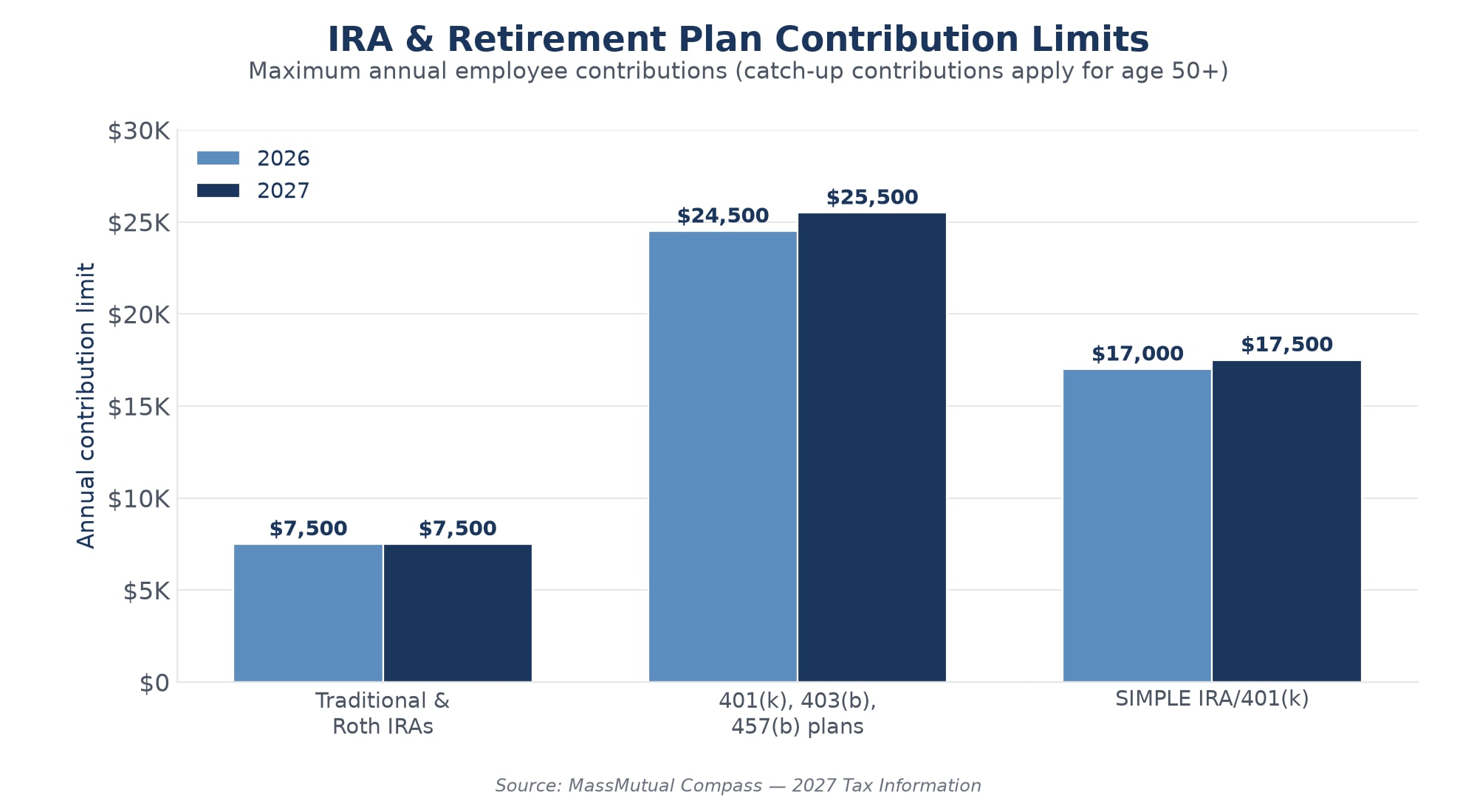
Every year, the IRS adjusts how much you can set aside in tax-advantaged retirement accounts. For 2027, the contribution limit for 401(k), 403(b), and 457(b) plans rises to $25,500 — up $1,000 from 2026 — while the limit for Traditional and Roth IRAs holds steady at $7,500. If you participate in a SIMPLE IRA or SIMPLE 401(k), your maximum contribution moves up to $17,500. These figures represent the base amounts; if you are age 50 or older, you may be eligible for additional catch-up contributions on top of these limits. The chart below compares the 2026 and 2027 limits side by side so you can see exactly where the changes land and plan your contributions accordingly.
Qualified plan benefit & compensation limits
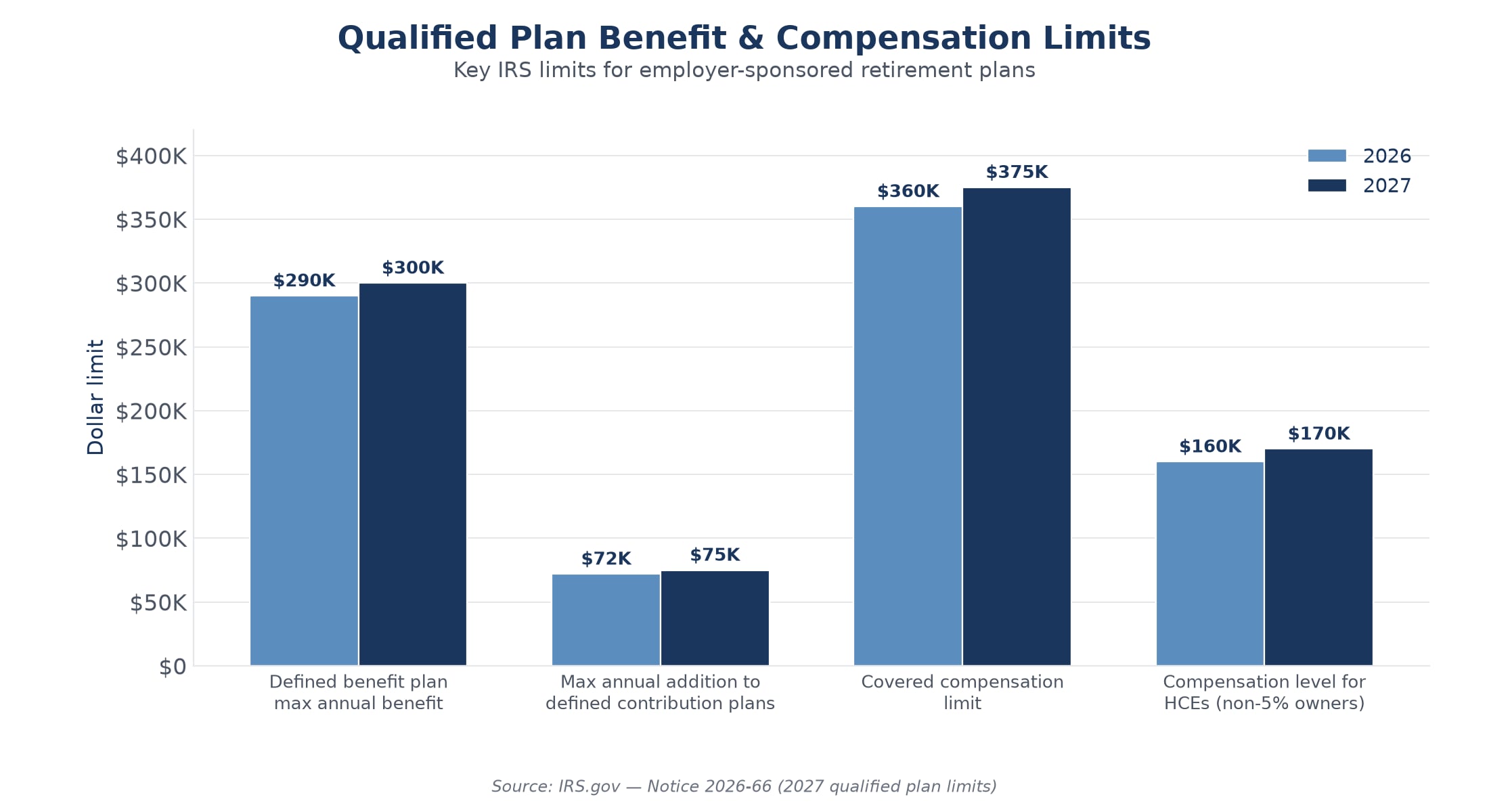
Beyond individual contribution accounts, the IRS also sets ceilings on employer-sponsored qualified retirement plans — and these limits shifted noticeably for 2027. The maximum annual benefit under a defined benefit plan increases to $300,000, while the maximum annual addition to a defined contribution plan rises to $75,000. The covered compensation limit — the maximum amount of compensation that can be considered for plan purposes — moves up to $375,000, and the compensation threshold for highly compensated employees (other than 5 percent owners) increases to $170,000. If you help administer or participate in an employer plan, these figures determine how much can be contributed and how highly-compensated employees (HCE) are identified. The chart below shows each limit for 2026 and 2027 so you can see the year-over-year adjustments at a glance.
Social Security key figures
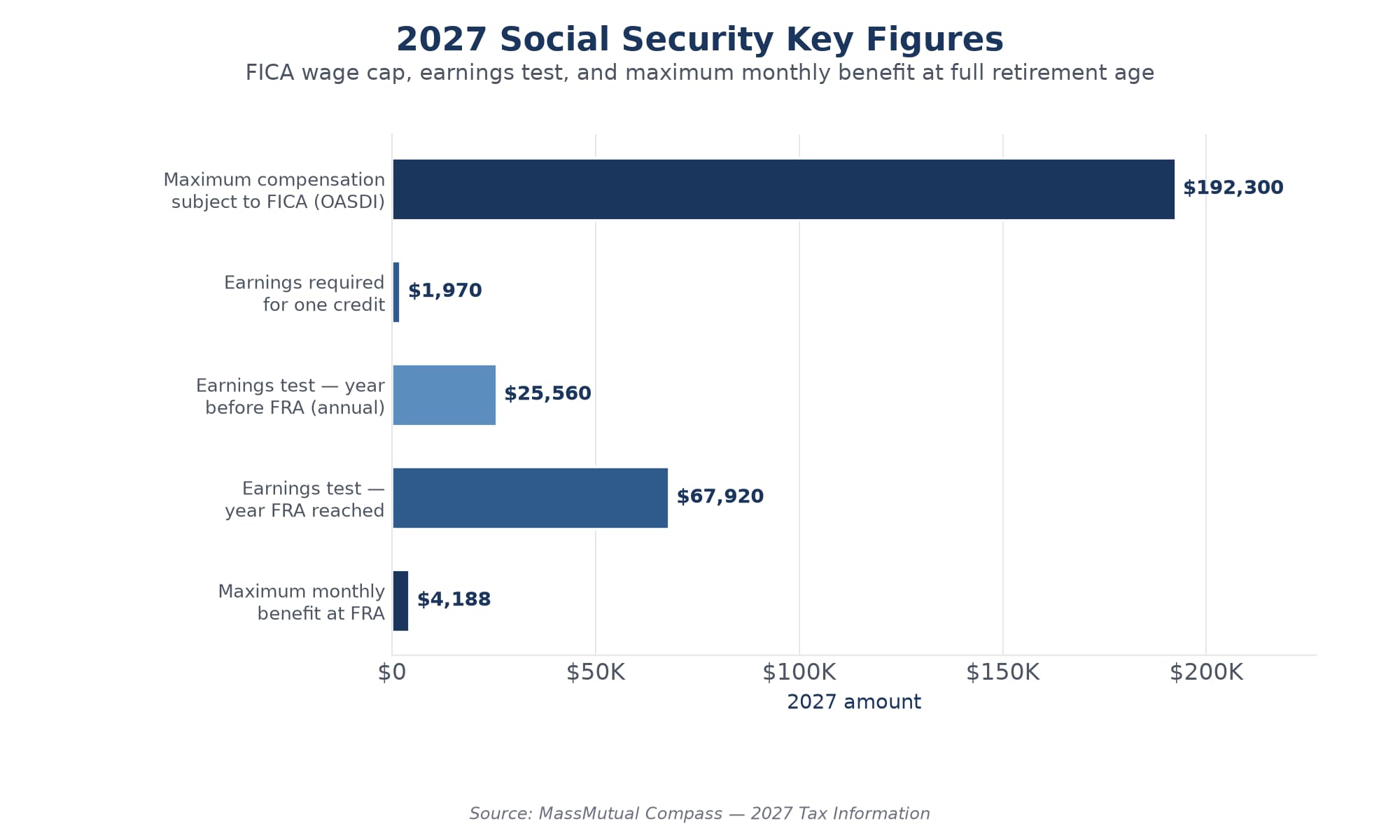
Social Security figures change each year based on national wage trends and cost-of-living adjustments. For 2027, the maximum amount of earnings subject to the Social Security portion of FICA taxes rises to $192,300, while the earnings required to earn a single Social Security credit increases to $1,970. If you have not yet reached full retirement age (FRA) and are still working, the earnings test allows you to earn up to $25,560 per year ($2,130 per month) before benefits are reduced; in the year you reach FRA, that threshold rises to $67,920 ($5,660 per month) for the months before you reach FRA.1 The maximum monthly Social Security benefit payable at full retirement age is $4,188, and the cost-of-living adjustment for 2027 is 3.6 percent. The chart below highlights these key figures so you can understand how they may affect your retirement planning.
Medicare information
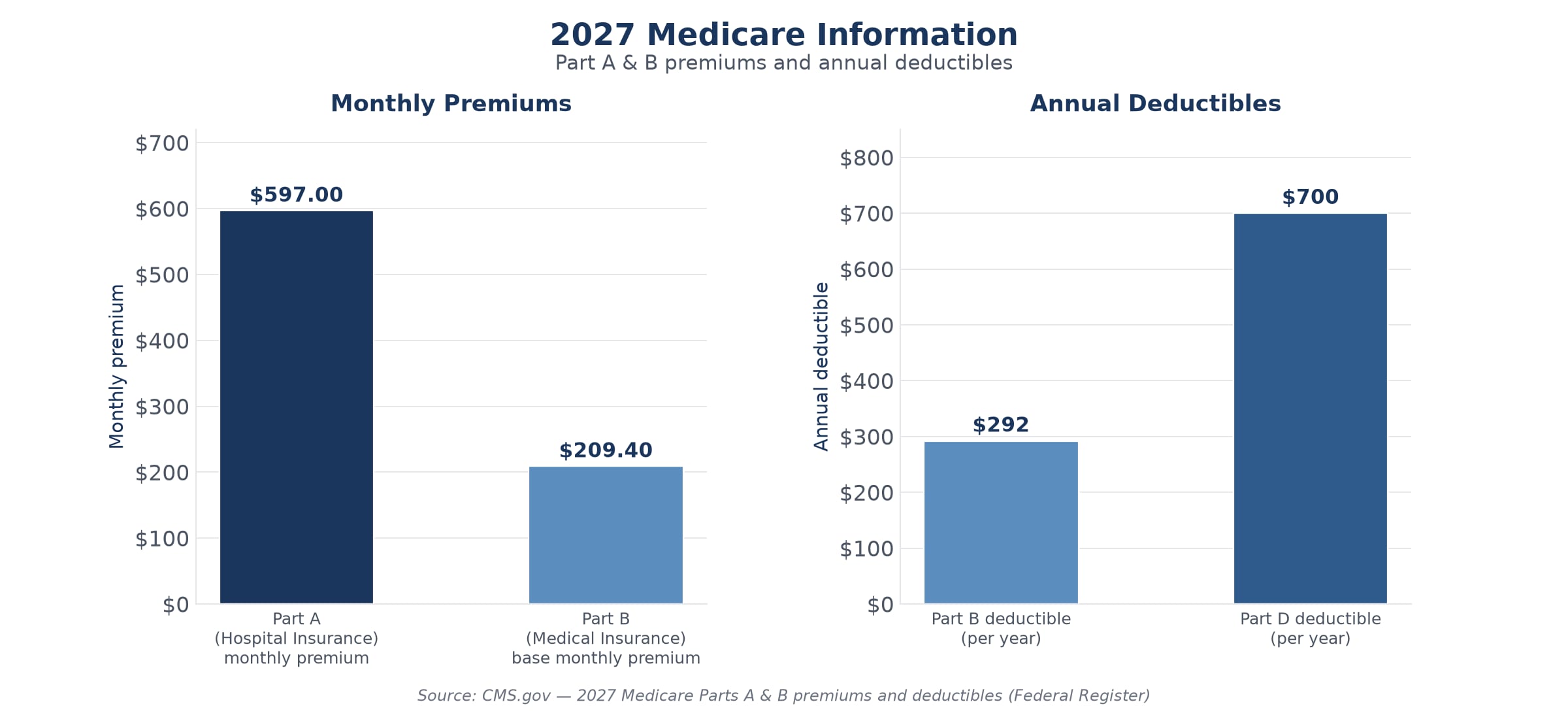
Medicare premiums and deductibles also see adjustments for 2027. The full monthly premium for Part A (hospital insurance), for those not eligible for premium-free coverage, is $597, while the Part B (medical insurance) base monthly premium is $209.40. On the deductible side, Part B carries an annual deductible of $292, and Part D (prescription drug coverage) has an annual deductible of $700. If your income exceeds certain thresholds — $112,000 for individual filers or $224,000 for joint filers — you may be subject to income-related monthly adjustment amounts (IRMAA), which increase your Part B and Part D premiums. The chart below breaks down these premiums and deductibles so you can estimate your out-of-pocket Medicare costs for the year. (Related: Medicare pitfalls in retirement)
Standard deductions
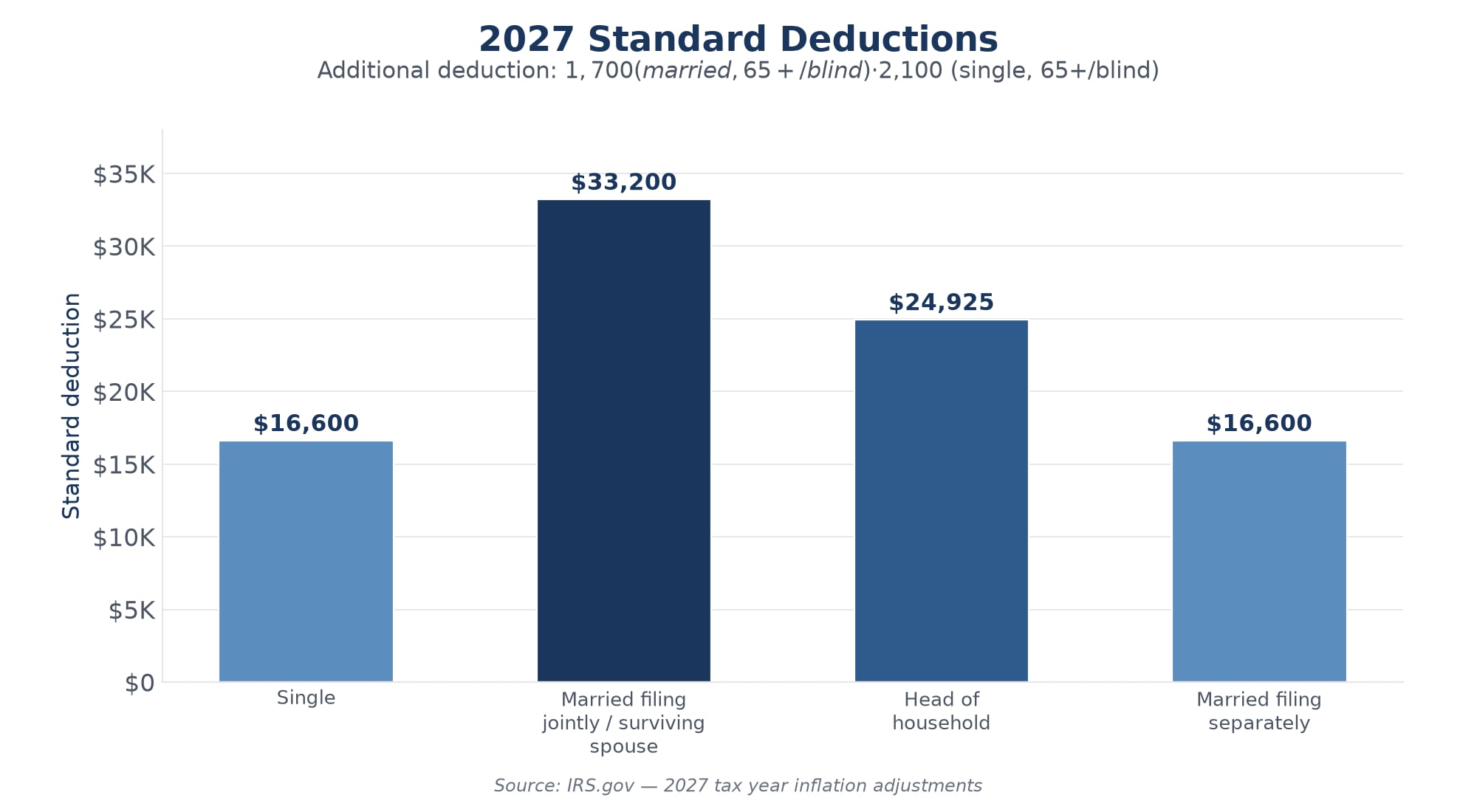
The standard deduction reduces your taxable income without requiring you to itemize, and the amounts increase slightly for 2027. Single filers and married individuals filing separately can claim a standard deduction of $16,600, while married couples filing jointly and surviving spouses get $33,200 — double the single amount. Heads of households can deduct $24,925. If you or your spouse is age 65 or older or blind, you may qualify for an additional standard deduction: $1,700 for married taxpayers and $2,100 for single filers. For 2025 though 2028, qualifying seniors age 65 or older may also be able to claim an additional deduction of up to $6,000, subject to income limitations. The chart below shows the standard deduction for each filing status so you can quickly identify the amount that applies to your situation.
Capital gains & dividend tax brackets
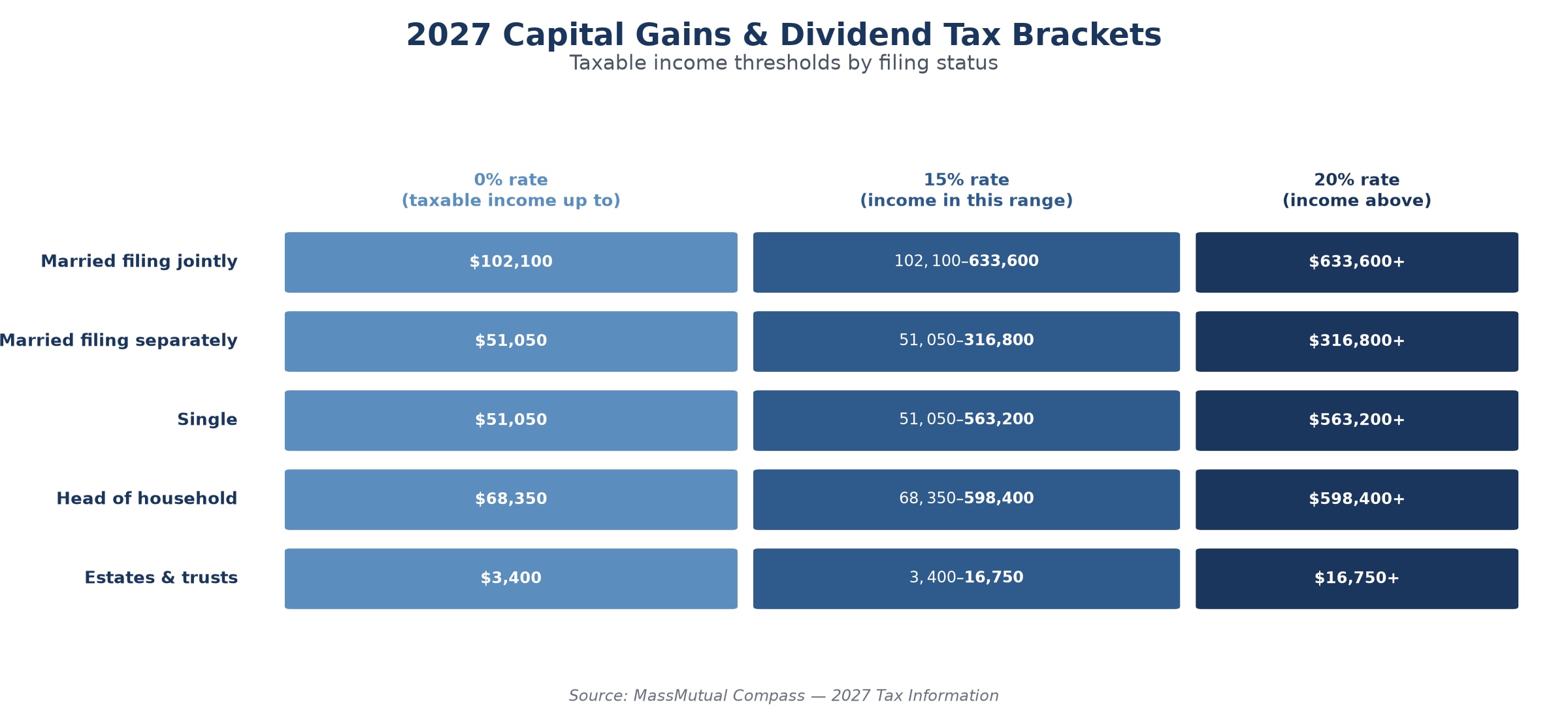
Long-term capital gains and qualified dividends are taxed at preferential rates of 0 percent, 15 percent, or 20 percent, depending on your taxable income and filing status. For 2027, married couples filing jointly pay 0 percent on gains up to $102,100, 15 percent on gains between $102,100 and $633,600, and 20 percent on gains above $633,600. Single filers hit the 15 percent bracket above $51,050 and the 20 percent bracket above $563,200, while heads of household cross into 15 percent above $68,350 and 20 percent above $598,400. Estates and trusts face the lowest thresholds, with the 15 percent rate kicking in above $3,400 and the 20 percent rate above $16,750. The chart below lays out each bracket by filing status so you can see where your investment income falls and estimate your potential tax liability. (Related: How to avoid and offset taxes on capital gains)
Federal gift & estate tax amounts
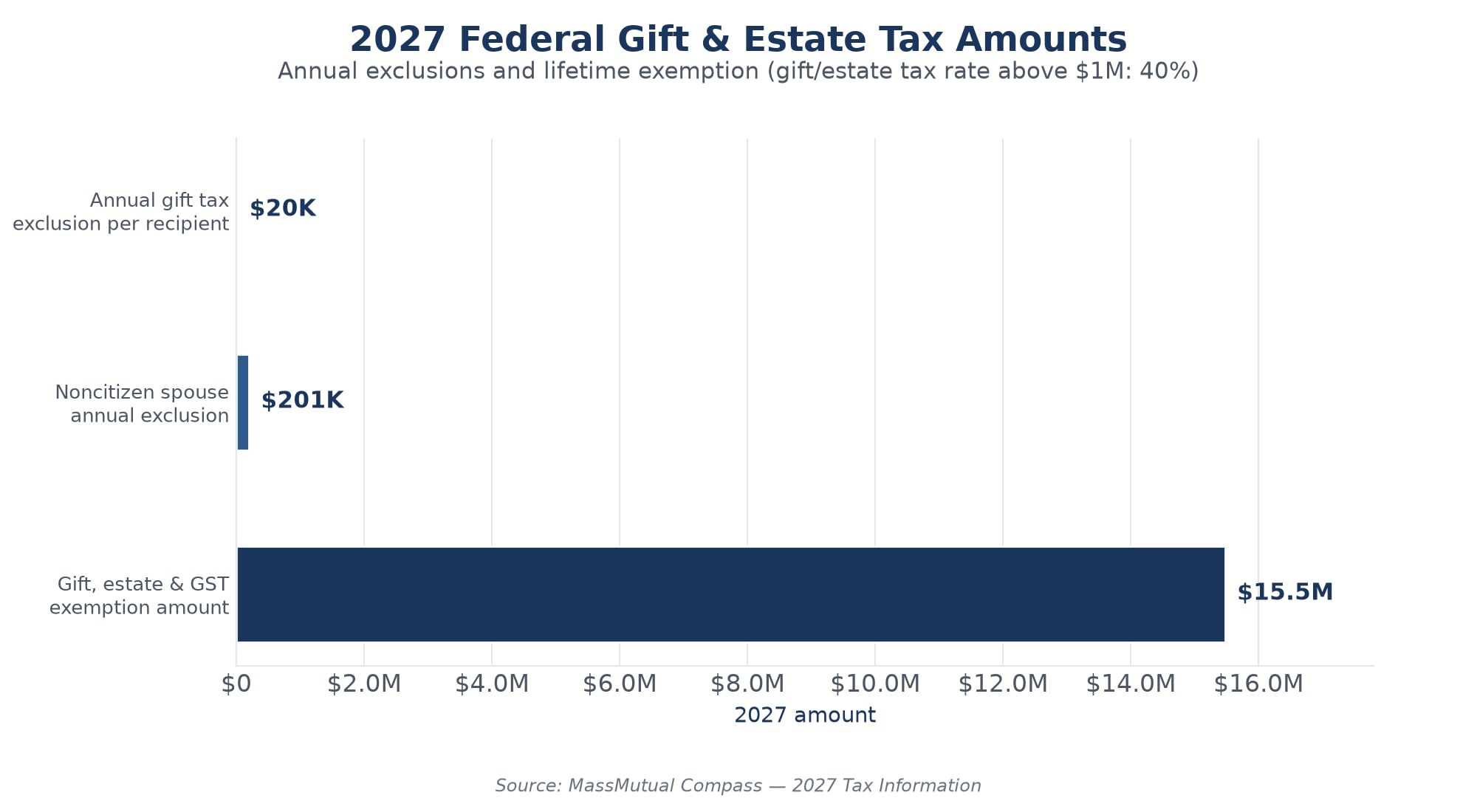
If you give assets to family or others, or if you are planning your estate, the 2027 gift and estate tax thresholds offer more room than ever. The annual gift tax exclusion — generally the amount you can give to any one recipient each year without filing a federal gift tax return — increases to $20,000 per recipient. If your spouse is not a U.S. citizen, the annual exclusion for gifts to that spouse rises to $201,000. The lifetime gift, estate, and generation-skipping transfer (GST) exemption climbs to $15,480,000, meaning you can transfer a substantial amount of wealth free of federal transfer taxes over your lifetime. Any amount subject to federal gift or estate tax above $1 million is subject to a 40 percent tax rate. The chart below shows these key amounts so you can see how much you can transfer tax-free in 2027. (Related: Estate planning tactics for gifting)
Health Savings Account (HSA) limits
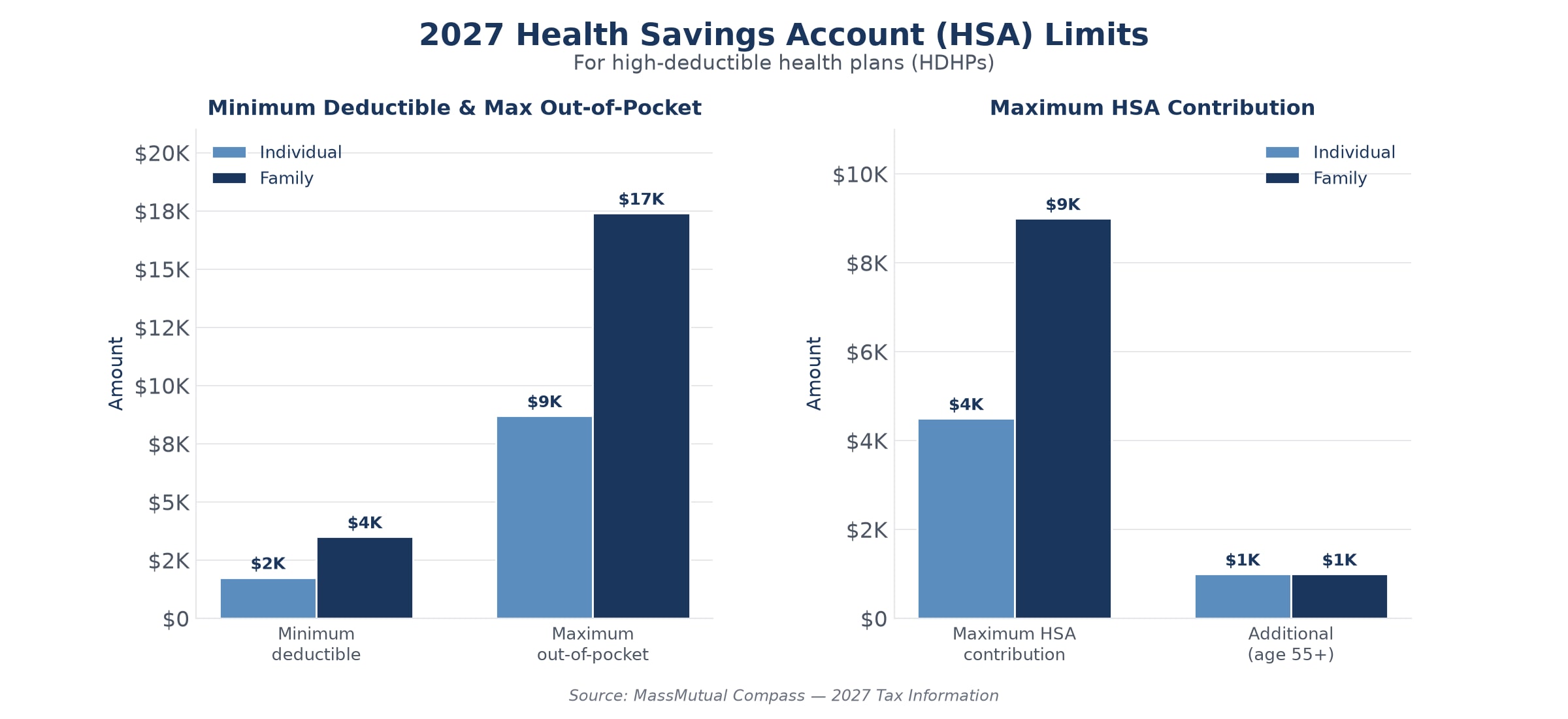
Health Savings Accounts let you set aside pre-tax money for qualified medical expenses if you are enrolled in a high-deductible health plan (HDHP). For 2027, the minimum deductible for an HDHP is $1,750 for individual coverage and $3,500 for family coverage, while the maximum out-of-pocket limit is $8,700 for individuals and $17,400 for families. The maximum HSA contribution is $4,500 for individuals and $9,000 for families, and if you are age 55 or older, you can make an additional $1,000 catch-up contribution. If both spouses are in the 55+ age range, the family contribution effectively increases further. The chart below compares the individual and family amounts for deductibles, out-of-pocket limits, and contribution maximums so you can make the most of your HSA in 2027.
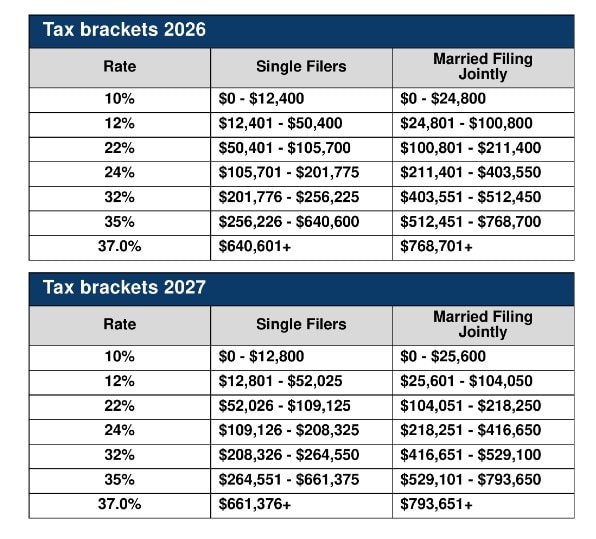
Tax brackets
Marginal tax rates won’t change in 2027. The seven rates will still be 10, 12, 22, 24, 32, 35, and 37 percent. The dollar amount you can earn within each tax bracket will increase for inflation — although by slightly less. It’s essentially a 3.2 percent bracket increase against a 3.7 percent inflation rate. (The IRS uses a chained CPI measure, which tends to run slightly lower than the headline inflation rate.)
Discover more from MassMutual …
Turning 73? Required minimum distributions explained
4 simple ways to delay Social Security
The retirement income crunch: Are you in it?
_________________