
| ||||||||||||

Bonds have long been the workhorse of a balanced investment portfolio, providing fixed income exposure and a counterweight to stock market volatility. Indeed, when stock prices fall, bond prices tend to climb, making them an effective hedge against equity risk — at least historically.
But, given the way that high-quality bonds have behaved in recent years during moments of economic uncertainty, it may be time for investors to consider other financial products that can potentially provide stability when the going gets tough.
“It used to be that buy-and-hold investors were advised to allocate their portfolio 60/40, where 60 percent was invested in stocks and 40 percent in bonds,” said Corey Schneider, a financial professional with Sentinel Solutions in New York City. “But during the most recent tariff tantrum, stocks fell off a cliff and bond yields rose, which pushed bond prices down, so that strategy didn’t work. The stock and bond markets were also down double digits at the same time in 2022, which hadn’t happened in nearly 150 years. Just because you haven’t seen it before, doesn’t mean it can’t happen.” (Related: When markets dive, keep your strategic calm)
Connect with a MassMutual financial professional
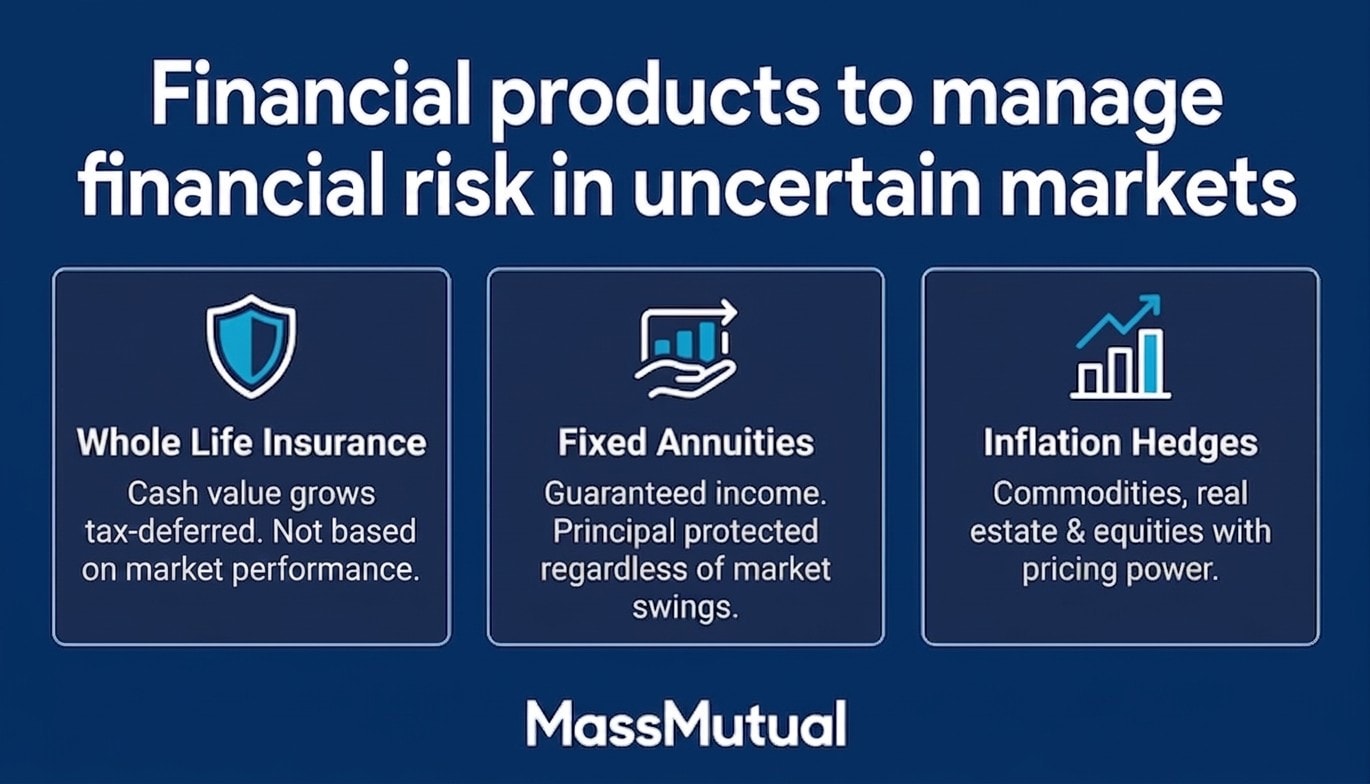
As such, he said, investors today who are looking to diversify more broadly might explore:
Accumulation phase versus decumulation phase
To be clear, there is no one-size-fits-all product mix. The investment strategy that’s right for you will be determined by your age, financial goals, and tolerance for risk.
But risk is borne in many ways, noted Schneider.
“If you don’t take the right amount of risk at the right age, you might not have enough money to retire. But if you take on too much risk during your decumulation phase, you may incur sequence of returns risk, which makes it more likely you will outlive your assets,” he pointed out. Sequence of returns risk occurs when a series of negative returns early in retirement combined with withdrawals serve to deplete a portfolio faster than expected.
“When the stock market is volatile, especially during the early years of retirement, and you don’t want to lock in losses by selling, we start looking to other assets from which to draw income to give retirement portfolios time to recover,” said Schneider.
The mix of financial products that Schneider recommends to clients is largely determined by where they fall on the retirement planning continuum:
- Accumulation phase — Those who are still saving for retirement might favor investments that involve greater risk, but also greater upside potential over time.
- Decumulation phase — Retirees who are already drawing down their assets might be better suited to products that provide a guaranteed income stream.
Whole life insurance
Life insurance, specifically whole life insurance, wears many hats. Its primary purpose is to provide a guaranteed death benefit to your named beneficiary when you die. Because the death benefit is generally paid out tax-free it is also sometimes used as an estate planning tool.
You can tap your cash value account for college expenses, an unexpected medical bill, or during bouts of unemployment.1 Or, you can use it to cover living expenses during stock market declines, giving your retirement i portfolio time to recover. (Learn more: How life insurance can help supplement retirement income)
“Whole life insurance cash value can be an alternate source of income for retirees as well as for business owners and parents who are paying for their children’s college expenses,” said Armando Sallavanti, a financial professional with Vista Wealth Solutions near Philadelphia. “The cash value takes some time to build up, but once it does, it is typically growing in a safe, secure way, at a guaranteed rate that could potentially beat inflation.”2
Schneider agrees: “In 2020, when the stock market was in a freefall and one of my clients, who owns a surgery center, needed enough money for payroll, the solution was to borrow the cash value from his life insurance policy,” he said, noting that his client paid the policy back when the economy recovered.
Annuities
Annuities can also help provide a steady source of income for retirees during periods of economic uncertainty, potentially more so for women who have longer life expectancies and face bigger hurdles on the road to retirement security. (Related: Why annuities may be more valuable for women)
An annuity is a contract between the policyowner and an insurance company that offers a guaranteed income stream either for life or for a specified period of time in exchange for an upfront payment or series of payments.3
Unlike nonqualified investments, annuities offer tax-deferred growth, meaning the contract owner does not pay taxes on the earnings they receive until it’s withdrawn in retirement, at which point they may be in a lower tax bracket. (Learn more: Different types of annuities explained)
By purchasing an annuity to cover the gap between their living expenses and any other sources of steady retirement income they may have from Social Security, pensions, or trusts, retirees can help eliminate some of the worry when their investment portfolio balance declines due to market conditions.
“Annuities can provide a guaranteed income stream, which can be a great way to secure part of your retirement income,” said Sallavanti. “Index-linked deferred annuities, where growth potential is tied to a market index, may also enable investors to participate in some market gains while providing a level of downside protection during market downturns.” Index-linked annuities are complex, have restrictions and limitations, such as caps and participation rates, are illiquid, and have the potential for loss. (Learn more: Life insurance and annuity alternatives in investing)
Cash and cash equivalents
When markets are volatile, it’s important to have cash or cash-equivalent accounts on hand, which may enable you to pay the bills regardless of how your investments perform.
Having a cash cushion available may also give investors the confidence to maintain their strategic calm, avoid knee-jerk reactions to market swings, and potentially maximize their returns. (Related: 3 tips to avoid locking in losses)
Financial professionals often recommend having at least three to six month’s worth of living expenses set aside in a liquid, interest-bearing account, such as a savings account or money market account. But those who are self-employed, single, or have income instability may need 12 months of living expenses saved for financial security. Retirees who depend on their investment income may need even more. (Related: Preparing for bad times)
“As a business owner myself, it is priceless to have three months of my expenses for my business, as well as three months of my personal expenses set aside at all times,” said Sallavanti. “There is nothing that gives me more peace of mind than this — knowing that a bad economy or season in business can be weathered by my cash reserves.”
Inflation hedges
Inflation is an insidious thief, eroding the value of savings and investments over time. As the price of goods and services climbs, purchasing power falls.
Rising prices are a bigger financial challenge for retirees who are living on a fixed income, making it harder to maintain their desired living standard and putting them at greater risk of outliving their assets.
Investors can potentially help insulate themselves against inflation risk by adding assets to their portfolio that have shown resilience when elevated inflation reigns. (Be aware, of course, that past performance is no guarantee of future returns.) Those include:
- Commodities, such as energy, precious metals, and agricultural products, often experience price increases when inflation climbs.
- Real estate. Depending on the type of property owned, investing in income-producing real estate may help hedge against inflation as property values and rental income tend to climb when inflation rises. Keep in mind that earnings potential may be negatively affected by the tax treatment of this type of investment. (Learn more: Should REITs be in your portfolio?)
- Stocks, or equities, can potentially be a long-term hedge against inflation, especially those issued by companies that tend to benefit from inflation. A well-diversified portfolio of stocks across all sizes and sectors can sometimes help flatten volatility over the long term.
Conclusion
Investing can be an effective way to build wealth, but the markets don’t always go up — and bonds may not provide the downside protection that investors have come to rely on.
By adding financial products that help to counter market swings, however, you can potentially stabilize your long-term returns and keep your investment strategy on course.
A financial professional can help you determine which financial products may be a fit for your unique profile and objectives.
______________________________________
Frequently Asked Questions about how to protect your portfolio in market uncertainty
Q: What role can whole life insurance play in a volatile market?
A: The primary purpose of whole life insurance is to provide a guaranteed death benefit to your named beneficiary when you die. But whole life insurance offers living benefits as well. For starters, it accumulates cash value that grows at a guaranteed rate that is tax-deferred for as long as you continue to pay the required premiums. Critically, this cash value is not tied to the stock market. During a downturn, you can tap your cash value account to cover living expenses, medical bills, or other needs — giving your equity investments time to recover. However, it's crucial to understand that taking a loan from your life insurance policy can have significant negative effects, including reduced death benefits, increased lapse risk, and potential tax consequences.
Q: What is a fixed annuity and how can it potentially help in uncertain markets?
A: fixed annuity is an insurance product that provides a guaranteed stream of income and protection of principal, regardless of what the stock market does. Because its value is not directly tied to market performance, it offers a level of predictability that bonds may lack. For those in the accumulation phase of retirement planning, a fixed annuity can potentially serve as a stable foundation — generating income you can count on even when other asset classes are struggling.
Q: What does "inflation hedging" mean, and which products offer it?
A: Inflation hedging refers to investing in assets whose value tends to rise alongside inflation, helping to preserve your purchasing power. Historically, commodities (such as energy or precious metals), real estate, and equities in sectors with strong pricing power have been more likely to appreciate when inflation climbs, but past performance is no guarantee of future returns.
Discover more from MassMutual…
Understanding asset allocation
What to do with real estate proceeds
Need a financial professional? Find one here
_______________________________________
1 Tapping cash value can reduce the death benefit and cash value of the policy, increase the chance that it lapses, and result in a tax bill if the owner dies while a loan in excess of the cost basis is still outstanding. (Learn more: Treat your cash value with care)
2 Distributions under the policy (including cash dividends and partial/full surrenders) are not subject to taxation up to the amount paid into the policy (cost basis). If the policy is a Modified Endowment Contract, policy loans and/or distributions are taxable to the extent of gain and are subject to a 10 percent tax penalty if the policyowner is under age 59½.
3 Guarantees are subject to the claims-paying ability of the issuing insurance company.