
| ||||||||||||

Two financial options have become popular as savings vehicles among conservative investors approaching or in retirement: certificates of deposit (CDs) and fixed-rate annuities, particularly multiyear guarantee annuities (MYGAs).
Why?
Both offer some attractive features in terms of security and growth, which can appeal to risk-averse investors. And because of the similarities, such investors might consider choosing between the two.
“A CD can loosely be compared with a multiyear guarantee annuity in that both offer a fixed rate for a certain period of time, with a full refund of principal at the end of their respective terms,” noted Doug Collins, financial planning director with Fortis Lux in New York City.
While there are similarities, there are important differences between the two in terms of liquidity and some types of risk. Understanding the pros and cons as well as the differences is critical to making a decision about which type of holding makes sense for anyone’s portfolio.
Definitions
As a starting point, it’s important to understand the basic structure of what each vehicle is.
- Certificate of deposit. This is essentially a special savings account where a bank pays better-than-typical interest on a fixed amount of money for a set period of time.
- Multiyear guarantee annuity. This is a contract with an insurance company where the invested funds grow on a tax-advantaged basis at a fixed interest rate with the guarantee of an income stream at some point in the future.
“A CD, which is generally offered by a bank, offers a fixed rate of return for a specific period of time,” noted Jeffrey Rotman, wealth management advisor at Rotman & Associates in Boca Raton, Florida. “It ranges from one month to as long as 5 years or more. Usually, a one-year CD seems to be the most popular. And typically, the longer the term, the higher the rate. A fixed annuity [like a MYGA] is offered by an insurance company. … The fixed annuity is similar in duration, however, it has a significant surrender charge for cashing in early.”
Beyond these basic definitions, each option has specific advantages and disadvantages.
CDs: Pros and cons
Pros
- Safety: Because CDs are typically issued by banks, they are covered by the Federal Deposit Insurance Corporation (FDIC), which insures up to $250,000 per depositor, per insured bank.
- Guaranteed returns: CDs offer fixed interest rates, locking in gains over the term of the deposit. The interest rates on CDs are typically a little higher than those for regular savings accounts, since the bank can count on the money being there for a set amount of time.
- Defined timing: CDs come in various terms, usually ranging from a few months to 10 years. Typically, the interest rate on a CD is higher the longer the maturity. An investor can choose a term that aligns with their financial goals and liquidity needs.
These qualities make CDs a safe investment option for those looking to preserve their principal and earn a return. But there are limitations.
Cons
- Liquidity: Withdrawing money from a CD before its maturity date typically results in a penalty.
- Lower returns: The returns on CDs are generally lower compared with other investment options, like fixed annuities and market-based investments.
- Inflation risk: The fixed interest rates on CDs may not keep pace with inflation.
These drawbacks mean CDs are less attractive for those who may need quick access to their funds or want higher growth potential.
MYGAs: Pros and cons
Before examining the specific pros and cons of MYGAs, it’s important to understand that they are just one type of annuity among a wide range of choices. Some annuities are aimed at accumulation over time through various types of interest or investment mechanisms. Others are aimed at establishing a stream of income immediately or on a deferred basis at some point in the future. (Learn more: Different types of annuities explained)
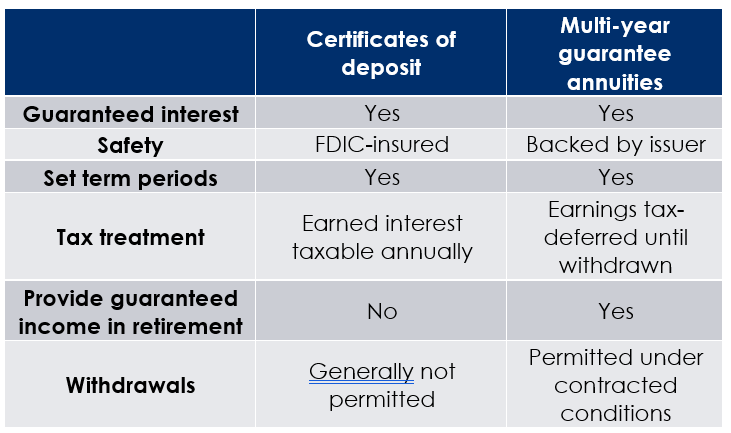
MYGAs are a type of fixed-rate deferred annuity. They are typically purchased with a single premium and provide a predetermined and contractually guaranteed interest rate for a specified period of time. In that sense, they can resemble certificates of deposit, in terms of guaranteeing a certain rate of return on an investment over a defined amount of time. And, depending on the contract terms, they can allow for withdrawals under specific conditions. Also, as an annuity, they offer you the opportunity to have a guaranteed stream of income at a future point in time — like when you retire.
Pros
- Higher interest rates: MYGAs often offer higher interest rates compared with CDs, especially for longer terms. That’s because insurance companies typically have a wide range of investments that can enable them to be more competitive on rate offerings.
- Guaranteed return: Fixed-rate annuities, such as MYGAs, can guarantee an eventual income stream, making them attractive as a source of retirement income.
- Tax-deferred: The interest earned on such fixed-rate annuities is not taxed until withdrawal.1
So, compared with CDs, MYGAs can offer a higher annual return that is not subject to annual taxes. And the guarantee of a future income stream can be especially attractive for retirees seeking financial stability in the years ahead.
Cons
- Liquidity: Withdrawing funds early from any annuity, including MYGAs, can result in significant penalties and surrender charges. And the time commitment to an annuity can be significant, typically at least five to 10 years or more.
- Complex: The terms and conditions tied to some annuities can be complicated.
- Risk: Unlike CDs, fixed-rate annuities are not FDIC-insured. They are backed by the issuing insurance company. So, the financial strength of the issuing company is important. (Check MassMutual’s strength here)
The commitment necessary and possible complexity of annuities can be off-putting from some investors.
Which option for what investor?
Both types of investment can appeal to conservative investors, in that they are relatively secure and have guaranteed rates of return. Those rates of return will typically be less than market-based investments, but that’s the trade-off for less risk. Investors in these vehicles are prioritizing safety and capital preservation over high returns. (Related: What’s your risk tolerance?)
Fixed-rate annuities like MYGAs typically offer higher rates of return than CDs.
“The rates for fixed-rate annuities trend a bit higher than CDs and the fixed annuity is tax-deferred,” said Rotman. “Tax deferral means there are no 1099 forms each year and no taxes until withdrawal. And some annuities can also have a long-term care provision that will allow full surrenders without a penalty if those services are needed.
However, CDs are ultimately insured by the government, and so can be deemed by some as a little safer.
“Sure, a bank is FDIC insured and an insurance company is backed by the full faith and ratings of the insurer,” observed Rotman. “But the highest-rated insurance companies have been around for well over 100 years and survived the Great Depression, whereas most banks failed.”
Beyond security, there are also tax considerations to take into account.
“Perhaps the advantage of a fixed-rate annuity over a CD is the ability to continue to defer tax past the maturity date by keeping the money within an annuity’s tax-deferred structure,” Collins pointed out. “A CD will pay the interest to a depositor each year and therefore incur a taxable event each year.”
Laddering
Timing may also be a factor in considering which investment is better suited to a particular investor.
CDs may be more appealing to those investors who may want some near-term liquidity options, in that maturities for CDs can be a little more flexible. For example, if you think you may need a new car in a year or so, you can put funds into a one-year CD to grow at an interest rate that’s better than your savings account. When the CD matures, go car shopping.
Indeed, some people adopt a “ladder” approach where they buy multiple CDs with different maturities. That way, funds can become regularly available at different times as the different CDs mature. The investor can use those funds if needed, or reinvest them in another CD, extending the so-called ladder.
Some investors adopt a similar approach to fixed-rate annuities, cashing them in after their surrender periods in order to use or reinvest the money in another annuity or investment. But since annuities tend to have longer surrender periods — a number of years at a minimum — this only makes sense for those people with longer-term financial strategies. (Related: You can ladder life insurance too)
Conclusion
Given these timing and return differences, fixed-rate annuities like MYGAs are likely best suited for investors who are focused on long-term financial planning as they prepare for retirement. They can particularly appeal to individuals seeking to establish a guaranteed income stream in their retirement years and are willing to commit their funds for an extended period. Such investors should be comfortable with the possible complexity and risk in annuities in exchange for higher returns and tax advantages.
“This year is a good opportunity to take advantage of the long-term rates in fixed annuities,” advised Rotman. “As interest rates decline and the future is unknown, some fixed annuities are currently offering a six-year term at roughly 4.45 percent. This could potentially insulate you from the decline in rates that have affected the CD market over the last year and are expected by some to continue to decline. Currently, most FDIC banks are between 4.0 and 4.25 percent on a five-year term. Fixed annuities can also offer guaranteed income for life with annuity payout options if the need for guaranteed income for life is a consideration.”
CDs are likely better suited to those investors who put added emphasis on safety but still want a better-than-savings-average return on their money. And CDs are likely more appropriate for those who may have relatively short-term needs for funds, like an eventual home repair or major purchase.
On the fence? A financial professional can help further sort out the differences between the two and personalize what each has to offer in a particular individual situation. To locate a MassMutual financial professional, you can use this tool or let us know you’d like to speak with one.
Discover more from MassMutual …
How to close a retirement income gap? One possible solution
How to live off interest only in retirement
_____________________