| ||||||||||||

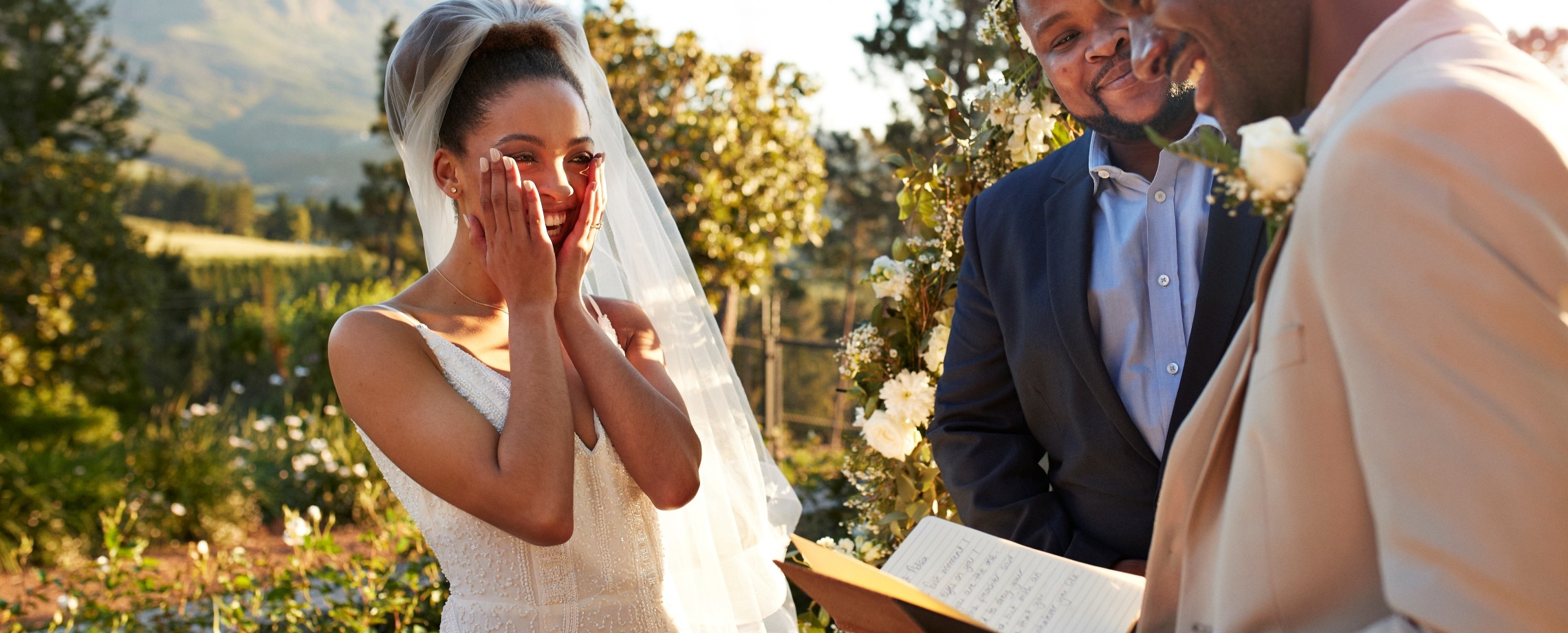
Microweddings. You can immediately guess what they are, even if you’ve never heard the term before. They’re a rebellion — often practical and sometimes ideological — against the wedding-industrial complex. They’re bigger than an elopement, but they’re a fraction of the extravaganza whose guest list might include your dad’s carpool buddy from 25 years ago.
Couples’ motivations for choosing a microwedding are more varied than you might expect. Their small scale isn’t just about cutting costs; it’s also about control. It’s for the bride who dreads the attention of walking down the aisle, the midlife couple with mouths to feed, and the self-sufficient 20-somethings who don’t want to trade their down payment for a party.
But opting out of tradition isn’t as simple as slashing your guest list. If you’re wondering whether a microwedding is the right choice for your special day, here’s a look at how they differ from larger affairs and how two real couples pulled off their celebrations for under $10,000.
However you celebrate, protecting what comes after the wedding is worth planning for — starting now. To create or revise your financial plan and insurance coverage as a new household, get in touch with a MassMutual financial professional today.
Connect with a MassMutual financial professional
What is a microwedding, exactly?
The concept isn’t new. The terminology is relatively recent. But not everyone agrees on what it means.
It’s not an elopement, according to Christopher Shelley, a licensed professional wedding officiant and owner of Illuminating Ceremonies.
"An elopement is two people and an officiant and a photographer by a tree in a park,” he said. “More than five guests and it's not an elopement anymore." Shelley puts microweddings at roughly six to 30 people.
Both couples and vendors might use the terms "elopement" and "microwedding" interchangeably, notes Ariana Straznicky-Packer of Ariana Strings, a live string performance company serving New England and destination events. But to her, an elopement still implies something spontaneous and private.
Whatever you want to call them, their common thread is their intention and intimacy.
Who chooses a microwedding, and why?
Joe Cullen and his then-fiancée, now wife, Julie knew about the option to get married at city hall, but they wanted something that felt a little more traditional and less like an elopement. The microwedding concept — which he discovered on a photographer’s website — seemed like the perfect fit.
Microweddings can also be right for folks who don’t want the stress of planning a huge event or being in the spotlight.
“The most common thing I see is people who are just a little more introverted, and the idea of having a big wedding where you have to work a room of 100 people is really daunting,” said Jusmine Martin, owner of microwedding space Dearly Studio and justice of the peace in Somerville, Massachusetts.
People who had big weddings for a previous marriage — or who were never into them — are good candidates for microweddings too.
Bucking tradition means tuning out a lot of noise, however.
“The people who do smaller weddings are more confident in knowing who they are,” Shelley said.
People who have practical reasons for needing to get married quickly — like insurance, civil rights, or immigration — might want to separate the legal ceremony, which requires little planning, from the larger party, which can require months or years of work.
“Some people are finding they don’t need the big party once they separate the two, and some people still do both,” Martin said.
Another common motivation for having a microwedding is to celebrate across geographically distant locations when the couple’s families live abroad, Straznicky-Packer said. If the bride is from Canada and the groom is from France, the couple might hold two separate microweddings, one in each country.
And Martin said she’s worked with many couples who struggled for years to commit to a venue.
“They just wanted to be with their closest people, but when they looked for inspiration, they were only being presented with two options: an enormous wedding or a courthouse elopement,” she said. “The rise in popularity of microweddings means couples have more examples to draw from in the middle.”
Winning the library lottery
Joe and Julie got married at the historic Boston Public Library in Copley Square in 2026. Instead of the $8,000 minimum they would have paid to rent the library’s Guastavino room on a Saturday, they paid $200 to rent a portion of the room for an hour on a Monday morning — an opportunity they won by entering the library’s lottery system for the space and date. It allowed a maximum of 12 guests plus the couple, photographer, and officiant.
After the ceremony, the couple and their photographer made the 15-minute walk to the nearby public gardens. “The places we staged the photographs were not only beautiful, they were also low traffic because it was a Monday,” Julie said.
While the bride and groom had their photos taken, their guests walked over to Saltie Girl, a neighborhood seafood restaurant. The couple rented one of its private event spaces for their friends and family to enjoy hors d'oeuvres. Joe and Julie joined them afterward, and everyone ordered lunch from the regular menu. Between the ceremony, wardrobe, photographer, and lunch reception, their total wedding cost was around $7,000.
"We have no regrets,” Cullen said. “And we also just happen to not have huge bills either."
Bluegrass and bourbon on a budget
Rae Hartley Beck got married in Red River Gorge, Kentucky. Instead of hosting the event in her or her husband’s own hometowns, they tied the knot where they had originally met — which made it a destination wedding for most of their friends and family.
They housed 14 people in a rented mansion for three days and looked for ways to cut costs on things that didn’t matter to them. The couple held a morning ceremony at the mansion with family only, followed by lunch at a famous local pizza and rock-climbing joint.
That night, they held a larger reception for 65 people from 8:00 p.m. to midnight. By skipping the traditional sit-down dinner, they were able to reallocate their budget to a live bluegrass band and good bourbon.
“It was awesome,” Hartley Beck said. “I do not regret keeping it small.”
The total wedding cost was under $6,000 in 2016, or about $8,200 in 2026 dollars.
Microwedding costs: Do microweddings save money?
The median wedding cost more than $34,000 in 2025, according to The Knot. The venue tended to be the most expensive element, running from $3,500 to almost $25,000.
Needing a spacious venue for a large guest list can limit your options and increase your costs. A small guest list can also reduce costs for food, alcohol, and decor. (Related: How to save on a wedding)
“Lots of my couples opt for a restaurant wedding reception to curb costs,” Martin said, because they don’t have to rent things like chairs, tableware, or decor.
However, some wedding vendor costs don’t scale down with guest count.
“In the case of music, it doesn't matter if you're playing for four or 400 people — the service is the same,” Straznicky-Packer said.
Microwedding couples’ priorities
In getting remarried at age 48, Joe said he and Julie had higher financial priorities than paying for a large wedding: college and daycare costs for the children in their blended family, maintenance on the properties they own, and saving for retirement. (See: Blended family finances for new stepparents)
“There's always a way to make it work with your style, personality, and budget,” Julie said.
Bypassing traditional wedding expenses allows some couples to change the trajectory of their lives.
“Saving the money allowed us to buy our first house,” Hartley Beck said. “If we’d had a big wedding, it might have taken us five more years to get on the property ladder, and I don’t know if we would have been able to because the market went up so much over that time.”
Similarly, Martin said she worked with a couple who was initially planning a big wedding, but then ended up finding a home they wanted to buy much sooner than expected. They decided to put their wedding budget toward the house and have a ceremony with just their parents. Two years later, the couple held a big party with a larger guest list.
"Micro" doesn’t automatically mean inexpensive, however.
“You can drop tens of thousands of dollars,” Martin said.
Sometimes, people get their hearts set on a certain wedding vision from what they’ve seen on Pinterest or Instagram without realizing that they’re looking at a $250,000 wedding, she said. To have exactly the kind of day they want, they might choose to scale down the guest list.
A typical couple she works with might spend $1,600 for Dearly Studio’s one-hour package. For the reception, they might spend $1,800 for a private dining experience nearby, and $800 on décor (such as flowers).
“That’s $4,200 before photography or videography, hair and makeup, outfits, invites, cake, etcetera,” Martin said. Some couples will use the savings over a larger ceremony to afford a higher-priced photographer or more hours of coverage. “It’s all about priorities,” she added.
Indeed, a microwedding might cost more per guest than a larger wedding to create the couple’s desired experience.
“Our last two microweddings had string quartet plus piano and string trio plus drums, respectively,” Straznicky-Packer said, whereas a 200-person wedding is more likely to request a solo violinist.
The social cost of a microwedding
“The main caution against microweddings is the real possibility that you will have to disappoint many friends and family members who would have wanted to attend,” Shelley said. “Assuaging those people may require additional events, and then the headache of planning isn't better, it's just different.”
Some couples who want a microwedding aren’t comfortable saying no to family members who want a larger wedding — and who may be offering to foot the bill.
“If you’re younger and your parents are bankrolling your wedding, there are strings attached,” Julie said. “That wasn’t the case for us, so we had flexibility to do what fit our preferences.”
Still, the smaller the wedding, the less likely people may be to feel offended, hurt, or left out.
“If you say your venue only holds 20 people, most people don't expect to be in that 20,” Martin said. “If it's 100, they might be like, what? I'm not even the 100th most important person in your life?”
At the same time, seeing wedding photos and videos online might make some friends and family feel excluded in a way they wouldn’t have historically.
Making the right choice for your future
A microwedding can be a great choice for couples who feel it best aligns with their personalities and values. However, couples who do want a big wedding might feel shortchanged if they settle for something small, even if it saves them time and money. As a middle ground, a microwedding can be a way to address practical reasons to get married sooner while allowing more time to save and plan for a big party later.
____________________________
Frequently Asked Questions about microweddings
Q. What exactly is a microwedding, and how is it different from an elopement?
A. A microwedding is an intimate ceremony typically involving roughly six to 30 guests — think your closest circle, not your dad's carpool buddy from 25 years ago. Where an elopement is often just the two of you (or nearly so), a microwedding gives you a real celebration — just a deeply intentional, curated one. The common thread isn't the headcount; it's the intention and intimacy behind the event.
Q. Will a microwedding actually save you money?
A. In most cases, yes — significantly. The median traditional wedding cost more than $34,000 in 2025, with venue costs alone ranging from $3,500 to nearly $25,000. A smaller guest list directly reduces what you spend on venue size, food, alcohol, and décor. One couple, for example, paid just $200 to hold their ceremony at the Boston Public Library rather than the $8,000 minimum a Saturday rental would have required. That said, "micro" doesn't automatically mean inexpensive — the savings depend entirely on the choices you make.
Q. Beyond cost, what are the real reasons couples choose microweddings?
The motivations are far more varied than you might expect. Some couples simply don't want the spotlight — a microwedding is the right fit for the bride who dreads walking down the aisle or anyone who finds large-scale social events overwhelming. Others have urgent practical needs, such as insurance, civil rights, or immigration, and want to separate the legal act of marriage from a future, larger celebration. Still others, like couples with families spread across continents, use intimate ceremonies to navigate geography. And for some, the savings unlock a larger life goal entirely — one couple used the money they saved to buy their first home.
_________________
Discover more from MassMutual…
Love and money: A financial guide for romance
How to share finances in marriage: The mutual payoff
Approaching a prenup before the honeymoon ends
__________________________