
| ||||||||||||

You’re in your 50s, or thereabouts. Your kids have grown and flown. And your caregiving responsibilities for an aging parent have come to an end. Welcome to the empty nest.
It might take a minute to adjust to this next life stage, and here’s hoping you soon embrace the relative calm. But the years ahead also bring new opportunities to get your financial house in order.
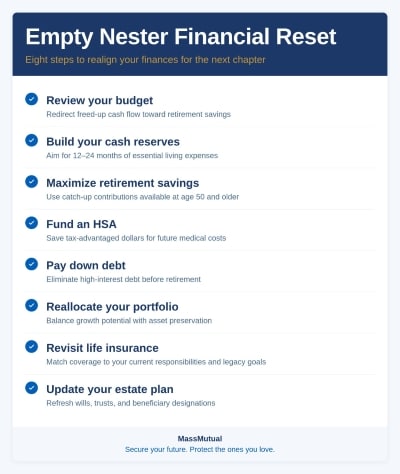
With fewer expenses during what are likely to be your peak earnings years, you can potentially make a meaningful difference in your future quality of life by following these steps:
- Review your financial plan.
- Build your cash reserves.
- Double down on savings.
- Fund an HSA.
- Pay down debt.
- Reallocate your investment portfolio.
- Revisit your life insurance coverage.
- Review your estate plan.
“The empty-nest stage is really a financial reset point,” said Bryan Bibbo, a financial professional with Prosperity Capital Advisors in Avon, Ohio. “It is an opportunity to realign your plan with the next chapter of life, while your household may still have time and income to make real progress.”
Review your financial plan
Indeed, when your status shifts to empty nester, your first step should be to review your financial plan to be sure it still aligns with your goals and objectives.
“You need to update your financial plan around your household’s new reality,” said Bibbo. “What changed? What expenses went away? What new goals have emerged? What does retirement look like now?”
Other questions to ask yourself include:
- Where can we save more?
- Where can we spend less, or redirect cash flow more intentionally?
- Do we still need to support adult children?
Bibbo noted that many of his clients in preretirement enjoy greater financial flexibility.
“Expenses tied to children, school activities, groceries, transportation, and caregiving often decline,” he said, noting those dollars can be redirected to other goals.
Connect with a MassMutual financial professional
Build your cash reserves
The next step is to bolster your financial safety net.
When you’re younger, the standard rule for an emergency fund is to hold three to six months’ worth of living expenses in a liquid, interest-bearing account. Those on the cusp of retirement, however, may need 12 to 24 months’ of essential living expenses set aside. Why? Because retirees:
- Lose the luxury of being able to replenish their cash reserves with new earnings.
- Need a bigger cash cushion to draw from during periods of market decline, giving their investments time to recover.
- Typically have higher health care costs as they age. (Related: How to plan for higher health care costs as you age)
Double down on retirement savings
Your 50s and early 60s are also an opportune time to double down on your retirement savings, which can make a significant difference in your future lifestyle.
Start by maxing out your 401(k) or traditional IRA and take advantage of catch-up contributions for those age 50 and older. (Review the pretax contribution limits to see how much you can save.)
You can contribute up to $24,500 to your 401(k) in 2026, plus an additional $8,000 if you are 50 or older, for a total of $32,500.1
By contributing $2,708 monthly (or $32,500 per year) to your retirement account for the next 10 years, your retirement account balance could increase by about $449,000, assuming you retire at age 67 and achieve an average 7 percent annual return, according to an Investor.gov calculator.2
A financial professional can help you determine whether your savings and investment strategy are still on track. In the years immediately before you retire, they can also help you create a budget that lets you practice living on your projected income.
“This is a great time to say, ‘OK, this is what retirement will look like, so let’s take a closer look at our budget, actual cash flow, and expenses,’” said Michael J. Perisho, a private wealth advisor with Baystate Financial in Boston.
If you hope to retire early, he added, you may want to direct additional savings to a taxable brokerage account — savings that will be accessible to you for living expenses or to pay for health care premiums before Medicare kicks in at age 65.
“That’s the first money you touch going into retirement, so you can give your traditional IRA and 401(k) a chance to pursue continued growth on a tax-deferred basis,” said Perisho.
Your claiming strategy for Social Security can also significantly affect your retirement income, so it's worth reviewing when you plan to start taking benefits.
Fund an HSA
You might also consider funding a health savings account (HSA), if you are covered by a qualifying high-deductible health plan.
HSAs are funded with pretax contributions and withdrawals are tax-free if used for qualified medical expenses. Unused contributions can be left in the account to accumulate and to help pay for future medical costs, including those you will incur during retirement.
In some cases, account owners can also invest a portion of their HSA balance for possible growth. Any earnings would also be tax-free if used for qualified medical expenses. (Related: What is a health savings account (HSA) and what are its tax benefits?)
Proactive tax planning for retirement
Depending on the size of your taxable estate, it may also be prudent to consider protective tax planning with the help of a tax professional.
That may involve strategic moves that could help minimize your tax liability during retirement, such as tax-loss harvesting, to offset future gains.
If most of your retirement savings are held in a pretax account, like a 401(k) or traditional IRA, you might also wish to begin converting a portion of those savings to a Roth IRA in small, yearly increments — otherwise known as a Roth conversion ladder.
The amount you convert to a Roth IRA would be subject to ordinary income tax in the year you convert, but investments inside a Roth IRA can grow without current taxation, and qualified withdrawals are tax-free if you are at least age 59½ and have held the account for at least five years.3
Perhaps the biggest potential benefit of a Roth IRA conversion, however, is that Roth IRA accounts (unlike 401(k)s and traditional IRAs) are not subject to required minimum distributions when you turn age 73 (or age 75 starting Jan. 1, 2033), giving those dollars the chance to continue growing without current taxation throughout your life.
As such, Roth IRA conversions are sometimes favored by affluent investors who seek to maximize the size of the financial legacy they leave behind.
Pay down debt
Next up: paying down as much debt as possible.
Carrying consumer debt into retirement will either reduce your monthly cash flow available to spend on other priorities, such as health care or housing, or it will necessitate drawing down retirement accounts faster than planned. That makes it more likely that you could outlive your savings or have to face significant lifestyle changes to make ends meet.
Related: What you need to know about debt in retirement
As for debt reduction strategies, some suggest tackling your highest interest debt first, such as credit cards, to reduce your interest fees faster. But others prefer to pay off their smallest balances first, while continuing to make minimum monthly payments on their other debt obligations, to maintain motivation. The right strategy is whatever works best for you.
Review your asset allocation
Your 50s and early 60s are also the time to review your asset allocation, a task best done with the help of a financial professional.
A split of 70 percent stocks and 30 percent bonds in your investment portfolio may have been appropriate in your 30s and 40s, but as your time horizon to retirement draws closer, your focus may shift to asset preservation. That may require a more conservative allocation of, say, 60 percent stocks and 40 percent fixed income. (Related: What is your risk tolerance when it comes to investing?)
Some investors already invest in target date funds through their 401(k) or IRA, which automatically adjust to become more conservative as they age. Just be sure that you understand how your asset allocation will change, also called the glide path. Depending on your goals, target date funds could potentially become too conservative too quickly.
Many retirees still need some exposure to growth, or they risk losing purchasing power due to inflation. Here again, a financial professional can offer valuable guidance. (Related: Why a balanced asset allocation is never one and done)
Revisit your life insurance relative to new goals
When your children leave home, you should also revisit your life insurance coverage to be sure that you still have both the type and amount of coverage you need.
Some empty nesters find they are over-insured relative to their current responsibilities, and reducing their death benefit or transitioning from a larger term policy to a smaller one can free up cash flow to redirect to other goals.
Others discover the opposite — that a remaining mortgage or outstanding business debt means they still need robust protection. Or, that they need to add long-term care insurance coverage.
Those focused on leaving a financial legacy may instead opt to convert all or some of their term life insurance policy to a whole life insurance policy, which provides a guaranteed death benefit that is generally received free from income tax by their beneficiaries, as long as the premiums are paid.
Whole life insurance also accumulates cash value over time, which the policyowner can use during their lifetime to supplement their retirement savings or help pay for long-term care.4 (Learn more: How life insurance can help you in retirement)
A thoughtful review of your insurance needs can help ensure that the safety net you built for your family still holds up when the shape of that family has changed.
Update your estate plan
Lastly, your estate plan deserves special attention as you enter the on-ramp to retirement.
The documents you signed when your kids were young — wills, trusts, powers of attorney, beneficiary designations — were designed for a household that no longer exists, and outdated provisions can create confusion, unintended distributions, or unnecessary tax exposure precisely when your assets are at their peak.
For example, a will drafted in your 30s may still name minor children as beneficiaries with guardians you no longer need, or it may rely on contingencies that no longer reflect your wishes.
It is also critical that the beneficiary designation forms for your life insurance policies, retirement accounts, and annuities are up to date. Why? Whoever is named on the beneficiary forms to these accounts are entitled to those assets when you die, even if it conflicts with what is written in your will.
Empty nesters frequently discover that a former spouse, a now-adult child's custodian, or an outdated trust is still named as a beneficiary — errors that are easy to fix but costly to ignore. (Related: Estate planning mistakes)
Powers of attorney and health care directives should be refreshed as well, ensuring that the people authorized to act on your behalf are still the ones you trust most and that your medical preferences are current.
Finally, retirement proximity brings tax and legacy considerations that younger families rarely face. Strategies around charitable giving and gifting to adult children or grandchildren could meaningfully reduce the tax burden your heirs will one day carry, and many of these moves are most effective when initiated several years before retirement income begins.
An estate planning attorney can help you craft a plan that is both legally sound and aligned with the future you envision so that the wealth you have built serves the people and causes that matter most to you now.
Conclusion
Becoming an empty nester is an emotional milestone, but it is also a window of opportunity. With fewer expenses and peak earnings, you may be positioned to spend more on things you enjoy today, while improving your quality of life in the decades ahead.
“Many people enjoy this life phase financially because they feel like they can be more free with their money,” said Perisho. “They may dine at better restaurants, embark on a home renovation project, or buy some things that they could never previously afford, like a second home.”
By treating this transition with the same care and attention that you gave to raising your family, you can potentially continue to provide lasting security — for yourself and for the people you love.
______________________________
Frequently asked questions about financial tips for empty nesters
Q: Why is becoming an empty nester an important financial transition?
A: When your children leave home — or caregiving responsibilities for a family member come to an end — your household's cash flow, priorities, and long-term goals all shift. This stage is often a financial reset point: a window where you may still have time and peak earnings to make meaningful progress toward retirement.
Q: What should I do first financially when I become an empty nester?
A: Start by updating your financial plan to reflect your household's new reality. Ask yourself what expenses went away, what new goals have emerged, and what your ideal retirement looks like now. Consider where you can save more, spend less, or redirect cash flow more intentionally.
Q: How can I avoid "lifestyle creep" once my expenses drop?
A: When expenses go down, it can be easy for extra cash flow to quietly disappear into higher discretionary spending. There's nothing wrong with enjoying this stage of life — you've earned the right to relax — but it should be done with intent and balanced with retirement readiness.
________________________________________
Discover more from MassMutual…
Financial protection tactics as you near retirement
How life insurance can help supplement your retirement income
Need a financial professional? Find one here
________________________________________
1 Those age 60 to 63 can make catch-up contributions of $11,250 instead of the standard $8,000. The example above assumes catch-up contributions of $8,000 for all 10 years.
2 This hypothetical example is for illustrative purposes only and is not intended to predict or project the performance of any specific investment. Actual results will vary.
3 Earnings withdrawn from a Roth IRA before a qualified distribution may be subject to income taxes and additional tax penalties.
4 Loans and withdrawals from life insurance cash value, subject to policy terms, increase the chances that the policy will lapse, reduce the cash value and death benefit, and may result in a tax bill if the policy terminates before the death of the insured.