
| ||||||||||||

The goal of every business owner is to build and grow a successful business. And when owners view their businesses as an asset, they have the ability to build something with tremendous value that can one day be sold and monetized for themselves or future generations. However, the one thing that can get in the way of this potential reality is risk.
Risk is defined as an event or circumstance, oftentimes unforeseen, that has a prolonged negative effect on the business. Business risk mitigation refers to the strategies owners use to identify, reduce, and prepare for events that could threaten business continuity, income, or value.
Types of risk vary from business to business and industry to industry. You must decide how much risk you are prepared to take on in your business, and potential acquirers will value your business based on how much risk they will have to assume when you leave.
Four types of business risk
As a business owner, you should consider the four risk pillars:
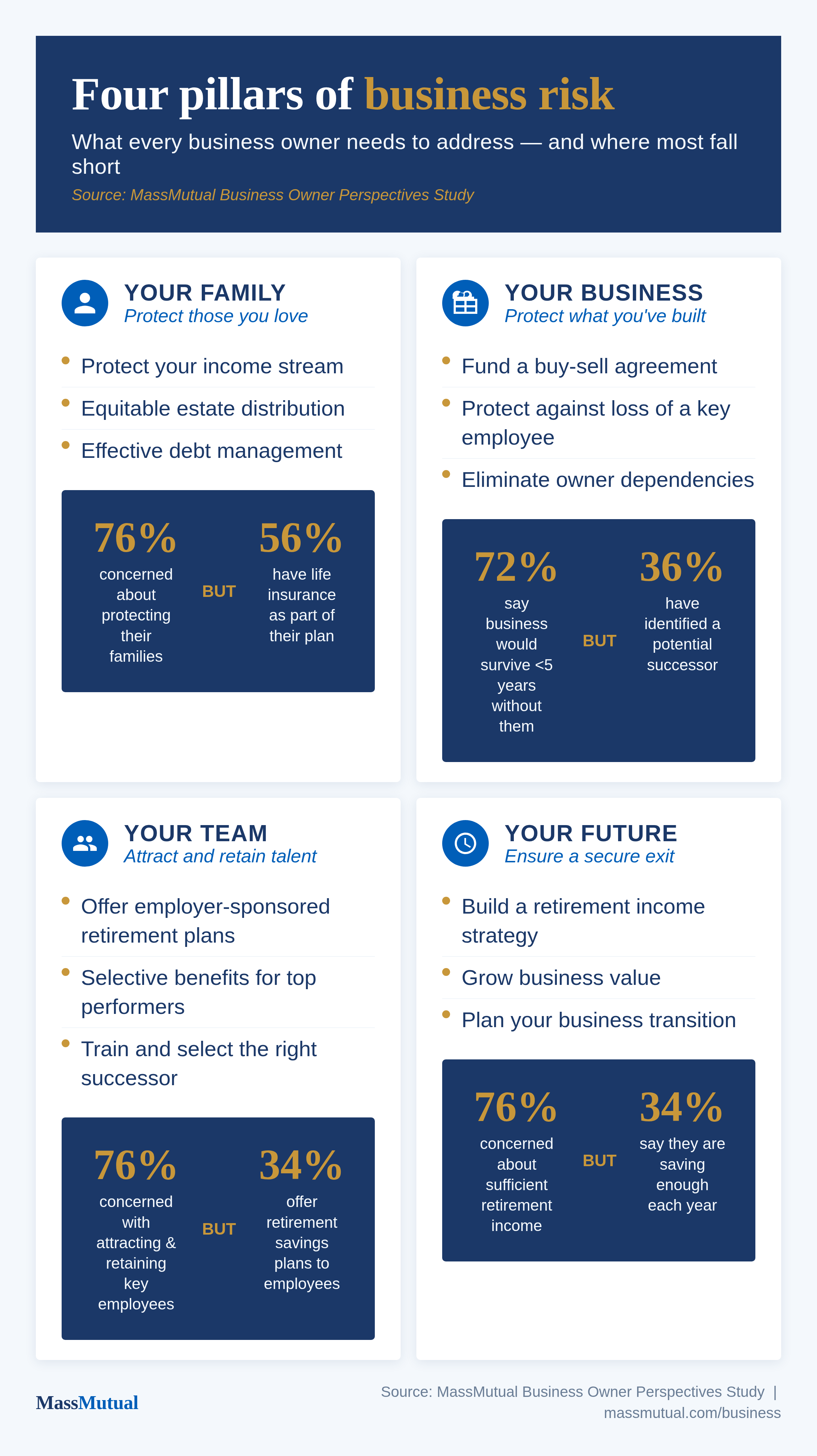
1. Your family: Helping to ensure that your protection planning extends beyond the business and to your family and heirs by protecting your income stream, being fair and equitable regarding the distribution of your estate and effectively managing debt.
2. Your business: Understanding the steps you can take to help mitigate some of the risks that can threaten the viability of your business by drafting and properly funding a buy-sell agreement, protecting against the loss of a key employee, and eliminating owner dependencies inside the business.
3. Your team: Understanding the importance of encouraging top talent to stay loyal and attracting new talent to the business by offering employer-sponsored retirement plans, providing selective benefit packages to top performers, and selecting and training the appropriate successor to the business. (Related: Employee retention tips)
4. Your future: Helping to ensure that the income and lifestyle you’ve become accustomed to as a business owner can still be achieved when you leave the business by building a retirement income strategy, focusing on growing business value, and understanding the different ways to transition the business.
Mitigating all or at least some of these risks can go a long way toward achieving your goals as a successful business owner.
Identifying and reducing business exposure
MassMutual recently conducted a Business Owner Perspectives Study to better understand what products or solutions they have in place to help mitigate these risks.
Unfortunately, many business owners have areas of exposure in terms of their business, personal, and financial pictures. Here’s what we learned:
- 76 percent of owners are concerned about protecting their families if they pass away unexpectedly, yet only 56 percent have life insurance as part of their personal plan.
- 72 percent say the business would survive for less than five years if an owner unexpectedly left, yet only 36 percent have identified potential successors. (Mitigate now: How to create a succession plan)
- 76 percent of owners are concerned about having sufficient income in retirement, yet only 34 percent say they are saving enough each year.
- 76 percent are concerned with attracting and retaining key employees, yet only 34 percent offer retirement savings plans to their employees. (Related: Are you doing enough to protect your highest earners?)
Your business isn’t just your largest asset; it provides income for your family and the families of your employees, a legacy for the next generation, and is a pillar in your community.
And while starting and running a business is inherently risky, understanding the value of your business and learning about products like disability income insurance and key person life insurance can be a great way to start protecting what you’ve worked so hard to build.
___________________________
Frequently Asked Questions about business risk
Q. What are the four types of business risk owners should address?
A. Business owners typically face four interconnected risk areas: protecting their family's financial security, safeguarding the business itself, retaining key employees, and planning for their own financial future after the business. Addressing these areas may help create a more resilient business and a smoother transition.
Q. How does risk affect the value of a business?
A. Potential buyers evaluate a business partly on the risk they would need to assume upon acquisition — including owner dependencies, lack of succession plans, and unprotected key employees. Mitigating these risks may make the business more attractive to prospective buyers and may be one factor considered during valuation discussions.
Q. What is a buy-sell agreement and why might business owners consider one?
A. A buy-sell agreement is a legal contract that establishes what happens to a business owner's share of the company if they die, become disabled, or decide to leave. Without one,ownership transitions may become more complicated — and life insurance is often used to fund the agreement
___________________________
Discover more from MassMutual …
Tips to run a successful micro business
5 common business decisions that can impact your personal finances
Business owners and the tight capital market
_______________