
| ||||||||||||

If you own a small business, chances are you play a major role in bringing in revenue — especially if you offer a specialized service your employees may not be able to provide. So, if you were to become too sick or hurt to work for an extended period of time, there could be major financial repercussions for your company.
Many people assume that the chances of their becoming disabled for an extended period of time are slim to none. But the truth is, it’s more common than you might think. In fact, there’s a one-in-four chance that a 20-year-old will become too ill or injured to work sometime during their career.1
To protect the business you’ve created, and the employees who help keep it running, it’s important to have a contingency plan. Business overhead expense (BOE) insurance can help protect the business that you worked so hard to build.
BOE insurance is a type of disability income insurance that helps cover a small business's fixed operating expenses if the owner becomes too sick or injured to work.
BOE insurance is generally designed for small business owners who are actively engaged in running their company — especially professionals and service-based businesses where the owner is central to revenue.
Why do I need business overhead insurance?
The need for BOE insurance is clear: If you are temporarily unable to work, your business might have significantly less revenue coming in because of your inability to provide the services your clients and customers need.
But you’d still be responsible for your overhead expenses, like:
- Rent or mortgage payments.
- Loan payments, insurance premiums and utility bills.
- Payroll and employee salaries.
BOE insurance can help cover these basic expenses for up to two years after a disabling event, depending on the policy. So even though your revenue may decrease, the business can stay afloat while you recover. But like many disability policies, BOE insurance typically includes an elimination period — a short waiting period (often 30 to 90 days) after a disability begins before benefits start.
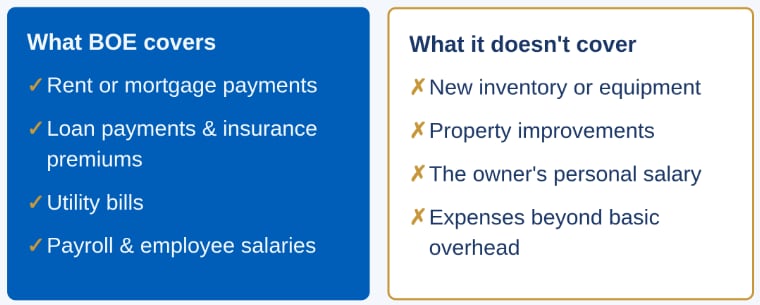
One important detail: BOE insurance only covers fixed business expenses. Business overhead insurance won’t cover the cost of buying new inventory, equipment or property improvements — anything that’s above and beyond the basic overhead of the business.
Another cost BOE insurance doesn’t cover is the disabled owner’s salary. For this, you would need to have individual disability income insurance — which you should consider if you do not already have coverage. After all, you have your own fixed expenses at home, too.
Plenty of options — and some benefits, too
To figure out how much business overhead expense insurance your business needs, you’ll want to take stock of your overhead expenses.
- You can use a business expense calculator to get started. (You can find MassMutual’s BOE calculator on our Business Continuity page here).
- You could also work with a financial professional for deeper guidance. (Connect with one here).
You’ll also need to determine what share of the expenses are paid for by the revenue you, the owner, bring in. This is the proportion of business costs the policy benefit will cover. (Related: Life insurance as business loan collateral)
Most insurance companies allow you to customize your BOE insurance policy with a number of different optional riders.2 These might include:
- Automatic benefit increases to reflect rising overhead costs over time.
- Partial disability benefits, in case you’re able to return to work, but in a reduced capacity.
- Benefits to cover the salary of someone brought in temporarily to do your job.
And here’s a perk: The premiums your company pays for BOE insurance are generally tax-deductible. While the benefit payments, on the other hand, are taxable, they are used to pay for overhead expenses which are typically tax-deductible.
Don’t let the lights go out
You know better than anyone just how much goes into owning and running a small business. So, while it’s stressful to think that you or another owner might be temporarily disabled at some point, it’s a relief to know that your business cancontinue operating — even while you recover.
Since 1851, MassMutual has been focused on helping people secure their financial future and protect the ones they love. That mission is why we have thousands of financial professionals to assist you on your journey through insurance, investing, retirement planning, estate management, and more.
_______________________________
Frequently Asked Questions about business overhead expense insurance
Q. What is business overhead expense insurance?
A. Business overhead expense (BOE) insurance is a type of disability income insurance that helps cover a small business's fixed operating costs — like rent, payroll, and utilities — if the owner becomes too sick or injured to work. Benefits are typically paid for up to two years after a disabling event.
Q. How is BOE insurance different from individual disability income insurance?
A. BOE insurance helps cover your business's overhead expenses, while individual disability income insurance replaces a portion of your personal income. Most business owners should consider having both, since BOE does not cover the owner's salary.
Q. What expenses does business overhead expense insurance cover?
A. BOE insurance typically helps cover fixed business expenses such as rent or mortgage payments, loan payments, insurance premiums, utility bills, and employee salaries and payroll. It does not cover new inventory, equipment purchases, property improvements, or the owner's personal salary.
_________________________
Discover more from MassMutual...
Health hazards of being a boss
The bonus that keeps on giving
Knowing the value of your business
This article was originally published in September 2017. It has been updated.
________________________________
2 Optional riders available at an additional cost.