| ||||||||||||

Most working Americans relish the notion of one day calling it quits and retiring to a warmer climate, or staying put during their senior years to pursue personal interests. They may plan to exit the workforce gradually, by reducing their hours or consulting part-time. But the endgame is clear: leave the 9-to-5 grind behind when they reach retirement age.
And then there are those who intend to keep working for as long as they can, either because they haven’t saved enough to retire, or because they find purpose in their career. They never want to retire.
Count Tim Sullivan, a financial professional with Strategic Wealth Advisors Group in Shelby Township, Michigan, among the latter.
“I’m probably going to work into my 70s because I enjoy it,” he said. “I see this a lot with our clients. They enjoy what they do and don’t want to quit.”
Even if you ascribe to the never retire philosophy, however, Sullivan said you still need a retirement plan. You never know what the future may hold. (Related: How to create a retirement readiness mindset)
For example, you may fall ill, get laid off, suffer a cognitive decline, or simply lose your stamina for work as you age. You may also be forced to quit your job prematurely to care for an aging spouse. “The question is, ‘What happens if I am no longer able to work?'” said Sullivan.
Connect with a MassMutual financial professional
To protect themselves and their loved ones, those who do not plan to retire must consider:
Do I still need savings if I never plan to retire?
For starters, the “never retire” crowd must set money aside during their working years like everyone else to ensure they don’t outlive their assets as they age.
Most financial professionals suggest that your retirement income should be at least 80 percent of your pre-retirement salary, depending on projected lifestyle, for each year you expect to (or potentially could) live in retirement. (Related: Should you retire with a mortgage?)
Whatever portion of that amount does not come from guaranteed income sources (such as Social Security, pensions, and annuities), must come from ongoing employment income, personal savings, and/or investments.
“It’s about maximizing what you’re able to put into your IRA and 401(k), especially if your company is going to match,” said Sullivan. “If you’re still working, you want to be putting as much away as you can.”
It’s never too late to start saving. If you make $50,000 a year and contribute 10 percent of your salary annually to a 401(k), you could potentially amass more than $356,000 in pretax savings over 20 years. That assumes a 3 percent employer match and a 7 percent average annual return.
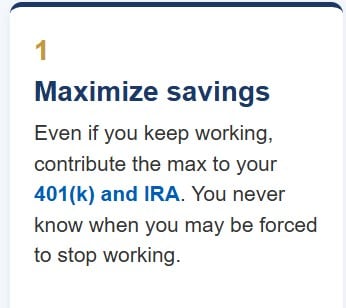
The federal government lets you contribute up to $24,500 per year to a tax-deferred 401(k), 457(b), or 403(b) plan for tax year 2026, the tax returns you file in April of 2027. If you are age 50 or older by the end of the calendar year, you may be eligible to make additional catch-up contributions of up to $8,000 in 2026, bringing the total you may contribute on a pre-tax basis to $32,500.
Under a change made in recent legislation, employees aged 60 to 63 who participate in these plans can make higher annual catch-up contributions of up to $11,250 to a workplace plan.
The 2026 limit for contributions to a traditional IRA or Roth IRA is $7,500 in 2026. Those age 50 or older may make catch-up contributions to their IRA of an additional $1,100. (Related: 4 reasons why maxing out your 401(k) may not be enough)
Savings give you the safety net to exit the workforce if and when you choose, said Elijah Kovar, a financial professional with Great Waters Financial in Minneapolis, Minnesota. Planning ahead is key.
“Many times, people we meet have enough money to retire, but they continue working because they don’t really know whether they can retire and spend what they want to spend, travel where they want to travel, and still have enough down the road,” he said. “They worry about nursing home costs, taxes, inflation, and rising health care costs. They have so many concerns that without a clear plan, they don’t really know if they have the means to retire or not. Having a plan inspires freedom and confidence.”
Live a little
If your health holds up and you are able to work as planned during your senior years, those savings become a vehicle for having fun.
Perhaps you dream of sending your grandkids to college, treating the family to an African safari, donating to a favorite charity, or helping your adult children eliminate debt.
Indeed, if you’re still working and don’t need the income, you can afford to be frivolous — perhaps for the first time.
“For the person with plenty of money who is just working because they like what they do, it really comes down to deciding what the purpose of that extra money is,” said Kovar. “Maybe you don’t have to save it like you’ve always done. Maybe you can use it as a tool to be meaningful for kids and grandkids, while you’re alive rather than just leaving a big inheritance when you die.” (Related: Keeping heirs from fighting)
Remember that every dollar you earn after the traditional age of retirement is also one that you don’t have to take from your retirement account, leaving that money invested longer to potentially generate higher compounded returns.
Once you turn age 73, you will have to begin taking required minimum distributions, or RMDs, from your tax-qualified retirement accounts — like 401(k) plans and IRAs. The RMD age will increase to 75 in 2033. (Related: Required minimum distributions explained)
How does working affect my Social Security benefit?
Staying employed for longer, of course, also enables you to potentially delay claiming Social Security beyond your full retirement age, which ranges from 66 to 67, depending on when you were born. That permanently increases the size of your future Social Security benefit.
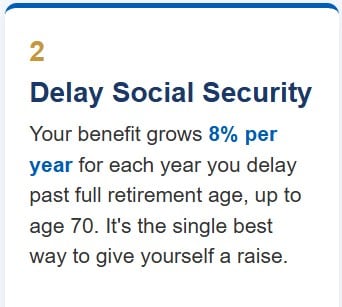
The amount of your monthly check will increase by 8 percent per year for each year you delay benefits after your full retirement age, until you reach age 70, when delayed retirement credits cease to accrue. That’s the single best way to give yourself a raise during your retirement years.
“Some people take Social Security at the earliest opportunity at age 62 because a coworker did or their neighbor told them to,” said Sullivan. “It’s all about understanding your options and timing.”
Be aware that if you begin collecting Social Security while you are still employed, it could have either a positive or a negative impact on your monthly benefit:
- For example, if you earn more than you did during a prior year that was used to compute your Social Security retirement benefit, the government will recalculate your benefit amount and adjust it higher — up to an annual limit. Social Security is based on your earned income during the 35 years in which you earned the most. Thus, by increasing the size of your monthly benefit, you lock in a higher benefit for life and potentially increase the future benefit amount that your family and your survivors could receive.
- If you are younger than full retirement age, however, and you collect Social Security while you are working, your income may reduce the amount of your monthly benefit by $1 for every $2 you earn above the annual earnings limit. For 2026, that limit is $24,480. In the year you reach full retirement age, you lose $1 in benefits for every $3 you earn above a different earnings limit. In 2026, that threshold is $65,160, but the government only counts earnings before the month you reach your full retirement age. Once you reach full retirement age, your earnings no longer reduce your benefits, regardless of how much you earn.
- If Social Security benefits are reduced or withheld because of money you earned after you started receiving benefits but before you reached your full retirement age, that money is not gone forever. When you reach full retirement age, Social Security Administration will increase your monthly benefit to account for payments that were withheld due to those earlier earnings. (Related: Four simple ways to delay social security
How to use an HSA for retirement
No one knows for sure what health care costs they will incur as they age, but they know it won’t be cheap, regardless of when they exit the workforce.
According to Fidelity’s Retiree Health Care Cost Estimate, a 65-year-old couple retiring in 2026 with Medicare Part A and Part B coverage can expect to spend $371,000 in out-of-pocket health care and medical expenses throughout retirement. That does not include any nursing home or long-term care costs they may incur.1
If your employer offers a high-deductible health insurance plan with a health savings account (HSA), take advantage of it, said Sullivan. (Related: HSAs explained)
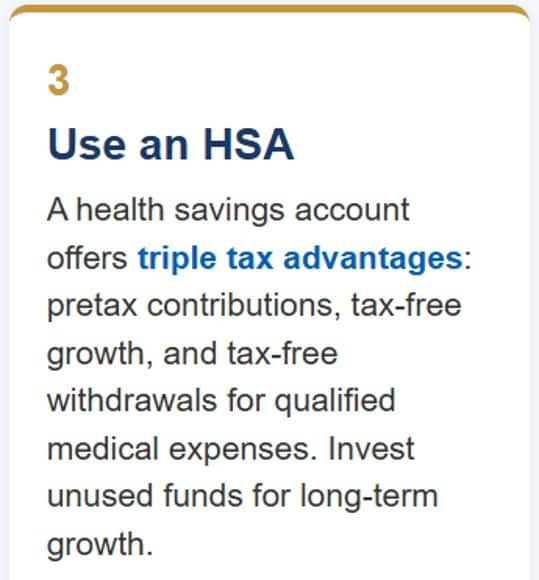
For 2026, the IRS allows individuals with self-only coverage to contribute up to $4,400 and those with family coverage up to $8,750.2Contributions to an HSA are made on a pretax basis, yielding an immediate tax deduction. They offer the added benefit of tax-free growth and tax-free withdrawals if used for qualified health care expenses.
A portion of HSA savings can generally be invested in mutual funds, giving the account an opportunity to generate earnings.
And, unlike contributions to a flexible spending account, any savings left unused in an HSA at the end of the year remain in the account and can be used to help pay for qualified medical expenses in future years — including during retirement.
“HSAs are one of the most tax-beneficial accounts out there,” said Sullivan. “If someone is in good health and has the financial ability and mindset to pay their health costs out of pocket while they work, an HSA could be a great way to save for that possible huge health care bill in the future.”
Rather than using the account to pay for ongoing health care costs, account holders who can afford it should consider treating their HSA as a long-term savings vehicle and allow those dollars to accumulate for health care costs during retirement. (Related: How to use an HSA for retirement planning)
“Treat it as an investment tool that will improve your overall financial plan in retirement,” he said. “Instead of leaving it in a savings account, invest it for growth.”
Long-term care coverage
As a final layer of financial protection, Kovar said that all working adults, including those who do not intend to retire, should consider their plan for covering long-term care expenses should the need arise as they age.
According to the U.S. Department of Health and Human Services, a person turning age 65 today has a nearly 60 percent chance of needing some type of long-term care service and support in their remaining years.3 (Related: Long-term care needs: Have a plan?)
Women need care longer on average (3.7 years) than men (2.2 years). While one-third of today’s 65-year-olds may never need long-term care support, 20 percent will need it for longer than five years.

Such care can be costly, and it’s rarely covered by private health insurance, Medicare, or even Medicaid. Based on national median charges, a non-medical home health aide costs $80,080, assisted living facilities cost $74,400, and a private room in a nursing home costs $114,975 per year.4
Kovar estimates that the average 60-year-old should have between $500,000 and $1 million set aside — depending on where they live, the type of facility desired, and the type of care needed — to pay for long-term care costs out of pocket, based on current and projected costs.
“Long-term care is a very real concern for a lot of people,” he said. “We recommend having a realistic conversation. Are you going to pay for care out-of-pocket or do you want to shift some of that risk by purchasing long-term care insurance coverage?” (Related: Long-term care and your wallet )
Never retire contingency
Not everyone expects, or even wants to retire. Those who plan to continue producing an income well past the traditional age of retirement, however, must still make a plan to protect themselves and their families in the event their “never retire” agenda does not pan out.
A financial professional can help you determine how much money you should be saving monthly to safeguard your future, how your Social Security benefit may be affected, and whether long-term care coverage might make sense for you.
Since 1851, MassMutual has been focused on helping people secure their financial future and protect the ones they love. That mission is why we have thousands of financial professionals to assist you on your journey through insurance, investing, retirement planning, estate management, and more. You can find a MassMutual professional with this tool or you can let us know you’d like to talk to one and we’ll have one of our financial professionals can contact you.
_________________________________
Frequently Asked Questions about the 'never retire' philosophy
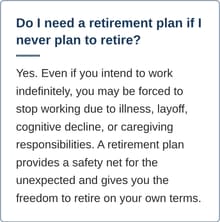
Q. Do I need a retirement plan if I never plan to retire?
A. Yes. Even if you intend to work indefinitely, you may be forced to stop working due to illness, layoff, cognitive decline, or caregiving responsibilities. A retirement plan provides a safety net for the unexpected and gives you the freedom to retire on your own terms.
Q. How much should I save for retirement if I plan to keep working?
A. Many financial professionals suggest your retirement income should be at least 80 percent of your pre-retirement salary. Even if you continue earning, maximizing contributions to your 401(k) and IRA helps ensure you don't outlive your assets if you're forced to stop working prematurely.
Q. How can a health savings account (HSA) help if I don't plan to retire?
A. An HSA offers a triple tax advantage — pretax contributions, tax-free growth, and tax-free withdrawals for qualified medical expenses. If you don't need the funds for current health costs, you can invest them for the opportunity to generate grow and use them to cover health care expenses later in life.
______________________
Discover more from MassMutual…
How to plan for healthcare costs in retirement
Healthcare costs in retirement
6 people who dismiss long-term care insurance, but maybe shouldn’t
Retirement planning for single seniors
This article was originally published in 2019. It has been updated.
______________________________
_______________________________
1 Fidelity Investments, “How to plan for rising health care costs,” March 13, 2026.
2 Internal Revenue Service, “About Form 8889, Health Savings Accounts (HSAs),” March 31, 2026.
3 LongTermCare.gov, “What is Long-Term Care (LTC) and Who Needs it?,”” Jan. 4, 2021.
4 CareScout, "CareScout Releases 2025 Cost of Care Survey Results,” March 2, 2026.