| ||||||||||||

Students may consider doing a college transfer for several reasons.
- It may be part of a plan to save money by earning general education credits at a less expensive school, then applying to a more prestigious school to complete a major.
- Sometimes, the first college a student attends turns out to be the wrong fit.
- Other times, a student’s finances might take a turn for the worse, necessitating a transfer to a less expensive school.
- Mental health, physical health, and family matters can also compel students to transfer.
Whatever the reason, it’s important to enter the college transfer process with an awareness of the uncomfortable truth that there may be costs in time and money. With the right planning, transfer students can complete their degrees on time or minimize the need for extra semesters. Sometimes, especially in situations where finances are prompting the move, students and families opt to consult with a financial professional.
Connect with a MassMutual financial professional
Consider these potential costs when switching schools and learn how to limit them.
Lost credits and increased time to graduate
One of the biggest concerns for any college transfer student is whether their new school will accept all the credits they’ve earned. There’s also the question of whether transferred credits will satisfy graduation or major requirements, or only count toward elective credits.
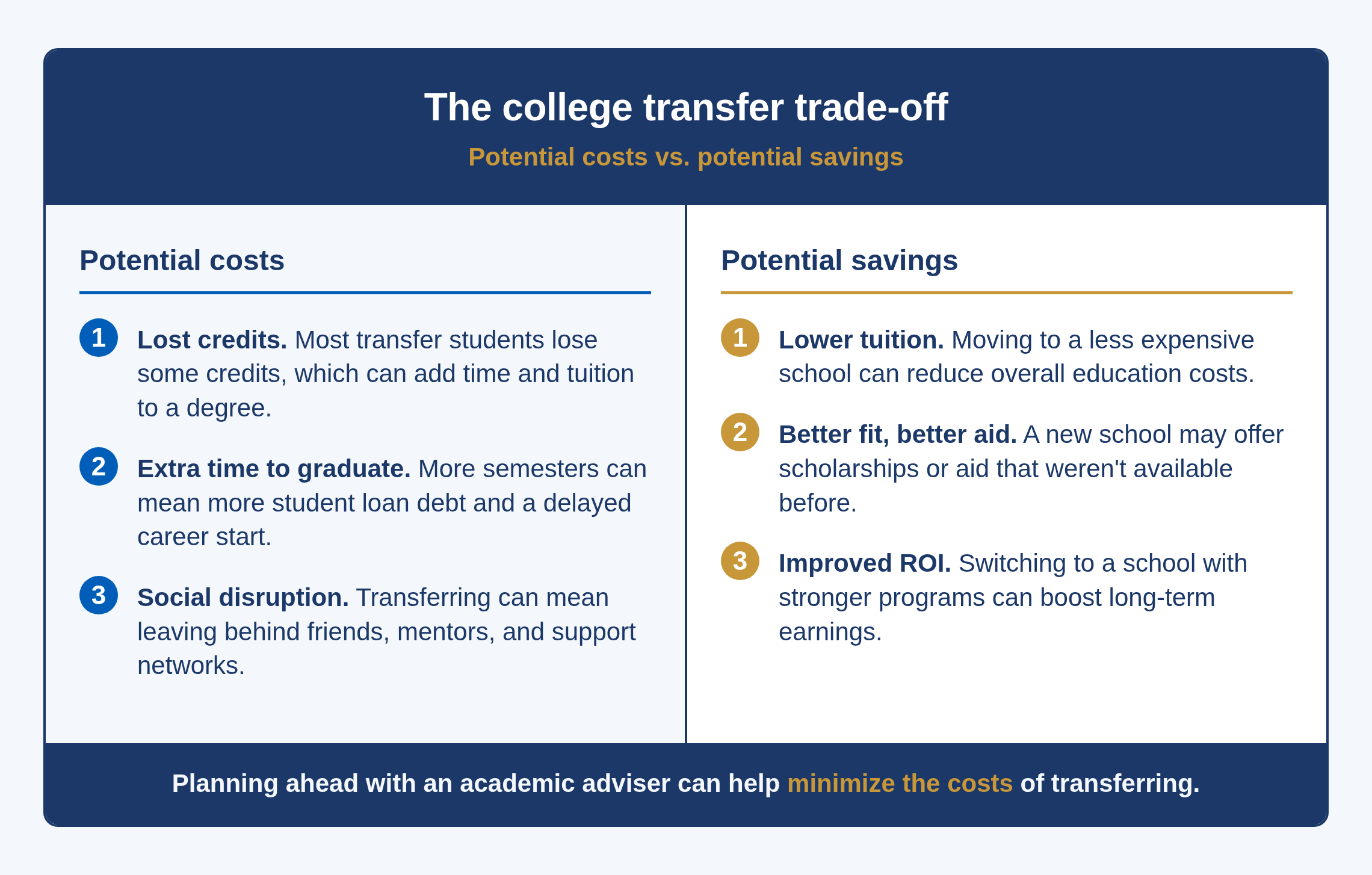
Losing credits can mean paying for additional credit hours and spending more time in the classroom. Indeed, research shows that most transfer students — about 83 percent — lose at least some credits in the process.
It might also mean increasing a semester workload from five classes to six, or attending summer school to stay on track for a four- or five-year graduation plan. Taking additional time to graduate can also mean additional student loan debt compounded by a delayed start to the well-paid career that should make college pay off.
Online tools such as CollegeTransfer.net can help students assess how much of their existing coursework — and credits earned through placement exams — will transfer to various schools. Some schools have partner institutions that can be easier to transfer credits to. For example, Tarrant County College in Texas has an arrangement with the University of Texas at Arlington that simplifies the transfer application process, helps students transfer credits, and enables students to identify needed coursework to complete their bachelor’s degree on time. Such arrangements are called “articulation agreements.”
There are even some state-level resources to help students transfer effectively. The Texas Common Course Numbering System, for instance, helps freshmen and sophomores at Texas community colleges transfer credits from general academic coursework to Texas universities. Other states have similar or are developing such systems.
Limiting the cost of additional credits
It’s a good idea for transfer students to meet with an academic adviser at their new school before registering for classes. An adviser can help prevent enrollment mistakes that could cost time and money. Students should bring transcripts showing their completed coursework to the adviser meeting. Some schools, especially those that receive many transfer students, offer degree-planning tools to help students see which of their completed courses will transfer over and count toward a degree.
Another strategy that can help transfer students minimize the time to complete a degree is a registration game plan. Since it can be challenging to get into all the courses one needs to take, it can be helpful to plan out different schedule combinations to allow for quick decision making if a student’s first choices fill up. Registering at one’s assigned time will offer the best chance of getting a spot in every needed course, or at least snagging a wait-list opportunity. Attending classes one has been waitlisted for and speaking with the instructor can facilitate enrollment once the semester begins.
Social costs of transferring colleges
Transferring can mean losing the network of friends, instructors, and advisers who supported a student at their previous school. Matthew Carpenter, CEO at College Funding Services in Salem, Massachusetts, and founder of College Aid Pro™, a software application that enables a family to financially model paths to college, said that while it often makes sense to attend two years of community college before transferring to a four-year school — whether for financial reasons or because a student is apprehensive about living away from home or about going to college at all — he doesn’t usually recommend strategically planning to transfer from one four-year college to another.
“The unknowns are too great,” Carpenter said. “What if you make best friends? What if you fall in love? What if you make the team?”
Yet, for some students, the social environment at their first college might have been a poor fit. Maybe there was too much emphasis on social life and not enough on academics. Maybe that small liberal arts college felt cliquish. Maybe it was too hard being a small fish in a big pond. In such cases, there may be more to gain socially than to lose by transferring.
Attending transfer student orientation at one’s new school can help ease the transition. This special orientation offers opportunities to meet other transfer students, learn about the school’s student resources, and find out about student activities, such as clubs and sports, where one can rebuild lost networks and start to integrate with non-transfer students. In addition, some schools have transfer student centers for year-round support.
Potential savings from making the switch
While the potential financial losses from transferring are significant, transferring can also save money in ways that might not be obvious.
“If it becomes apparent that the current institution is not a sound investment and there are other, more cost-effective options, it may be worth cutting bait,” Carpenter said. (Learn more: Tips for choosing the best ‘financial fit’ college)
For a hypothetical example, a student may have been an outstanding artist in high school who also earned excellent marks in their academic classes. They decided to pursue their passion by attending an art college that gave them a scholarship. By sophomore year, the student decided they didn’t want to pursue a career in visual art, but the school’s other offerings were virtually nonexistent.
Despite the scholarship at the art school, the long-term financial benefits for the student may improve by transferring to a school with more comprehensive BS and BA programs.
Conversely, some students don’t do so well in high school, but start to excel in college. They might encounter resources they didn’t have before, such as a supportive adviser, achievement-oriented classmates, or an instructor who sparks their interest in a subject. (Related: What high schoolers should know about student loans)
“If a student has done well at their current college, they may be able to receive scholarships at other colleges that would not have been available to them upon high school graduation,” Carpenter said. “Similarly, they may have the opportunity to be accepted into colleges that are more generous with financial aid that would not have been options when applying out of high school.”
Transfer students and financial aid
For students who depend on financial aid to earn a degree, Carpenter said that “for the most part, transfer students are treated the same way that incoming freshman are. There are exceptions, but generally speaking, financial aid works the same.”
Some schools and organizations even offer scholarships specifically for transfer students. However, as with freshman financial aid, it’s often first come, first served, so it’s best to apply early. Transfer students should aim to meet or beat all financial aid and admission deadlines if possible.
Federal student aid does not automatically transfer when a student changes schools. A transfer student will need to update their Free Application for Federal Student Aid (FAFSA) and find out what financial aid the new school will offer them, then determine how to pay for any difference. It’s also important to be aware of where one stands with regard to borrowing limits for federal student loans. The FAFSA has undergone significant changes in recent years, so transfer students should review current requirements and deadlines.
In addition, transfer students need to know that their federal student loans will automatically go into repayment when they withdraw from their current school. They will need to apply for an in-school deferment if they want to avoid making payments while attending their new school. They will also want to pay special attention to the requirements for remaining eligible for federal student aid by making satisfactory academic progress in terms of grade point average and progress toward graduation.
Deciding whether to transfer colleges
There are no guarantees, of course, that transferring will improve a student’s experience. Will the upheaval and potential additional costs be worth it? That’s something each student and their parents must decide.
“Most students go through some growing pains freshman year,” Carpenter said. “Doubt about their college choice and homesickness inevitably creep in. This is a normal part of the major life transition that is going to college.”
“Don’t mistake these uneasy feelings for signs that you should definitely transfer,” he said. “Most of us have gone through it and come out the other side to have an amazing experience.”
Still, for students who do choose to transfer, approaching the process with a careful plan — as well as support from an academic adviser, parent, or other trusted older adult — can minimize the financial, opportunity, and social costs of changing schools.
______________________________
Frequently Asked Questions about college transfer costs
Q. Will all my credits transfer when I switch colleges?
A. Not necessarily. Most transfer students lose at least some credits, especially if courses don't match the new school's degree requirements. Using transfer credit tools and meeting with an academic adviser before enrolling can help you minimize what you lose. (Related: How to reduce the cost of college by up to half)
Q. Does my financial aid transfer with me to a new school?
A. Federal student aid doesn't automatically transfer — you'll need to update your FAFSA with your new school's code so it can build a new aid package. Institutional scholarships and grants from your old school typically stay behind, so you'll want to research what the new school offers. (Related: How to make college more affordable with financial aid)
Q. Can transferring colleges save me money?
A. Yes, especially if you're moving from a more expensive school to a less expensive one, or if your new school offers better financial aid or scholarships. Transferring can also improve your return on investment if the new school has stronger programs for your career goals.
__________________________
Discover more from MassMutual…
Tips for choosing the best ‘financial fit’ college
9 ways to save on college...without a scholarship
On the hunt for the most generous colleges
This article was originally published in September 2021. It has been updated.
_______________