| ||||||||||||

Saving for college can be one of the more daunting tasks parents face. Besides how much to save, you need to choose where to put those savings.
Most families’ key considerations include:
- Taxes: How can I reduce taxes to save more for college?
- Risk: How do I invest my child’s college savings properly?
- Flexibility: Will I be able to use the money for something else if my child doesn’t go to college?
- Financial aid: How will saving affect scholarships, grants, and loans?
A variety of college savings programs are available to give families advantages in some or all of these areas. Perhaps the most well-known are 529 college savings programs. Unfortunately, a large portion of parents, 54 percent according to one recent survey, are unaware of 529 college savings programs, which can now be used for K-12 tuition, apprenticeships, and student loan repayment, not just college.
Many families are far more likely to consider traditional methods of saving.
These include:
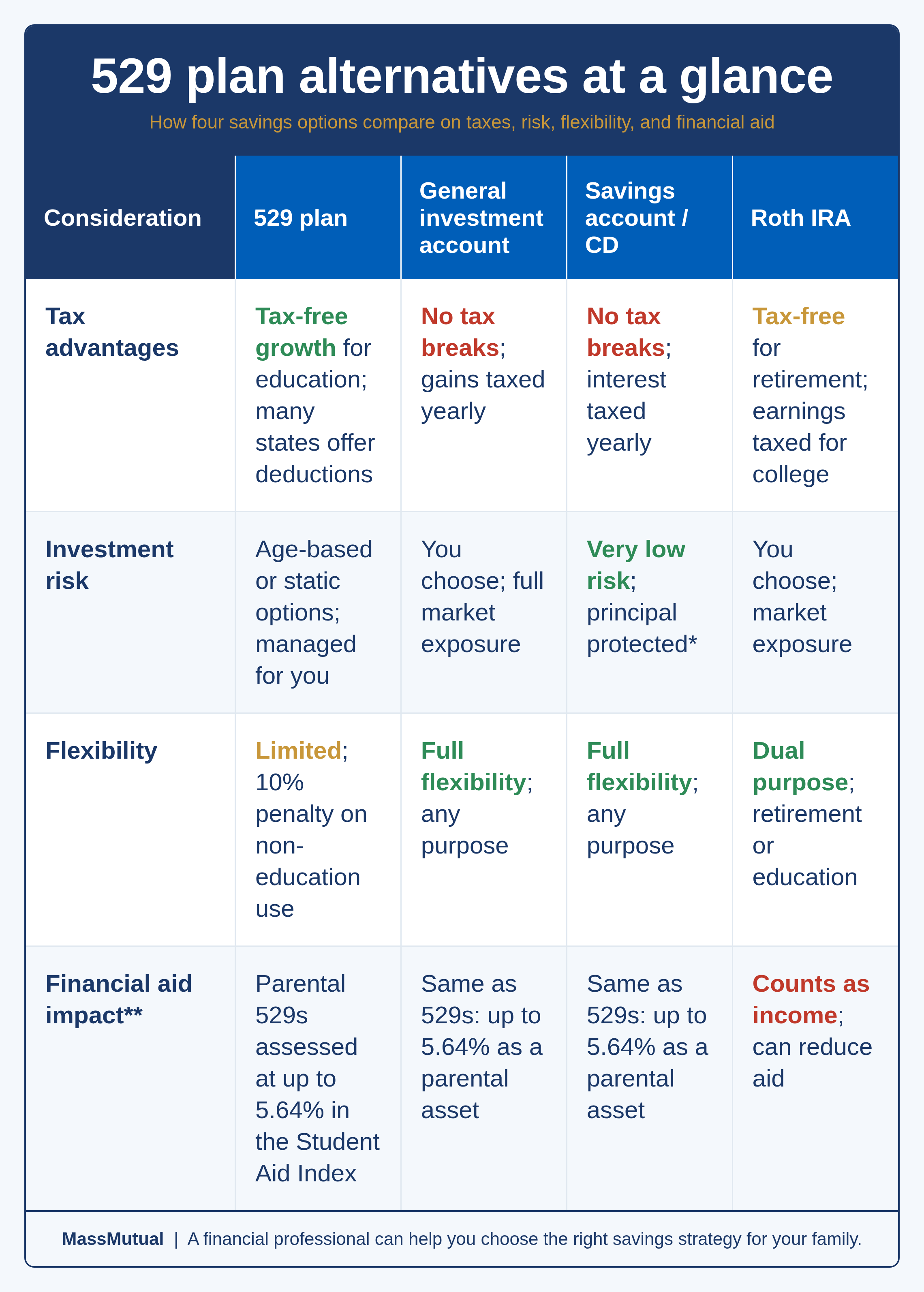
So how do such accounts stack up as 529 plan alternatives when it comes to paying for higher education and the four considerations above?
A good first step is to estimate how much will likely be needed, then look at the options for helping savings try to reach that target.
With the number in hand, many opt to consult a financial professional as they sort through the savings options, especially when trying to balance that college savings goal with other priorities like retirement.
Connect with a MassMutual financial professional
General investment accounts for college
General investment accounts typically do not offer state or federal tax breaks.
The lack of tax breaks means that money saved and invested in a general investment account may not grow to as large an after-tax sum as it would in a college savings plan, assuming the same rate of return for both types of accounts. If the child is young when you open the investment account, the same sum saved in a 529 plan could accumulate to a larger after-tax amount because any investment gains are not taxed federally when the money is spent on qualified education expenses (see IRS Publication 970 for details). Additionally, many states also offer income tax deductions or credits for 529 contributions.
But general investment accounts are flexible. Parents retain total control of their money, can use it for any purpose, and can invest it however they want, as long as the money is in the parent’s name and not the child’s. If the child doesn’t go to college or doesn’t use all the money for college, the parents can use it for something else, such as retirement, without penalty.
Families that do opt for general investment accounts may consider using them in conjunction with a custodial account — like a custodial 529 or Coverdell account for educational expenses. Understanding how to use these accounts, who they’re for, and how they can facilitate or hinder responsible life choices by young adults can help you decide what may be best for your family. (Related: Custodial accounts and Coverdells)
Additionally, the money in general investment accounts also has a low impact on financial aid.
“As far as FAFSA [Free Application for Federal Student Aid] goes, a general investment account and a 529 college savings account are treated the same way. In a parent’s name, up to 5.64 percent is added to the Student Aid Index (formerly known as the expected family contribution),” said Jim Anderson, a college and financial aid planner with Making College Worth It in Marietta, Georgia. (Related: How to read your FAFSA)
For those families who desire such flexibility and want to be hands-on with investments, the operating expenses and restricted investment choices of many 529 plans may be off-putting. So may the 10 percent penalty and applicable income taxes on earnings withdrawn for non-qualified expenses.
For families less active in investing, 529 college savings plans may be more manageable. Many 529 plans offer easy asset allocation strategies based on the child’s age. The portfolio may take more risk aiming for higher returns when the child is young, then grow more conservative as the child approaches 18. In a general investment account, parents may need to take a more hands-on approach to preserving principal as college nears — and some parents may prefer that. Many 529 plans do offer options other than age-based ones, however.
Parents can also choose to invest in a different state’s 529 plan if they don’t like their own state’s plan. They may lose some state tax breaks, but the federal tax savings could still make a 529 more appealing than a general investment account. There are also 529 plans that essentially prepay college tuition. (Learn more: 529 savings versus prepaid accounts)
Also of note, under recent rule changes, distributions from 529 accounts owned by someone other than the beneficiary's parent (e.g., grandparents) no longer count as student income on the FAFSA. (Related: College gifting moves for your grandchildren)
Savings accounts and CDs for college savings
Putting money in a savings account is one of the simplest ways to save. It’s also considered low risk because it largely preserves your principal. But it’s not entirely without risk because of inflation and opportunity cost.
- Inflation: Even with a high-yield account, the interest you’ll earn might not be enough to keep up with tuition inflation.
- Opportunity cost: You might earn better returns through market-based investments.
Certificates of deposit (CDs) also protect principal and can offer better returns than savings accounts, but may still earn much less than stocks and bonds over the long run. Additionally, there are typically no tax breaks on CDs or savings deposits, so what little returns you do earn will likely be diminished each year by federal and state taxes.
When are savings accounts and CDs best for college savings?
“This strategy might be a good one for older children with fewer years for growth,” Anderson said. “If it were me, I’d hate to see a market correction right before needing to make college payments.”
Even if you’re further out, these options may be right for you if you can’t stomach the ups and downs of the market.
As with investment accounts, savings accounts and certificates of deposit give parents complete flexibility over how and when to use the money. And again, as parental assets, only about 5 percent of the money counts toward the family’s expected contribution to college expenses in financial aid calculations.
What are the biggest potential disadvantages of saving this way? You may miss out on the potential for higher returns and tax savings you could achieve by investing in stocks and bonds through a 529 college savings plan or even a general investment account.
Roth IRAs as a 529 plan alternative
A Roth IRA is a retirement savings account, not a college savings account. So, from a parent’s perspective, it might seem like a more flexible savings option. The thought is that they’ll take Roth withdrawals if their child needs college money. But if not, the parent can use the money for retirement.
Using Roth withdrawals for college isn’t impossible. The IRS normally levies a 10 percent added tax when someone younger than 59½ withdraws any investment earnings from the account. But it usually doesn’t levy this penalty on withdrawals of investment earnings used to pay for qualified higher education expenses at an eligible educational institution. This is generally true as long as the withdrawal pays for the parent’s own education or for the education of a spouse, child, or grandchild.
While the 10 percent penalty tax may not apply, income tax on earnings does apply unless the parent is 59½ or older. This tax on withdrawn earnings can put the Roth IRA at a disadvantage compared with a 529 savings plan. The IRS does not tax 529 earnings that are used for qualified higher education expenses.
Roth IRAs, like general investment accounts, typically offer more investment options than 529 plans. Within a state’s 529 college savings plan or plans, you’ll be limited to a list of preapproved investments. There’s a good chance they’re similar to what you’d choose even if you had more options, but their expenses might be slightly higher than you’d incur for comparable investments in a Roth. Most families will likely find that a 529’s tax savings may outweigh such small differences in investment fees, however.
Where families can run into big problems with using a Roth IRA to pay for college is in financial aid calculations. For wealthy families who will not be eligible for financial aid, this consideration may not matter. But families who expect to qualify or want to preserve their chances to qualify should know that Roth withdrawals are counted as parental income, and 22–47 percent of a parent’s discretionary income is counted toward the family’s expected financial contribution. This is true even if your withdrawal consists entirely of returned contributions and doesn’t include any investment gains.
Parents should also consider how using Roth withdrawals to pay for a child’s college expenses would affect their own finances later on.
“A Roth is generally a retirement savings vehicle for most people,” said Joseph Bogardus, a financial planner with Barnum Financial Group in Shelton, Connecticut. “Tapping into retirement funds for college can cause a lot of headaches and heartaches when the parents get older — possibly even on the part of the youngster whom the parents helped.” (Learn more: Why saving for retirement early is important)
For many families it is advisable to consult a financial or tax professional about possible moves involving Roth IRA plans.
A side note on Roth IRAs. Recent legislation now allows unused 529 funds to be transferred to a Roth IRA for the original 529 beneficiary. While the unused savings do not go back to the account holder, typically a parent or grandparent, it can give the beneficiary (child, grandchild, student) a big head start on retirement. There are limits on such transfers, however. (Learn more: 529 Roth IRA rollover: Rules, limits, and eligibility)
The bottom line on 529 alternatives
General investment accounts, savings accounts, CDs, and Roth IRAs are all valid ways to save for college, and they’re probably better than not saving for college at all.
But are they wise 529 plan alternatives and truly the best savings plan for a child?
Families must decide if the flexibility gained from not being required to use these accounts for education expenses outweighs what they give up by not using an account whose tax advantages, financial aid considerations, and investment options are specifically designed for college. Working with a financial professional who can evaluate the family’s whole picture may be an option to make the decision a little easier.
_________________________________
Frequently Asked Questions about 529 plan alternatives
Q. What is the best alternative to a 529 plan?
A. There's no single best alternative — it depends on your priorities. General investment accounts offer the most flexibility, while Roth IRAs are intended for retirement savings, they may provide additional flexibility to help pay for education expenses. A financial professional can help you weigh the trade-offs.
Q. Are 529 plans better than regular investment accounts?
A. For many families, a 529 plan may offer advantages because it allows for tax-free withdrawals of earnings used for qualified education expenses and potential for state tax deductions. General investment accounts offer more flexibility and investment choice but lack these tax advantages.
Q. What happens to 529 money if my child doesn't go to college?
A. You can change the beneficiary to another family member, use the funds for qualified K-12 expenses or apprenticeships, or roll over up to $35,000 to a Roth IRA for the beneficiary, subject to certain rules and limits. Non-qualified withdrawals incur taxes and a 10 percent penalty on earnings.
________________________
Discover more from MassMutual...
10 mistakes to avoid with 529 savings plans
Preparing for the college decision letter
This article was originally published in October 2019. It has been updated.
___________________________
* Deposits at participating FDIC-insured banks and NCUA-insured credit unions are insured up to applicable limits.
** Financial aid treatment and assessment rates are based on current federal financial aid rules and may change. Eligibility for financial aid depends on numerous factors beyond asset ownership and account type.