| ||||||||||||

On May 15, 1851, MassMutual was born.
That’s when the company’s charter was officially granted by the Commonwealth of Massachusetts.
Getting to that point, however, wasn’t as easy as it may seem. And there were challenges in the early years after as well.
The vision of George and Caleb Rice
The company was actually the brainchild of George Rice, an agent for a Connecticut insurance company, according to one company history.1 George, in his late twenties, saw a lot of requests for insurance, both from individuals and businesses, coming out of the Springfield, Massachusetts, area. Yet his company wasn’t inclined to underwrite all of it.
He believed a local insurance company, one more familiar with the region and, therefore, more inclined to support the people and businesses there, would help build the community and, at the same time, grow and thrive along with it. It would be a real-world embodiment of the idea of building strength through mutual support.
George Rice originally planned to start the company as a mutual enterprise, and, consequently, managed with the best interests of its customers at heart. Other insurance companies, like the one he worked for, had such structures. (Related: Mutual life insurer advantages)
Securing the initial investment
But Massachusetts law required insurance companies to be chartered via stock ownership first, meaning investors had to put up a pool of money in exchange for shares in the company. That pool of money would act as a reserve for the company’s policies. Once a company was in business long enough to establish a large enough surplus out of its own funds, it could retire the stock, pay back the original investors, and mutualize.
George recruited his cousin and county sheriff, Caleb Rice, to lobby the leading businessmen of Springfield to muster the $100,000 investment needed to ask the Massachusetts legislature for a company charter.
At the time $100,000 was a huge investment — over $4.2 million in today’s dollars. And money back then went further. A railroad worker, for example, made roughly a dollar a day.
Springfield was a town of about 12,000 people. And while many businesses thrived there, thanks mostly to the federal armory established during the Revolutionary War, it wasn’t really a city with a large number of local investors.
Eventually the Rice cousins assembled a group of 31 investors, each making individual contributions. None of the individual contributions were more than $5,000. But together, the contributions added up to the $100,000 needed to secure the charter.
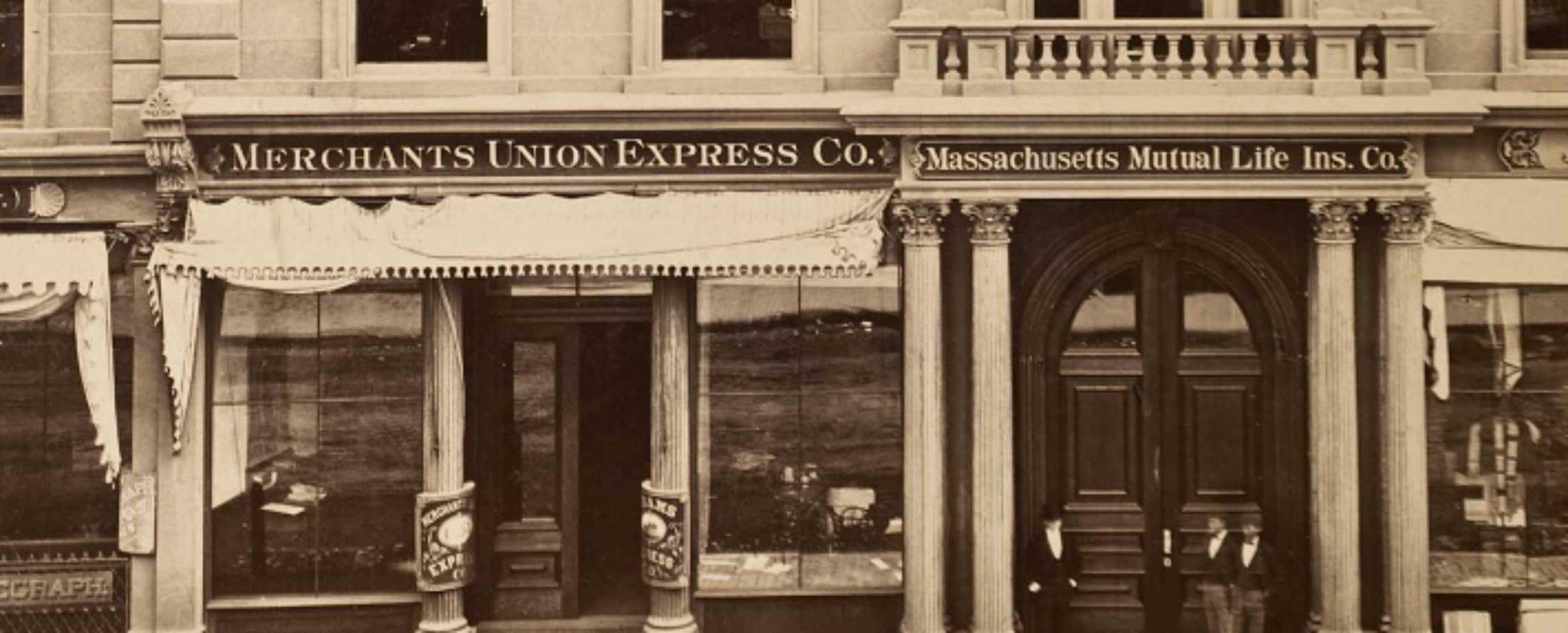
Once the charter was granted and the company formed, the investor group rented a one-room office in downtown Springfield and chose 20 of their number to serve on the formal board.
George Rice, however, couldn’t serve on the board, since he still worked for a Connecticut insurance company. So, Caleb Rice became president (he was paid $50 for his first year of service, $100 for his second).
Early challenges and milestones
Trouble came early, though. As the investor group came together for one of its first board meetings in 1851, one of the lead investors, Col. James M. Thompson, resigned, arguing that his colleagues hadn’t put up solid enough collateral to cover their investment pledges. He was, according to local histories, one of the more well-off citizens of Springfield.
The other investors scrambled to cover the loss of his contribution, and the company kept on. It issued its first life insurance policy on Aug. 2, 1851, insuring Harvey Danks, one of the directors who later became general agent for the company in Chicago, for $1,200.
Other policies followed, and after its first year of operation, the company had issued 341 policies representing $370,495 of insurance in force.
The achievement wasn’t without bumps, however. One man died six months after purchasing his life insurance policy and, with reserves tied up in investments, the company had to borrow money to pay the claim.
Yet the company’s investments and fiscal discipline made solid progress so that MassMutual became one of the leading life insurance companies in the nation by the end of the century. (Related: MassMutual and the father of American life insurance)
Unfortunately, George never saw the company grow out of its infancy. In 1856, he died of tuberculosis at age 33.2 Caleb continued on as president until his death in 1873. (He even served as the first mayor of Springfield once the town incorporated in 1852).
MassMutual today
By then, MassMutual had passed $1 million in assets (1865), which was a pretty hefty sum in those days. It also had begun building its first home office building (1866). And, perhaps most significant, it made the shift to a mutual company (1867). And MassMutual has paid a dividend every year since 1869 to eligible participating policyowners.
And look at where we are now: revenue over $43 billion3 and nearly $1.1 trillion of insurance in force.4 (See our results)
So, on May 15, we celebrate our beginning in 1851. Happy Birthday, MassMutual!
_____________________
Frequently asked questions about MassMutual's history
Q. When was MassMutual founded?
A. MassMutual was officially born on May 15, 1851. On this date, the company’s charter was officially granted by the Commonwealth of Massachusetts.
Q. Who founded MassMutual?
A. George Rice and his cousin Caleb Rice founded the company to serve the local Springfield community. Caleb Rice served as the company's first president and later became the first mayor of Springfield.
Q. How much life insurance does MassMutual have in force?
A. As of our recent financial reporting, MassMutual provides nearly $1.1 trillion of life insurance protection in force.4 This reflects our ongoing commitment to helping people secure their future and protect the ones they love.
Learn more from MassMutual…
A long history of Living Mutual
This article was originally published in May 2019. It has been updated.
___________________________________________
1 Richard Hooker, “A Century of Service: The Massachusetts Mutual Story,” Massachusetts Mutual Life Insurance Co., 1951.
2 Rusty Clark, “West Springfield, Massachusetts: Stories Carved in Stone,” Dog Pond Press, 2004.
3 This is a consolidated sales number for MassMutual and MassMutual Ascend (it includes sales from distribution channels: MassMutual Financial Advisors (MMFA), MassMutual Strategic Distributors (MMSD), Worksite, Institutional, MM Ascend, and MM Funds), as of December 31, 2025.
4 These are consolidated results of Massachusetts Mutual Life Insurance Company and its U.S.-domiciled life insurance subsidiaries: C.M. Life Insurance Company, MML Bay State Life Insurance Company, and MassMutual Ascend, as well as key subsidiaries, as of December 31, 2025.